
Dicymbium
Menge, 1868
dwarf spiders
Species Guides
1- Dicymbium nigrum(Black Dicymbium)
Dicymbium is a of dwarf spiders in the Linyphiidae, established by Anton Menge in 1868. The genus name refers to the distinctive male palpal , specifically a cup-shaped projection on the palpal tibia that surrounds the cymbium dorsally. The genus contains eight and one distributed across the Northern Hemisphere, including Europe, Asia, and North America.
Pronunciation
How to pronounce Dicymbium: /dɪˈsɪmbiəm/
These audio files are automatically generated. While they are not always 100% accurate, they are a good starting point.
Identification
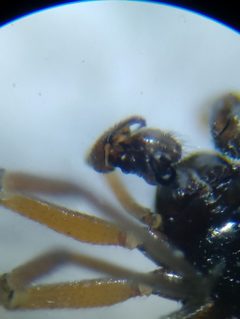
Identification relies primarily on examination of male palpal , specifically the presence of the characteristic cup-shaped projection on the palpal tibia that surrounds the cymbium dorsally. This feature distinguishes Dicymbium from other linyphiid . -level identification requires additional characters such as genitalic details and somatic measurements. Females may be difficult to assign to genus without associated males.
Images
Appearance
Members of this are small-bodied spiders characteristic of the Linyphiidae . The most distinctive morphological feature is found in males: the palpal tibia bears an elongated, broad, cup-shaped projection that envelops the cymbium from above. This structure gives the genus its name and serves as a key diagnostic character. General body form and coloration follow typical linyphiid patterns, though specific details vary among .
Distribution
The has a Holarctic distribution spanning Europe, northern Asia (Russia from Urals to Far East, Mongolia, China, Kazakhstan, Kyrgyzstan), and North America (USA, Canada). Records from GBIF confirm presence in Denmark, Norway, and Sweden. Individual show more restricted ranges; for example, D. nigrum is widespread across Europe and western Asia, while D. salaputium and D. yaginumai are restricted to Japan and the Russian Far East.
Similar Taxa
- Other Linyphiidae generaDistinguished by the unique male palpal tibial projection; most linyphiid lack this cup-shaped structure surrounding the cymbium.
More Details
Etymology
The name Dicymbium derives from Greek roots meaning 'two cymbia' or 'double cymbium', referring to the cup-shaped tibial projection that appears to form a second cymbium alongside the true cymbium.
Species diversity
As of May 2019, the contains eight and one : D. elongatum, D. facetum, D. libidinosum, D. nigrum (type species), D. n. brevisetosum, D. salaputium, D. sinofacetum, D. tibiale, and D. yaginumai.