
Pugettia
Dana, 1851
kelp crabs
Species Guides
1- Pugettia producta(Northern Kelp Crab)
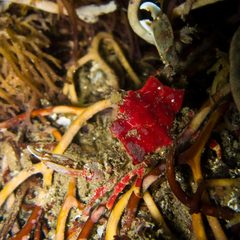
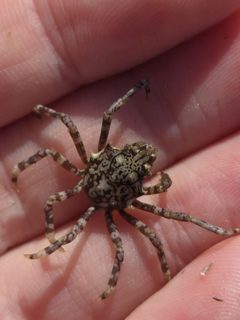
Pugettia is a of marine kelp crabs in the Epialtidae, distributed across the North Pacific from North America to East Asia. inhabit shallow subtidal zones, primarily associated with macroalgal including kelp beds, Sargassum stands, and red algal turfs. Many species exhibit ontogenetic habitat shifts, with juveniles and smaller individuals occupying deeper algal turfs while larger migrate to shallower macroalgal beds. The genus includes approximately 25 extant species plus one fossil species, with several species serving as important subjects for studies of crab growth, , and habitat .
Pronunciation
How to pronounce Pugettia: /pjuːˈɡɛtiə/
These audio files are automatically generated. While they are not always 100% accurate, they are a good starting point.
Identification
identification relies on examination of the orbital region structure, male first , and relative proportions of the and appendages. The is distinguished from similar epialtid genera by the combination of carapace shape, rostral structure, and leg proportions. is moderate, with males typically possessing larger claws relative to body size. Terminal can be identified by specific morphometric thresholds: in Pugettia ferox, males with relative claw length (claw length/post-pseudorostral carapace length) ≥ 0.660 and females with relative abdominal width ≥ 0.487 indicate post-terminal molt status.
Images
Habitat
Shallow subtidal marine environments, primarily in association with macroalgae. Specific use varies ontogenetically and among . Juveniles and individuals of P. quadridens occupy 1–4 m deep small red algal turfs (mainly Grateoloupia ), while larger stages migrate to 0.1–1 m deep Sargassum fusiforme beds near the low tidal mark during winter to early spring. Pugettia vulgaris inhabits lower subtidal (2–8 m) red algal turfs with physically complex structures throughout its entire post-settlement life. Pugettia producta occurs in kelp beds and rocky subtidal areas of the eastern Pacific.
Distribution
North Pacific Ocean, with distributed across temperate coastal waters of North America and East Asia. Western North American species include P. producta (British Columbia to Baja California) and P. gracilis. East Asian species are concentrated in Japanese waters (P. quadridens, P. ferox, P. vulgaris, P. intermedia, P. nipponensis) with extensions to the Philippines (P. leytensis, P. mindanaoensis), Taiwan, and Russia. Pugettia tasmanensis occurs in Tasmanian waters. Some species have overlapping ranges in northeast Asian waters.
Seasonality
Activity patterns and occupancy vary seasonally. In P. quadridens, larger individuals occur in shallow Sargassum beds only during winter to early spring. Pugettia vulgaris shows rapid increases during summer to late autumn due to successive recruitments, with highest densities recorded in September. Ovigerous females of P. vulgaris occur from spring through autumn. Stage III (fully grown) individuals of P. vulgaris die out by autumn, indicating approximate one-year longevity.
Life Cycle
Ontogenetic development proceeds through distinct stages (I–III) defined by combinations of secondary sexual characteristics and morphometric features. Stage I represents individuals; Stage II and III represent progressively mature phases culminating in terminal anecdysis. Pugettia vulgaris reaches Stage III at approximately 4–5 mm width and exhibits approximately one-year longevity. Ontogenetic shifts are documented: P. quadridens shifts from deeper algal turfs as juveniles to shallower Sargassum beds as , while P. vulgaris remains in lower subtidal algal turfs throughout life. Females of P. vulgaris become ovigerous at >4.28 mm carapace width. Males of some (e.g., P. ferox) can achieve functional maturity and mate before terminal .
Behavior
Decorating using materials attached to specialized setae on the has been documented in P. quadridens quadridens. Pugettia producta has been observed employing speculative hunting by pouncing on tuft or open sediment areas and probing with pereiopods, with documented piscivory on live teleost fishes—unexpected for a previously considered largely herbivorous. Pre-terminal males of P. ferox demonstrate behavioral maturity through successful copulation with virgin females under laboratory conditions.
Ecological Role
Potential of abalone in some , though impact is limited by habitat segregation from abalone . Documented predator of juvenile sea urchins (Strongylocentrotus intermedius); covering by sea urchins reduces risk. Contribution to nutrient cycling and energy transfer in kelp forest and algal turf . relationships may be more complex than traditionally assumed, with at least some exhibiting opportunistic piscivory.
Similar Taxa
- EpialtusSimilar epialtid kelp crabs; Pugettia distinguished by rostral and orbital region
- MajaMajid spider crabs with superficially similar body form; Pugettia are generally smaller and more closely associated with macroalgal rather than open substrates
Sources and further reading
- BugGuide
- Wikipedia
- GBIF taxonomy match
- iNaturalist taxon
- NCBI Taxonomy
- Catalogue of Life
- Ontogenetic habitat shift in Pugettia quadridens on the coast of Sagami Bay, Japan
- Growth and reproduction of the spider crab, Pugettia quadridens quadridens (De Haan) (Brachyura: Majidae)
- Redescriptions of Pugettia quadridens (De Haan, 1837) and P. intermedia Sakai, 1938 (Crustacea: Brachyura: Epialtidae) with description of a new species
- Piscivory by the crabs Cancer productus Randall, 1840 and Pugettia producta (Randall, 1840) (Decapoda: Brachyura: Cancridae, Epialtidae)
- Growth patterns and population dynamics of the kelp crab Pugettia vulgaris (Decapoda, Brachyura, Epialtidae) on the coast of Sagami Bay, Japan
- Morphology and distribution of setae used for decorating on the dorsal carapace of the spider crab, Pugettia quadridens quadridens (De Haan) (Brachyura: Majidae)
- Morphometric changes at terminal molt and reproductive capacity in the kelp crabPugettia feroxOhtsuchi & Kawamura, 2019 (Decapoda: Brachyura: Majoidea)
- Effect of the covering behavior of the juvenile sea urchin Strongylocentrotus intermedius on predation by the spider crab Pugettia quadridens
- Feeding preferences and the effect of temperature on feeding rates of the graceful kelp crab, Pugettia gracilis.