
Inachidae
MacLeay, 1838
spider crabs
Genus Guides
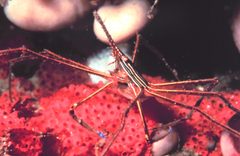
1- Stenorhynchus(arrow crabs)
Inachidae is a of marine crabs commonly known as spider crabs, characterized by long, slender legs and often elaborate camouflage . The family contains approximately 39 distributed primarily in Atlantic, Mediterranean, and Indo-Pacific waters. Members of this family are known for their association with organisms including sea anemones, sponges, and . Some exhibit specialized epibiosis, deliberately accumulating algae and other materials on their for camouflage.
Pronunciation
How to pronounce Inachidae: /ɪˈneɪkɪˌdiː/
These audio files are automatically generated. While they are not always 100% accurate, they are a good starting point.
Identification
Distinguished from other majoid crab by combination of: long, slender legs; typically longer than broad with prominent rostrum; orbits usually incomplete or with reduced supraorbital margin; male with narrow, triangular pleon. Differs from Majidae by generally more slender build and different structure. Separation from Epialtidae requires examination of sternal and gonopod characters. -level identification relies on rostrum shape, carapace tuberculation patterns, and leg proportions.
Images
Appearance
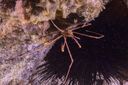
Spider crabs with elongated, often triangular or pear-shaped . Legs are notably long and slender relative to body size, giving the characteristic spider-like appearance. Carapace surface typically bears , spines, or other ornamentation. Chelipeds (claws) are usually slender and elongated. Body size varies considerably among . Many have reduced or modified fifth pereiopods tucked beneath the carapace.
Habitat
Exclusively marine. Found from intertidal zones to mesophotic depths exceeding 100 meters. include soft bottoms, rocky substrates, and areas with cover such as gorgonians, antipatharians, sponges, and sea anemones. Some occupy specialized including association with specific organisms.
Distribution
Primarily Atlantic Ocean (including NE Atlantic and Mediterranean), with significant representation in Indo-Pacific region. Records from Black Sea, Canary Islands, Korean waters, Colombian Caribbean, and South African coasts. Distribution is -specific; no single spans entire range.
Host Associations
- sea anemones - symbiotic associationInachus phalangium and Macropodia czernjawskii observed in association with sea anemones; specific nature of relationship not fully characterized
- sponges - associationPodochela curvirostris found associated with sponges at 107m depth
- gorgonians and antipatharians - associationAchaeus cranchii collected from soft bottoms with gorgonians and antipatharians
Behavior
Self-decoration with epibiosis is well-documented in multiple , particularly Macropodia. Crabs actively place , sponges, and other materials on hooked setae covering the and legs, providing camouflage and possibly chemical protection. Defensive include the 'stockade' posture (legs extended to appear larger) and swimming escape responses observed in Metoporhaphis calcarata. Some exhibit specialized associations with , using them as elevated perches or .
Ecological Role
Epibiotic serve as mobile substrate for diverse algal and , potentially facilitating of organisms. Association with sea anemones and other cnidarians may involve cleaning or protection, though mutualistic benefits remain poorly characterized. As and scavengers, they contribute to benthic dynamics.
Human Relevance
Limited direct economic importance. Some may be incidentally captured in fisheries. Museum collections of epibiotic species have been proposed as monitoring tools for tracking introductions of species, as the crab's epibiosis records local composition at time of collection.
Similar Taxa
- MajidaeSimilar spider crab ; distinguished by more robust body form, complete orbits, and different male pleon shape
- EpialtidaeOverlapping preferences and camouflage ; distinguished by sternal and structure
More Details
Taxonomic complexity
Inachus contains cryptic requiring integrative taxonomic approaches; molecular data have revealed unrecognized diversity and necessitated synonymizations in related genera.
Epibiosis as ecological indicator
Inachid crabs with abundant epibiosis, particularly Macropodia , have been proposed as bioindicators for monitoring establishment histories of species.
Sources and further reading
- BugGuide
- Wikipedia
- GBIF taxonomy match
- iNaturalist taxon
- NCBI Taxonomy
- Catalogue of Life
- Notice me! Neglected for over a century, Black sea spider crab re-described | Blog
- Swimming and the Stockade: Defensive Behaviors in the False Arrow Crab, Metoporhaphis calcarata (Brachyura: Inachidae)
- New records of Decapod Crustaceans (Decapoda: Pontoniinae and Inachidae) associated with sea anemones in Turkish waters
- First record of three brachyuran decapods (Inachidae, Polybiidae, Thiidae) from the Canary Islands (NE Atlantic)
- Taxonomy and ecology of the Cape Town Spider Crab, Macropodia falcifera (Stimpson, 1858) (Crustacea: Decapoda: Brachyura: Inachidae)
- Supplementary Data on the Distribution of Inachus Parvirostris (Risso, 1816) (Decapoda, Brachyura, Inachidae) from Turkey
- First records of Paratymolus pubescens Miers, 1879 and Litosus sexspinosus (Miers, 1884) (Decapoda, Brachyura, Inachidae) from Korean waters
- Phalangipus somnathensis Sureandiran, Karuppasamy & Suyani, 2024—a junior synonym of Encephaloides armstrongi Wood-Mason in Wood-Mason & Alcock, 1891 (Crustacea, Brachyura, Inachidae)
- FIRST RECORD OF THE CRAB PODOCHELA CURVIROSTRIS (A. MILNE EDWARDS, 1979) (BRACHYURA: INACHIDAE) FROM THE COLOMBIAN CARIBBEAN
- A new cryptic species of Inachus (Decapoda: Brachyura: Inachidae) from European waters and an updated identification key to the species of Inachus with two protogastric tubercles
- Review of Macropodia in the Black Sea supported by molecular barcoding data; with the redescription of the type material, observations on ecology and epibiosis of Macropodia czernjawskii (Brandt, 1880) and notes on other Atlanto-Mediterranean species of Macropodia Leach, 1814 (Crustacea, Decapoda, Inachidae)
- Supplementary material 1 from: Spiridonov VA, Simakova UV, Anosov SE, Zalota AK, Timofeev VA (2020) Review of Macropodia in the Black Sea supported by molecular barcoding data; with the redescription of the type material, observations on ecology and epibiosis of Macropodia czernjawskii (Brandt, 1880) and notes on other Atlanto-Mediterranean species of Macropodia Leach, 1814 (Crustacea, Decapoda, Inachidae). Zoosystematics and Evolution 96(2): 609-635. https://doi.org/10.3897/zse.96.48342
- Figure 2 from: Spiridonov VA, Simakova UV, Anosov SE, Zalota AK, Timofeev VA (2020) Review of Macropodia in the Black Sea supported by molecular barcoding data; with the redescription of the type material, observations on ecology and epibiosis of Macropodia czernjawskii (Brandt, 1880) and notes on other Atlanto-Mediterranean species of Macropodia Leach, 1814 (Crustacea, Decapoda, Inachidae). Zoosystematics and Evolution 96(2): 609-635. https://doi.org/10.3897/zse.96.48342
- Figure 1 from: Spiridonov VA, Simakova UV, Anosov SE, Zalota AK, Timofeev VA (2020) Review of Macropodia in the Black Sea supported by molecular barcoding data; with the redescription of the type material, observations on ecology and epibiosis of Macropodia czernjawskii (Brandt, 1880) and notes on other Atlanto-Mediterranean species of Macropodia Leach, 1814 (Crustacea, Decapoda, Inachidae). Zoosystematics and Evolution 96(2): 609-635. https://doi.org/10.3897/zse.96.48342
- Figure 8 from: Spiridonov VA, Simakova UV, Anosov SE, Zalota AK, Timofeev VA (2020) Review of Macropodia in the Black Sea supported by molecular barcoding data; with the redescription of the type material, observations on ecology and epibiosis of Macropodia czernjawskii (Brandt, 1880) and notes on other Atlanto-Mediterranean species of Macropodia Leach, 1814 (Crustacea, Decapoda, Inachidae). Zoosystematics and Evolution 96(2): 609-635. https://doi.org/10.3897/zse.96.48342
- Figure 12 from: Spiridonov VA, Simakova UV, Anosov SE, Zalota AK, Timofeev VA (2020) Review of Macropodia in the Black Sea supported by molecular barcoding data; with the redescription of the type material, observations on ecology and epibiosis of Macropodia czernjawskii (Brandt, 1880) and notes on other Atlanto-Mediterranean species of Macropodia Leach, 1814 (Crustacea, Decapoda, Inachidae). Zoosystematics and Evolution 96(2): 609-635. https://doi.org/10.3897/zse.96.48342