
Pugettia producta
(Randall, 1840)
Northern Kelp Crab, Shield-backed Kelp Crab
Pugettia producta is a spider crab found along the Pacific coast of North America, recognized by its shield-shaped and long, multi-jointed legs adapted for climbing kelp. The exhibits pronounced , with males reaching larger sizes and possessing more robust chelipeds. It demonstrates remarkable dietary flexibility, shifting from herbivory in summer to carnivory in winter.
Pronunciation
How to pronounce Pugettia producta: /pjuːˈdʒɛtiə proʊˈdʌktə/
These audio files are automatically generated. While they are not always 100% accurate, they are a good starting point.
Identification
Distinguished from similar majid crabs (especially decorator crabs) by two rows of hooked setae behind the rostrum; unlike decorator crabs, does not attach debris to its for camouflage. Shield-shaped carapace and long, multi-jointed legs separate it from other crab . Coloration typically matches kelp .
Images
Appearance
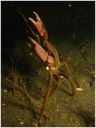
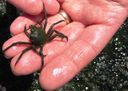
is shield-shaped (badge-like), curved and smooth with a slick texture, typically dark brown, olive, or olive-brown above. Underside surface is more vibrant, often red, yellow, or orange. Younger individuals may appear lighter olive-brown or reddish-brown. Front of carapace bears a protruding rostrum used in feeding. Large chelipeds present for defense and feeding. Long, multi-jointed, hairless legs characteristic of spider crabs.
Habitat
Associated with kelp forests, particularly bull kelp (Nereocystis). Found in lower intertidal zones in beds of or eelgrass. Occurs under rocks or shelters at extreme low tides within intertidal zones. migrate to waters as deep as 75 m for mating.
Distribution
Pacific Coast of North America from southern Alaska to northern Mexico.
Seasonality
Females carry during most of the year but are rarely observed in south Puget Sound during May, September, and October. Egg development and hatching occurs from approximately one month to nearly one year.
Diet
Seasonally variable: herbivorous in summer, feeding nearly exclusively on including kelp, rockweed, sargassum, and some red algae; in winter, consuming small mussels, barnacles, bryozoans, and hydroids.
Life Cycle
involves to deeper waters (to 75 m) for mating. Females carry clutches of 34,000 to 84,000 . Eggs change color during development: bright orange when laid, red as they mature, grayish-purple at hatching. Terminal occurs; older individuals may be covered with barnacles, limpets, or .
Behavior
Strongly associated with kelp; coloration provides camouflage. Long, multi-jointed legs adapted for climbing bull kelp and man-made pilings. Sometimes attaches bits of kelp and seaweed to hooked setae behind rostrum for food storage. Exhibits seasonal dietary plasticity.
Ecological Role
Herbivore and opportunistic in kelp forest . Prey for cabezon, gulls, sea otters, and staghorn sculpins. Sea otters are significant within kelp forests. Pelagic larvae (zoeae) consumed by Velella velella. for parasitic barnacle Heterosaccus californicus, which can alter host .
Human Relevance
Not targeted for human consumption due to low meat yield and difficulty of capture. Large, strong chelipeds can deliver aggressive, painful pinch.
Similar Taxa
- Decorator crabs (various Majidae)Distinguished by P. producta's lack of decoration and presence of two rows of hooked setae behind rostrum; decorator crabs attach debris to body for camouflage
More Details
Parasitism
Can be parasitized by rhizocephalan barnacle Heterosaccus californicus, visible as brown mass on underbelly. Parasitized crabs once more, during which the barnacle pushes its reproductive sac through the softened . This damages or destroys male reproductive organs, potentially causing males to become hermaphroditic and produce both and sperm. Parasitized females may show accelerated development of mature characteristics.
Predation pressure
Significant by sea otters makes this an important component of kelp forest .