
Exenterus amictorius
(Panzer, 1801)
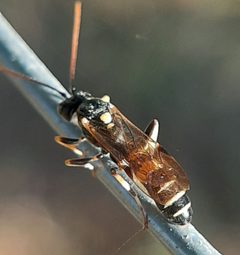
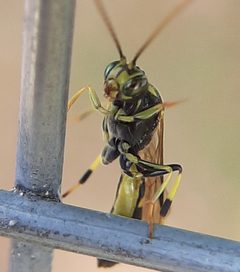
Exenterus amictorius is an ichneumonid introduced to North America that attacks larvae (Hymenoptera: Diprionidae), particularly during the pre-spinning eonymph stage. The exhibits adaptive discrimination that changes during the host's spinning period, lacks discrimination initially but rapidly acquires and maintains this ability. It shows strong positive -dependent responses to host abundance and has established successfully on multiple diprionid hosts across North America. In multiparasitism situations with the native E. diprionis, E. amictorius consistently survives due to faster larval development.
Pronunciation
How to pronounce Exenterus amictorius: /ɛkˈsɛn.tər.əs əˌmɪkˈtɔːr.i.us/
These audio files are automatically generated. While they are not always 100% accurate, they are a good starting point.
Images
Habitat
Pine forests and coniferous woodlands; associated with of diprionid on pine trees. In Quebec, studied specifically in jack pine stands supporting Neodiprion swainei populations.
Distribution
Native to Europe (documented from Belgium, Denmark, Norway, Sweden); introduced and established in North America with records from Quebec and Ontario, Canada. Successfully colonized various diprionid across North America.
Seasonality
activity coincides with larval development; approximately 60% of adults eclose in the same summer as attack occurs in Ontario .
Host Associations
- Neodiprion swainei - primary Swaine jack pine sawfly; attacks pre-spinning eonymphs
- Neodiprion sertifer - European pine sawfly; established in Ontario
- Various diprionid species - Successfully established on multiple North American diprionids
Life Cycle
Attacks first nymphal stage of preceding cocoon formation; development continues within host cocoon. Approximately 60% of emerge in the same summer as attack, with the remainder likely . Faster development rate than E. diprionis on shared hosts, enabling competitive superiority in multiparasitism.
Behavior
Oviposition characterized by variable discrimination against previously parasitized : discrimination absent at beginning of host spinning period, rapidly acquired and persisting through end of spinning period. Shows positive -dependent response to host abundance, with progeny production strongly correlated with host density. Attacks independently of co-occurring E. diprionis. Female-biased sex ratios observed, with females more frequent in female hosts.
Ecological Role
among Exenterus attacking Neodiprion swainei in Quebec; agent contributing to regulation of diprionid . More numerous in high- populations but less destructive per capita than E. nigrifrons at high densities.
Human Relevance
Introduced agent for management of pine forest pests; established successfully and spread across North America.
Similar Taxa
- Exenterus diprionisNative North American ; co-occurs on Neodiprion swainei but lacks adaptive discrimination and shows weaker response; E. amictorius survives multiparasitism due to faster development
- Exenterus nigrifronsNative on Neodiprion sertifer; more destructive at high densities, lower summer rate (6% vs. 60%)
- Exenterus affinisNative ; main attacking feeding larvae of N. sertifer rather than cocoon-stage
Sources and further reading
- BugGuide
- GBIF taxonomy match
- iNaturalist taxon
- Catalogue of Life
- A COMPARISON OF DISCRIMINATION AND OF DENSITY RESPONSES DURING OVIPOSITION BY EXENTERUS AMICTORIUS AND E. DIPRIONIS (HYMENOPTERA: ICHNEUMONIDAE), PARASITES OF NEODIPRION SWAINEI (HYMENOPTERA: DIPRIONIDAE)
- PARASITISM OF NEODIPRION SERTIFER (HYMENOPTERA: DIPRIONIDAE) BY EXENTERUS SPP. (HYMENOPTERA: ICHNEUMONIDAE) IN ONTARIO, 1962–1972, WITH NOTES ON THE PARASITES