
Neodiprion pratti
(Dyar, 1899)
Virginia pine sawfly, jack pine sawfly
Species Guides
1- Neodiprion pratti pratti(Virginia pine sawfly)
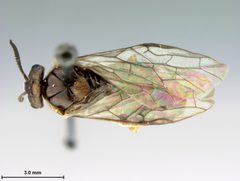
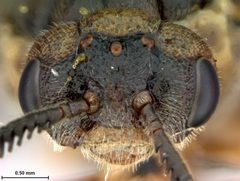
Neodiprion pratti is a native to North America with documented in Canada and the eastern United States. The exhibits complex -associated population structure, with distinct populations adapted to specific pine hosts including Virginia pine (Pinus virginiana), jack pine (Pinus banksiana), sand pine (Pinus clausa), slash pine (Pinus elliottii), and longleaf pine (Pinus palustris). Populations show significant variation in , with northern forms typically and a distinctive West Florida population exhibiting winter-active with emerging in October-November.
Pronunciation
How to pronounce Neodiprion pratti: /ˌnioʊˈdɪpriɒn ˈprætaɪ/
These audio files are automatically generated. While they are not always 100% accurate, they are a good starting point.
Identification
Larvae can be distinguished from caterpillars by possessing six or more pairs of (caterpillars have five or fewer). Within the Neodiprion, N. pratti is differentiated from by association and, in the case of N. pratti banksianae, by larval feeding orientation with consistently oriented toward needle tips. The West Florida is distinguished by its winter-active . Larval color patterns and head coloration provide additional distinguishing characteristics, though a complete larval key to is available in Davis et al. (2023).
Images
Habitat
Pine forests and woodlands; specific varies by . Northern populations occur in Virginia pine and jack pine forests. The West Florida population is restricted to sand pine scrub . Other populations occupy slash pine and longleaf pine stands.
Distribution
Canada (Manitoba, New Brunswick, Nova Scotia, Ontario); eastern United States. The comprises multiple geographically isolated with distinct associations, including a relict West Florida population representing an isolated southern remnant of postglacial northward .
Seasonality
Highly variable by . Northern populations: typically with summer activity. West Florida population: uniquely winter-active, with adults emerging October-November, laying in late autumn and winter, larval feeding February-March (or January in mild winters), and September-October.
Diet
Larvae feed gregariously on pine needles. Young larvae feed from needle tips, consuming approximately half the needle and leaving a dry sliver. Older larvae consume entire needles, leaving only stubs. Specific associations vary by : Virginia pine (Pinus virginiana), jack pine (Pinus banksiana), sand pine (Pinus clausa), slash pine (Pinus elliottii), and longleaf pine (Pinus palustris).
Host Associations
- Pinus virginiana - primary Virginia pine
- Pinus banksiana - primary Jack pine ( banksianae)
- Pinus clausa - primary West Florida ; only known for this isolated population
- Pinus elliottii - primary West Florida per biological study
- Pinus palustris - primary West Florida per biological study
Life Cycle
(one per year) in all studied , though with dramatically different seasonal timing. are inserted into pine needles using the saw-like ovipositor; in fine-needled , females lay only 2-3 eggs per needle with egg pockets positioned toward needle tips. Eggs overwinter in needles (West Florida population) or undergo direct development depending on population. Larvae pass through five instars, feeding gregariously throughout development. Mature larvae drop from host trees and spin cocoons in soil or duff. occurs in soil ; the prepupal is temperature-dependent (extended by high temperatures) and not influenced by . emerge from cocoons to complete the cycle.
Behavior
Larvae are gregarious, feeding in groups throughout their development. Group feeding may facilitate access to needle tissue by allowing larvae to breach tough needle surfaces cooperatively. When disturbed, larvae arch their backs and regurgitate stored pine resins from esophageal pouches as a chemical defense against . The West Florida exhibits thermoregulatory basking to maintain activity during cool winter conditions. Larvae of the jack pine population exhibit a consistent "free-end" feeding orientation with directed toward needle tips, a behavior independent of gravity, needle flexibility, and light cues.
Ecological Role
Primary folivore on native pine . Acts as a defoliator capable of causing significant damage during , though typically present in sub-outbreak densities regulated by natural enemies. Serves as prey for predatory insects including the Podisus modestus. Provides food resource for birds and supports .
Human Relevance
Occasional pest of pine trees in managed and natural landscapes. Large can defoliate thousands of acres. In urban and suburban settings, small can be managed by hand removal or dislodging larvae with water spray. Chemical control is rarely necessary as natural enemies typically regulate . The West Florida population's winter results in complete escape from , though it experiences periodic mortality from freezing and ice storms.
Similar Taxa
- Neodiprion leconteiRedheaded pine sawfly; distinguished by larval coloration (bright red vs. variable in N. pratti) and preferences (favors black pine, Scots pine, Mugo pine)
- Neodiprion sertiferEuropean pine sawfly; in North America with different larval color pattern and range
- Diprion similisIntroduced pine sawfly; distinguished by different larval and introduced status
Misconceptions
Larvae are frequently mistaken for caterpillars (Lepidoptera larvae) due to convergent ; they are actually hymenopterans more closely related to bees and . The West Florida was historically misunderstood regarding its specificity; early sources indicated feeding only on sand pine (Pinus clausa), but subsequent study documented use of slash pine and longleaf pine.
More Details
Parthenogenesis in West Florida population
The West Florida exhibits arrhenotokous , with females producing only haploid male offspring from unfertilized . No females are produced in this system, representing an unusual reproductive mode within the .
Population systematics
The comprises multiple -associated of uncertain taxonomic status. The name N. pratti banksianae has been used for the jack pine population, but the relationship among populations (whether representing , host races, or cryptic species) requires further study.
Sources and further reading
- BugGuide
- GBIF taxonomy match
- iNaturalist taxon
- NCBI Taxonomy
- Crazy redheads - Redheaded pine sawfly, Neodiprion lecontei(MISSING VIDEO AND LINKS) — Bug of the Week
- What's Eating Your Pine Needles? Sawflies, Probably
- Conifer sawfly larva - Entomology Today
- Studies on the life history of the Virginia pine sawfly (Neodiprion pratti Dyar) /
- STUDIES OF THE FEEDING ORIENTATION OF THE JACK PINE SAWFLY, NEODIPRION PRATTI BANKSIANAE ROH.
- The biology ofNeodiprion pratti(Dyar) (Hym., Diprionidae), a winter sawfly in West Florida
- A Study of the Group-Feeding Behaviour of Larvae of the Jack Pine Sawfly, Neodiprion Pratti Banksianae Roh 1)
- The relationship of the sterols of the Virginia pine sawfly, Neodiprion pratti Dyar, to those of two host plants, Pinus virginiana Mill and Pinus rigida Mill
- THE EFFECT OF PREY DEFENSE ON THE FUNCTIONAL RESPONSE OF PODISUS MODESTUS (HEMIPTERA: PENTATOMIDAE) TO DENSITIES OF THE SAWFLIES NEODIPRION SWAINEI AND N. PRATTI BANKSIANAE (HYMENOPTERA: NEODIPRIONIDAE)