
Exenterus
Hartig, 1837
Species Guides
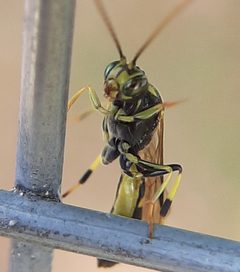
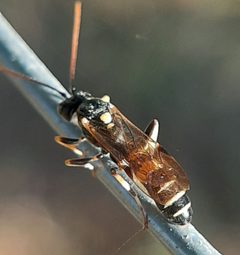
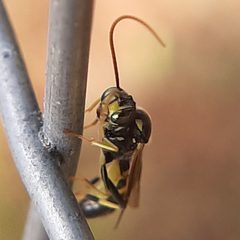
2Exenterus is a of in the Ichneumonidae, Tryphoninae, first described by Hartig in 1837. The genus contains that are specialized parasitoids of in the family Diprionidae, with documented including Neodiprion sertifer, N. swainei, N. autumnalis, Diprion sertifer, and Zadiprion falsus. Several species have been introduced across continents for of pine sawfly pests. The genus exhibits notable morphological diversity in structure, with European species showing an evolutionary gradient from simple to highly specialized stalked eggs that correlates with climatic and biological control success.
Pronunciation
How to pronounce Exenterus: //ɛksˈɛntərəs//
These audio files are automatically generated. While they are not always 100% accurate, they are a good starting point.
Identification
Members of Exenterus can be distinguished from other Tryphoninae by features of the structure: eggs are attached to via a stalk inserted into the host . Some groups, including the two Mexican species E. durangensis and E. sehuerachicus, are characterized by unusually short, depressed . Species-level identification requires examination of specific morphological characters; an identification key exists for the Mexican species.
Images
Habitat
Coniferous forests, particularly pine forests, associated with .
Distribution
Eurasia and North America; documented from Sweden, Hungary, Denmark, Norway, Ontario, Quebec, and Mexico. European have been introduced to North America for .
Seasonality
Activity coincides with larval and prepupal stages. For E. abruptorius, oviposition occurs on last-stage larvae or during the host's spinning period, with patterns varying geographically: in Hungary all emerge the spring following development, while in Sweden 37% may remain in hibernation for two winters.
Host Associations
- Diprionidae (sawflies) - -level association; all known hosts are diprionid
- Neodiprion sertifer - European pine sawfly; for E. abruptorius, E. affinis, E. nigrifrons, and E. amictorius in Ontario
- Neodiprion swainei - Swaine jack pine sawfly; for E. amictorius and E. diprionis in Quebec
- Neodiprion autumnalis - for E. sehuerachicus in Mexico; first record for on this host
- Diprion sertifer - Pine ; for E. abruptorius in Sweden and Hungary
- Zadiprion falsus - for E. durangensis in Mexico; first record for on this host
Life Cycle
, synchronized with . Females oviposit on last-stage host larvae or . hatch only after the host has spun its cocoon. In E. abruptorius, only 25% of primary larvae develop immediately; the remainder enter a resting period of up to 2.5 months during summer before continuing development. The prepupal stage consists of two distinct phases: eonymphal and pronymphal. Hibernation always occurs in the eonymphal stage. Developmental timing varies geographically: E. amictorius shows partial summer (about 60% of ) with most failing to reproduce due to host scarcity.
Behavior
Oviposition includes discrimination against previously parasitized that varies temporally: in E. amictorius, discrimination is absent at the beginning of the host spinning period but is rapidly acquired and persists to the end. This change in discrimination does not correlate directly with host or . The exhibits a positive density response to host availability. In multiparasitism situations, E. amictorius consistently outcompetes E. diprionis due to faster development rate.
Ecological Role
Specialized of conifer-feeding ; functions as a agent in managed and natural forests. rates vary with and sampling methodology; cocoon in July provide superior estimates of parasitism rates compared to larval samples or later cocoon samples. differ in their impact: E. nigrifrons is more destructive at high host densities while E. amictorius is less destructive at high densities.
Human Relevance
Several have been introduced internationally for of pine pests, including European species introduced to North America. Success of introduced has been roughly proportional to the degree of stalk specialization, with more specialized species better surviving drought conditions and establishing successfully.
Similar Taxa
- Other Tryphoninae generaExenterus shares the characteristic of stalked attached to , but differs in specific egg stalk and host specialization on Diprionidae
- Exenterus diprionisCompared to E. amictorius, E. diprionis shows weaker response and lacks adaptive changes in discrimination against previously parasitized ; E. amictorius outcompetes it in multiparasitism due to faster development
More Details
Egg structure specialization
European Exenterus exhibit an evolutionary gradient in stalk structure from simple single stalks with knob-like anchors to highly specialized doubled stalks with enlarged anchoring organs that half-enclose the egg. Simple stalks become brittle and break in dry conditions, killing the ; specialized stalks enable survival in drier climates and correlate with expanded geographic range, greater abundance, and success.
Geographic variation in life history
E. abruptorius shows marked geographic variation: in Sweden, 37% of individuals hibernate for two winters and sex ratios are approximately equal; in Hungary, all emerge the spring following development and females exceed males 4:1, suggesting possible biological races.
Sampling considerations
For monitoring rates, of cocoons in July are superior to larval samples in June or cocoon samples in August and the following May. However, mortality of Exenterus before and after sampling means that rearing data from cocoons underestimates actual impact.
Sources and further reading
- BugGuide
- Wikipedia
- GBIF taxonomy match
- iNaturalist taxon
- NCBI Taxonomy
- Catalogue of Life
- Mexican species of the genus Exenterus Hartig (Hymenoptera: Ichneumonidae: Tryphoninae) reared from diprionid hosts
- The prepupal Stage in Ichneumonidae, illustrated by the life-history of Exenterus abruptorius, Thb.
- SPECIALIZATION IN THE EGG STRUCTURE OF EXENTERUS (HYMENOPTERA: ICHNEUMONIDAE) IN RELATION TO DISTRIBUTION AND ABUNDANCE
- PARASITISM OF NEODIPRION SERTIFER (HYMENOPTERA: DIPRIONIDAE) BY EXENTERUS SPP. (HYMENOPTERA: ICHNEUMONIDAE) IN ONTARIO, 1962–1972, WITH NOTES ON THE PARASITES
- A COMPARISON OF DISCRIMINATION AND OF DENSITY RESPONSES DURING OVIPOSITION BY EXENTERUS AMICTORIUS AND E. DIPRIONIS (HYMENOPTERA: ICHNEUMONIDAE), PARASITES OF NEODIPRION SWAINEI (HYMENOPTERA: DIPRIONIDAE)