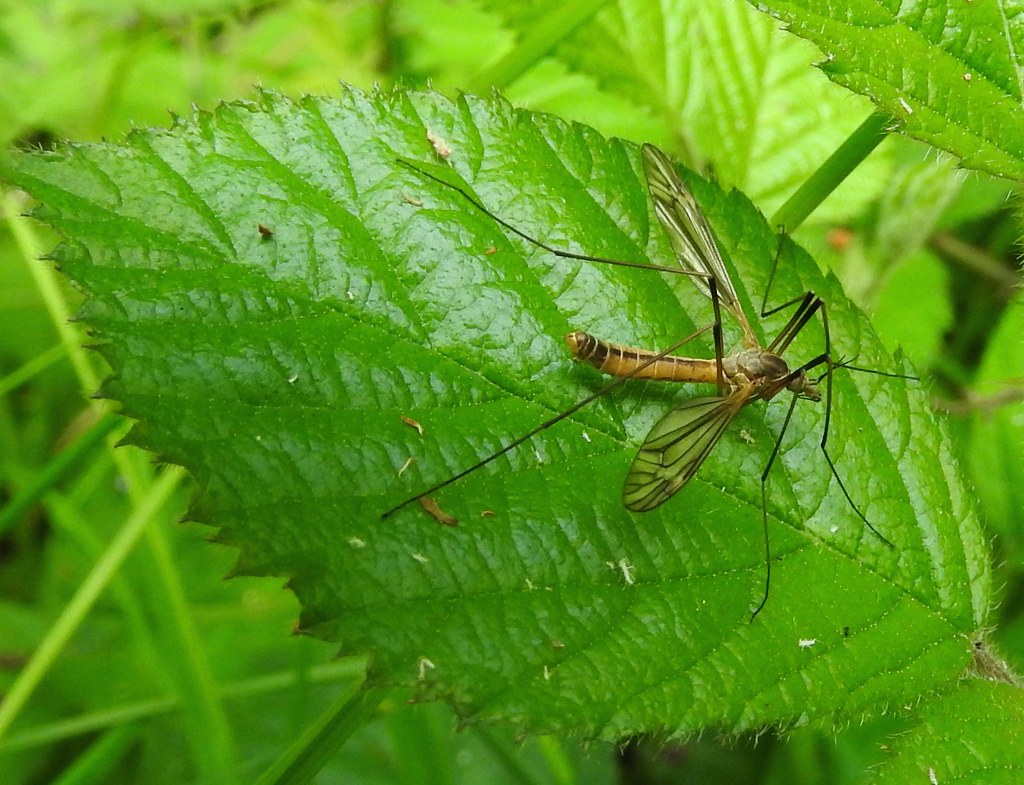
Pseudolimnophila is a genus of crane flies in the family Limoniidae, established by Alexander in 1919. The genus contains two subgenera: Pseudolimnophila (sensu stricto) and Calolimnophila. Species are small to medium-sized with distinctive wing venation and male genitalia structures. The genus has a broad global distribution with approximately 64 species across multiple biogeographic regions.
Pseudolimnophila contempta is a species of crane fly in the family Limoniidae, described by Osten Sacken in 1869. It belongs to a genus characterized by reduced wing venation and aquatic or semi-aquatic larval habitats. The species occurs across eastern North America, from Ontario and Newfoundland south to Kansas and Florida. Like other limoniid crane flies, adults are delicate, long-legged flies with slender bodies. The genus name refers to its superficial resemblance to true limoniids of the genus Limnophila.
Pseudolimnophila inornata is a species of limoniid crane fly in the family Limoniidae, first described by Osten Sacken in 1869 under the basionym Limnophila inornata. The species is recognized as having two subspecies: the nominate P. i. inornata and P. i. vidua Alexander, 1943. As a member of the Limoniidae, it belongs to a diverse family of slender, long-legged crane flies commonly found in moist habitats.
Pseudolimnophila luteipennis is a species of limoniid crane fly first described by Osten Sacken in 1860. The species is widespread across North and Central America, with substantial observational records documenting its presence. As a member of the family Limoniidae, it belongs to one of the most diverse families of crane flies.
Rhypholophus is a genus of crane flies in the family Limoniidae, subfamily Chioneinae. The genus comprises approximately 21 described species distributed across Europe and North America. Species were described primarily in the 20th century, with the earliest description dating to Meigen (1818) for R. varius and the type species R. phryganopterus described by Kolenati in 1860.
Symplecta is a genus of crane flies in the family Limoniidae, established by Meigen in 1830. The genus contains multiple subgenera, with subgenus Symplecta sensu stricto comprising Arctic and partly Arctic distributed species. Species-level taxonomy within this group has undergone recent revision, with several species redescribed, new species described from Canada and Russia, and taxonomic synonyms resolved. The genus is characterized by distinctive male and female terminalia morphology used for species identification.
Symplecta cana is a crane fly species in the family Limoniidae, subgenus Symplecta sensu stricto. It has a broad distribution across northern North America, extending from Alaska and Arctic Canada southward throughout the contiguous United States, and reaching into Mexico and Guatemala. Taxonomic revision has clarified its distinction from the closely related S. hybrida, with which it occurs sympatrically and syntopically in some regions.
Antlered Crane Fly
Tanyptera dorsalis is a species of crane fly in the family Tipulidae, commonly known as the Antlered Crane Fly. Males are distinguished by prominent antler-like projections on the head. The species occurs in eastern North America, with records from Canada and the United States.
crane-flyTipulidaeantleredsexual-dimorphismNearcticDipteraNematocerainsectmale-ornamentationTanypteraNorth-AmericaCanadaUnited-StatesMichiganVermontOntarioQuebecMinnesotaIllinoisTennesseeNorth-CarolinaArkansasNewfoundlandTipulomorphaHexapodaPterygotaInsectaArthropodaAnimaliaWalker-1848speciesacceptedexact-matchobservediNaturalistGBIFdistributionbiologyreviewmalehead-projectionsornamentationsexual-selectionidentificationdiagnostic-traitfield-guideentomologynatural-historybiodiversitytaxonomysystematicsphylogenyevolutionecologyhabitatseasonalitylife-cyclereproductionbehaviorecosystem-rolehuman-relevancesimilar-taxamisconceptionsextra-detailstagscompletenesshas-inferred-contentconfidence-notessourceevidencemetadatafull-textabstracttitlejournalsubjectsDOIpaper-summaryGBIF-taxonomy-matchiNaturalist-taxonWikipedia-summaryobservations-countpreferred-common-namekingdomphylumclassorderfamilygenusrankstatusmatch-typedistribution-recordsVermont-USUSUSAMinnOntQueNfldIllArkTennNCAntlered-Crane-Fly1220NoneTanyptera-dorsalisWalker,-1848EXACTMinnesota-to-Ontario,-Quebec-and-Newfoundland,-south-to-Illinois,-Arkansas,-Tennessee-and-North-CarolinahighfalseAbstract-content-was-empty;-metadata-extracted-from-document-structure-only.-Full-text-not-available-in-provided-source.-Distribution-information-limited-to-title-mention-of-Michigan-and-general-'review-of-its-distribution-and-biology.'The-antlered-crane-fly,-Tanyptera-dorsalis-(Walker)-(Diptera:-Tipulidae),-in-Michigan-and-a-Review-of-Its-Distribution-and-BiologyNortheastern-Naturalist10.1656/045.017.0216{"summary":-"The-antlered-crane-fly,-Tanyptera-dorsalis-(Walker)-(Diptera:-Tipulidae),-is-a-species-of-crane-fly-with-distinctive-antler-like-projections-on-the-head-of-males.-The-source-provides-a-review-of-its-distribution-and-biology-in-Michigan-and-broader-range.",-"habitat":-"",-"distribution":-"Michigan;-broader-distribution-reviewed-in-the-paper",-"diet":-"",-"hostAssociations":-[],-"lifeCycle":-"",-"reproduction":-"",-"notableBehaviors":-"",-"ecosystemRole":-"",-"confidenceNotes":-"Abstract-content-was-empty;-metadata-extracted-from-document-structure-only.-Full-text-not-available-in-provided-source.-Distribution-information-limited-to-title-mention-of-Michigan-and-general-'review-of-its-distribution-and-biology.'"}Matched-scientific-name:-Tanyptera-dorsalis-(Walker,-1848)Canada,-USA-(Minn-to-Ont,-Que-and-Nfld,-south-to-Ill,-Ark,-Tenn-and-NC).;-Nearctic;-Canada,-USA-(Minn-to-Ont,-Que-and-Nfld,-south-to-Ill,-Ark,-Tenn-and-NC).;-Nearctic;-Vermont-US,-US Teucholabis is a genus of small crane flies in the family Limoniidae, established by Osten Sacken in 1860. The genus contains numerous species distributed across multiple subgenera, with immature stages of at least some species being xylobiont (wood-dwelling). Larvae have been documented living under bark among bast fibers of host trees. Adult morphology and ecological details remain poorly documented for most species.
Teucholabis carolinensis is a species of crane fly in the family Limoniidae, described by Alexander in 1916. It belongs to a genus of small to medium-sized limoniid flies found primarily in the Nearctic region. The species is known from a limited number of observations, with records concentrated in the southeastern United States.
Common Crane Flies, Crane Flies, Daddy Longlegs
Tipula is a large genus of crane flies in the family Tipulidae, containing over 2,000 species distributed worldwide. Adults are characterized by elongated bodies, extremely long legs, and clear or brownish wings, with body lengths typically 15–20 mm. Larvae, known as 'leatherjackets' due to their tough cuticle, are soil-dwelling and feed on plant roots and decaying organic matter. Several species are significant agricultural pests in pastures and grasslands.
giant crane fly
Tipula abdominalis, commonly known as the giant crane fly, is a large species of crane fly in the family Tipulidae. The larvae are aquatic detritivores found in riparian habitats, where they feed on decomposing leaf litter. Their hindgut harbors a dense, diverse bacterial community that facilitates digestion of lignocellulosic material. The species has been studied for its potential applications in biofuel production due to its efficient natural biorefinery system. Adults are among the largest crane flies in North America but do not feed.
Tipula algonquin is a species of large crane fly in the family Tipulidae, described by Charles Paul Alexander in 1915. It belongs to one of the most species-rich genera of crane flies, with Tipula containing hundreds of species across the Northern Hemisphere. The species epithet references the Algonquin people or region of North America.
Tipula apicalis is a large crane fly in the family Tipulidae, first described by Loew in 1863. The species occurs across eastern North America, from Ontario and Quebec south to Tennessee and North Carolina. It belongs to the diverse genus Tipula, which contains hundreds of species of crane flies worldwide.
Tipula aprilina is a species of large crane fly in the family Tipulidae. It was described by Alexander in 1918 and is found in the eastern United States, ranging from Maine south to Tennessee and South Carolina. As a member of the genus Tipula, it belongs to one of the most species-rich genera of crane flies.
Tipula atrisumma is a species of crane fly in the family Tipulidae, described by Doane in 1912. It belongs to the large genus Tipula, which contains hundreds of species worldwide. The species is known from California in the western United States. Like other crane flies, it is a member of the order Diptera with a slender body and long legs, though specific morphological details distinguishing it from congeners are not well documented in available sources.
Large crane fly
Tipula borealis is a species of large crane fly in the family Tipulidae. It is distributed across northern North America, ranging from Canada southward through the eastern and central United States. Like other crane flies, it has a slender body and extremely long legs, with adults typically active during warmer months. The species is part of a diverse genus containing numerous similar-looking species that require careful examination for identification.
California Tipula
Tipula californica is a crane fly species in the family Tipulidae, placed in the subgenus Hesperotipula. It is a Nearctic species distributed from British Columbia southward through California. As with other crane flies, adults are characterized by their elongated legs and slender bodies, though specific morphological details distinguishing this species from congeners require examination of key characters.
large crane fly
Tipula caloptera is a species of large crane fly in the family Tipulidae, distributed across much of Canada and the United States. It is one of the larger crane fly species in North America. The species was described by Loew in 1863 and is currently recognized as valid.
Tipula carinifrons is a species of crane fly in the family Tipulidae, described by Holmgren in 1883. The species belongs to the large genus Tipula, which contains hundreds of species distributed across the Northern Hemisphere. Crane flies in this genus are characterized by their elongated bodies and extremely long, fragile legs. Like other tipulids, the larvae likely develop in moist soil or decaying organic matter, though specific details for this species remain poorly documented.
Tipula chlorion is a species of large crane fly in the family Tipulidae, described by Alexander in 1965. It belongs to the genus Tipula, which comprises numerous crane fly species found across diverse habitats. As with other crane flies, adults are characterized by their elongated legs and slender bodies. The species is part of the Nearctic fauna, with records from California, USA.
Tipula colei is a crane fly species first described by Alexander in 1942. It belongs to the subgenus Triplicitipula within the large genus Tipula. The species has been documented from residential areas in Baton Rouge, Louisiana, and is distributed across parts of the eastern United States and Mexico. Detailed behavioral studies reveal complex male genital courtship functions involving rhythmic stimulation of females during extended copulation periods lasting approximately three hours.
collared crane fly
Tipula collaris is a large crane fly species in the family Tipulidae, distributed across eastern North America from Canada to the southeastern United States. First described by Thomas Say in 1823, this species is characterized by its substantial body size relative to other crane flies. Adults are typically encountered during the warmer months. Like other members of the genus Tipula, the larvae develop in soil or decaying organic matter.
Tipula dietziana is a species of large crane fly in the family Tipulidae, first described by Alexander in 1915. It is known from the Nearctic region, with records from New York south to Kansas and South Carolina. As a member of the genus Tipula, it shares the characteristic elongated body and extremely long legs typical of crane flies, though specific distinguishing features for this species are not well documented in available sources.
Tipula dorsimacula is a large crane fly species in the family Tipulidae, first described by Walker in 1848. It is one of two recognized subspecies within the species complex, with the nominate subspecies T. dorsimacula dorsimacula and T. dorsimacula shasta described by Alexander in 1919. The species belongs to the diverse genus Tipula, which contains hundreds of species across the Northern Hemisphere.
Tipula duplex is a species of large crane fly in the family Tipulidae, first described by Walker in 1848. It belongs to a diverse genus of crane flies found across the Northern Hemisphere. The species is known from the Nearctic region with documented occurrences in Canada and the United States.
large crane fly
Tipula fragilis is a species of large crane fly in the family Tipulidae. It is found in Canada and the United States, ranging from Alberta to the Atlantic provinces and south to Indiana, Tennessee, and Washington, D.C. The species was described by Loew in 1863.
Tipula grahamina is a species of large crane fly in the family Tipulidae, described by Alexander in 1963. It belongs to the diverse genus Tipula, which contains hundreds of species worldwide. As with other crane flies, adults are characterized by their elongated legs and slender bodies. The species is known from California, USA.
Tipula hermannia is a species of large crane fly in the family Tipulidae, order Diptera. Described by Alexander in 1915, this species is distributed across the Nearctic region, occurring from Canada southward through the eastern and central United States. As a member of the genus Tipula, it belongs to one of the largest genera of crane flies. The species has been documented in 46 iNaturalist observations, indicating it is encountered with moderate frequency by naturalists.
hairy crane fly
Tipula hirsuta is a large crane fly species in the family Tipulidae, first described by Doane in 1901. It is characterized by its notably hairy body, as indicated by its species epithet. The species occurs across eastern North America, with records spanning from Wisconsin to the northeastern United States and south to Kentucky, Virginia, and Tennessee.
Tipula ignobilis is a species of large crane fly in the family Tipulidae. It is known from Canada and the United States, with records spanning from Manitoba and Ontario south to Kansas, Tennessee, and South Carolina. As a member of the genus Tipula, it belongs to one of the most species-rich genera of crane flies in North America.
Tipula inusitata is a species of large crane fly described by Charles Paul Alexander in 1949. It belongs to the family Tipulidae, one of the most diverse families within the order Diptera. The species is known from California, USA, though specific details regarding its biology and ecology remain poorly documented in published literature.
Tipula jacintoensis is a species of large crane fly in the family Tipulidae. It was described by Charles Paul Alexander in 1946. The species is known only from California, where it has been recorded in the San Jacinto Mountains. As a member of the genus Tipula, it shares the characteristic elongated body and extremely long legs typical of crane flies, though specific details of its biology remain poorly documented.
Tipula jacobus is a species of large crane fly in the family Tipulidae. First described by Alexander in 1931, it was long perceived as restricted to eastern North America until a Midwestern record from Indiana extended its known range westward. The female was formally described for the first time in a 2009 paper documenting this range expansion.
Tipula longiventris is a species of large crane fly in the family Tipulidae. It is a Nearctic species distributed across eastern and central North America, with records from Canada through the United States. As a member of the genus Tipula, it belongs to one of the most species-rich genera of crane flies. The species is documented through iNaturalist observations and taxonomic databases, though detailed biological information remains limited.
Tipula megaura is a species of large crane fly in the family Tipulidae, described by Doane in 1901. It is one of the larger species within the genus Tipula. The species occurs across the Nearctic region, with records from Canada and the northern United States. Like other crane flies, it has a slender body and extremely long legs relative to its body size.
Metacomet crane fly
Tipula metacomet is a large crane fly in the family Tipulidae, described by Charles Paul Alexander in 1965. The species is named after Metacomet (also known as King Philip), a Wampanoag chief who led Native American resistance against English colonists in New England during the 1670s. It is one of numerous crane fly species in the genus Tipula, which is the largest genus of crane flies with hundreds of species distributed across the Northern Hemisphere.
Tipula morrisoni is a species of large crane fly in the family Tipulidae, first described by Charles Paul Alexander in 1915. It belongs to the diverse genus Tipula, which contains hundreds of species distributed across the Northern Hemisphere. As a crane fly, it exhibits the characteristic elongated body, extremely long legs, and single pair of wings typical of the family. The species is known from the eastern and central United States.
marsh crane fly, common crane fly
Tipula oleracea is a crane fly species native to the Palaearctic region that has been introduced to parts of the Nearctic and Neotropics. Adults are typically greyish with wings 18–28 mm long, and are active in two flight periods: early summer (April–June, peaking May–June) and late summer (August–October). The species is notable for its larval 'leatherjackets' which can reach densities of up to 400 per square meter in agricultural soils, causing damage to crops such as cabbage by feeding on roots and, at night, above-ground plant parts.
Pacific crane fly
Tipula pacifica is a species of large crane fly in the family Tipulidae. It occurs along the Pacific coast of North America, from British Columbia south to California. The species was described by Doane in 1912. As a member of the genus Tipula, it shares the characteristic elongated body and extremely long legs typical of crane flies.
Tipula praecisa is a species of crane fly in the family Tipulidae. It was first described by Hermann Loew in 1872. The species is endemic to the western United States, with records from California, Oregon, and Washington. As a member of the large and diverse genus Tipula, it shares the general body plan of crane flies: an elongated body, very long legs, and a single pair of membranous wings.
Tipula sackeniana is a crane fly species in the family Tipulidae, described by Charles Paul Alexander in 1918. It belongs to the large genus Tipula, which contains hundreds of species worldwide. The species is known from the eastern United States, with records spanning from New York and Connecticut south to Tennessee and Georgia. Like other crane flies, adults are characterized by their elongated legs and slender bodies, though specific distinguishing features for this species require close examination.
Tipula schizomera is a large crane fly in the family Tipulidae, described by Charles Paul Alexander in 1940. It is distributed across the southwestern United States and Mexico, representing one of the Nearctic species in this diverse genus. As with other Tipula species, it belongs to a group commonly known as crane flies or daddy longlegs, characterized by elongated bodies and extremely long legs.
Tipula senega is a species of large crane fly in the family Tipulidae, described by Charles Paul Alexander in 1915. It is distributed across the Nearctic region, occurring in Canada from Alberta and Ontario to Newfoundland, and southward through the United States to Iowa, Illinois, New Jersey, Virginia, Tennessee, and North Carolina. As a member of Tipulidae, it belongs to one of the most species-rich families of Diptera.
Tipula silvestra is a large crane fly species in the family Tipulidae, described by Doane in 1909. It is found in the western United States, particularly California. As a member of the genus Tipula, it shares the characteristic elongated body and extremely long legs typical of crane flies, though specific distinguishing features for this species are not well documented in available sources.
range crane fly
Tipula simplex, commonly known as the range crane fly, is a crane fly species in the family Tipulidae found in California and potentially Oregon. It is notable for pronounced sexual dimorphism in wing development: males possess fully developed wings, while females are essentially wingless with reduced wings subequal to the halteres. The species inhabits unirrigated pastures and has been documented to reach larval densities capable of causing significant pasture damage.
Tipula siskiyouensis is a species of crane fly in the family Tipulidae, described by Charles Paul Alexander in 1949. The species epithet refers to the Siskiyou Mountains, suggesting a geographic association with this mountain range along the California-Oregon border. Like other Tipula species, it belongs to a large and diverse genus of crane flies commonly known as "daddy longlegs" due to their elongated legs and slender bodies. The species is documented from Oregon in the Nearctic region.
Tipula subeluta is a species of crane fly in the family Tipulidae, described by Johnson in 1913. It is a member of the large genus Tipula, which contains hundreds of species distributed across the Northern Hemisphere. The species is recorded from the eastern United States, with distribution extending from Massachusetts southward to Louisiana and Florida. Like other crane flies, it is a delicate, long-legged insect often mistaken for a giant mosquito, though adults do not bite and most species have short adult lifespans focused on reproduction.
Tipula submaculata is a species of large crane fly in the family Tipulidae, first described by Loew in 1863. It is distributed across eastern and central North America, ranging from Wisconsin and Ontario south to Arkansas, Tennessee, and South Carolina. As a member of the genus Tipula, it belongs to one of the most species-rich genera of crane flies, though specific ecological and behavioral details for this particular species remain poorly documented in the scientific literature.
Tipula tricolor is a Nearctic species of crane fly in the family Tipulidae, first described by Fabricius in 1775. It is distributed across much of eastern and central North America, from Canada south through the United States. As a member of the large genus Tipula, it shares the characteristic elongated body and extremely long legs typical of crane flies.