
Tipula collaris
Say, 1823
collared crane fly
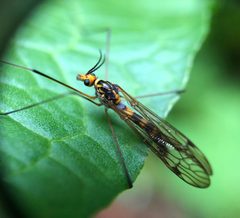
Tipula collaris is a large crane fly in the Tipulidae, distributed across eastern North America from Canada to the southeastern United States. First described by Thomas Say in 1823, this species is characterized by its substantial body size relative to other crane flies. are typically encountered during the warmer months. Like other members of the Tipula, the larvae develop in soil or decaying organic matter.
Pronunciation
How to pronounce Tipula collaris: /ˈtɪpjʊlə kəˈlɑːrɪs/
These audio files are automatically generated. While they are not always 100% accurate, they are a good starting point.
Identification
Large size distinguishes Tipula collaris from many smaller crane fly . The specific epithet "collaris" suggests a possible collar-like marking on the , though this requires verification. Definitive identification relies on examination of genitalic structures and detailed wing venation patterns, requiring reference to specialized dipteran taxonomic keys. Distinguished from other large Tipula species by combination of body proportions and specific wing patterns.
Images
Habitat
Found in a range of across its broad distribution, including deciduous forests, forest edges, and adjacent open areas. Larval habitat consists of moist soil rich in organic matter or decaying plant material. are often encountered in wooded areas and near larval development sites.
Distribution
Eastern North America: Canada (Ontario, Quebec, possibly other provinces), United States (Michigan, New York, Pennsylvania, Tennessee, South Carolina, Vermont, and intervening states). Distribution spans the Nearctic region with records from the Great Lakes region through the Appalachian Mountains to the southeastern coastal plain.
Seasonality
activity period spans spring through fall, with peak likely varying by latitude. In northern portions of the range, adults are most common in late spring and summer; in southern areas, the season may extend longer.
Life Cycle
Complete with four stages: , larva, pupa, . Larvae are soil-dwelling, feeding on decaying organic matter and root material. occurs in soil. Adult lifespan is brief, focused on .
Behavior
are weak, fluttering fliers typically active during periods or nighttime. Males and females engage in mating swarms. Adults do not feed, or feed minimally on nectar. Larvae are in soil and leaf litter.
Ecological Role
Larvae contribute to soil nutrient cycling through consumption and processing of decaying organic matter. serve as prey for birds, bats, spiders, and other . The participates in energy transfer between soil detrital and aerial .
Human Relevance
may enter buildings, where their large size and gangly appearance cause concern, though they are harmless and do not bite or sting. Larvae occasionally damage turf or seedlings in high densities, though this is rarely significant. The has no known medical or economic importance.
Similar Taxa
- Tipula abdominalisAnother large eastern North American crane fly; distinguished by abdominal coloration patterns and wing venation details
- Tipula furcaOverlapping distribution and similar size; requires examination of genitalia for reliable separation
- Nephrotoma speciesSimilar general appearance but in Tipulidae Tipulinae; distinguished by yellow and black thoracic patterning and wing details
More Details
Taxonomic History
Described by American entomologist Thomas Say in 1823, one of the earliest documented North American crane flies. The specific epithet "collaris" likely refers to a pale or contrasting collar-like marking on the , a common naming convention in early dipteran .
Research Needs
Detailed biological studies of Tipula collaris are lacking. Basic information on larval requirements, precise , and remains undocumented. The would benefit from focused ecological study given its broad distribution.