
Nephrotoma
Meigen, 1803
Tiger Crane Flies
Species Guides
15- Nephrotoma alterna
- Nephrotoma altissima
- Nephrotoma breviorcornis
- Nephrotoma byersi
- Nephrotoma cingulata(large crane fly)
- Nephrotoma eucera(large crane fly)
- Nephrotoma ferruginea(Ferruginous Tiger Crane Fly)
- Nephrotoma macrocera(large crane fly)
- Nephrotoma occipitalis(spotted-winged crane fly)
Nephrotoma is a of crane flies (Tipulidae) commonly known as tiger crane flies, distinguished by their lustrous yellow bodies with black or brown stripes and spots. The genus is globally distributed across all major biogeographic regions, with approximately 518 described . are found in deciduous and mixed forests, shrubland, and moist meadows. Larvae are soil-dwelling and have been observed to cause damage to agricultural crops and ornamental plants.
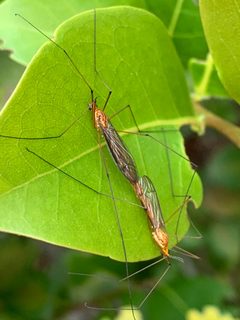
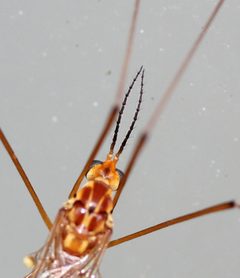
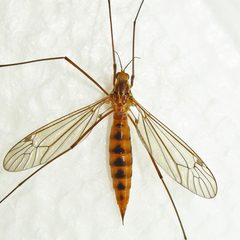
Pronunciation
How to pronounce Nephrotoma: //ˌnɛfroʊˈtoʊmə//
These audio files are automatically generated. While they are not always 100% accurate, they are a good starting point.
Identification
Body lustrous with yellow ground color and black or brown stripes and spots; if body black, bears colored bands. Prescutum with three distinct stripes. short; verticillate. Wing venation diagnostic: subcosta (Sc) fuses with radial R slightly to base of radial sector (Rs), no longer than cross-vein (m-cu). First media vein termination (m1) , rarely short and . m-cu located before base of (d). Male genitalia: tergite 9 with microscopic black streaks at apex.
Images
Habitat
Deciduous and mixed forests; shrubland; moist meadows. High-elevation recorded at 2867–3075 m in mountainous regions of Northwest China.
Distribution
Global distribution across six biogeographic regions: Palaearctic (167 ), Afrotropical (125), Oriental (129), Nearctic (40), Neotropical (30), and Australasian/Oceanian (27). Nearctic records include areas south of the maximum extent of the Laurentide Ice Sheet, with new distributional data for 18 Nearctic .
Seasonality
activity observed July–August in Northwest China; attracted to light traps during summer months.
Life Cycle
Larvae soil-dwelling. involves selective acetylation of α-tubulin in kinetochore microtubules, with acetylation lagging behind polymerization in nondividing but occurring within 5 minutes in spindle microtubules.
Behavior
attracted to light traps.
Ecological Role
Larvae may function as soil-dwelling herbivores or ; some reported as agricultural pests.
Human Relevance
Larvae sometimes harmful to agricultural crops and ornamental plants.
Similar Taxa
- TipulaLarger body size, different wing venation with Sc typically longer relative to m-cu, and distinct pattern of abdominal coloration; lacks the lustrous yellow-and-black tiger-striped appearance of Nephrotoma.
- Ctenophora with toothed or serrate flagellomeres rather than verticillate; body typically more elongate with different color patterns.
Sources and further reading
- BugGuide
- Wikipedia
- GBIF taxonomy match
- iNaturalist taxon
- NCBI Taxonomy
- Catalogue of Life
- - Entomology Today
- A NEW SUBSPECIES, NEPHROTOMA LUNDBECKI ALEXANDERI, DESCRIBED FROM SOUTH OF THE MAXIMUM EXTENT OF THE LAURENTIDE ICE AND NEW DISTRIBUTION RECORDS FOR OTHER NEARCTIC NEPHROTOMA (DIPTERA: TIPULIDAE)
- Acetylated α‐tubulin in spermatogenic cells of the crane fly Nephrotoma suturalis: Kinetochore microtubules are selectively acetylated
- Two new species and a new record of the genus Nephrotoma Meigen, 1803 (Diptera, Tipulidae) from Northwest China, with a key to species in the region.