
Tipula abdominalis
(Say, 1823)
giant crane fly
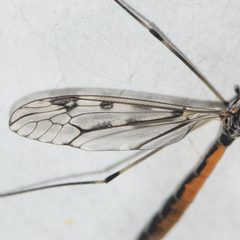
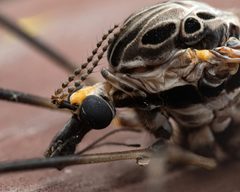
Tipula abdominalis, commonly known as the giant crane fly, is a large of crane fly in the Tipulidae. The larvae are aquatic found in riparian , where they feed on decomposing leaf litter. Their harbors a dense, diverse bacterial that facilitates digestion of lignocellulosic material. The species has been studied for its potential applications in biofuel production due to its efficient natural biorefinery system. are among the largest crane flies in North America but do not feed.

Pronunciation
How to pronounce Tipula abdominalis: /tɪˈpuːlə æbdɒˈmɪnəlɪs/
These audio files are automatically generated. While they are not always 100% accurate, they are a good starting point.
Images
Habitat
Riparian aquatic ; larvae live in water-saturated environments with accumulations of decomposing leaf litter along streams and in wetlands.
Distribution
Nearctic region: Canada (Ontario, Quebec, Newfoundland) and USA (Minnesota south to Kansas, Louisiana, and Florida, including Vermont).
Diet
Larvae are that consume decomposing leaf litter. lack functional mouthparts and do not feed.
Life Cycle
Larvae are the primary feeding stage and are aquatic. Larvae undergo periodic molting (), during which the bacterial is sloughed but recolonizes to previous and diversity. Specific details on and timing are not documented in available sources.
Behavior
Larvae exhibit leaf-shredding feeding . The bacteria form a distinct layered or 'weblike' architecture, with filamentous bacteria overlying mats attached to the gut wall. This attached recolonizes after each , indicating a stable symbiotic relationship.
Ecological Role
that processes leaf litter in aquatic , contributing to nutrient cycling and energy flow in riparian . The microbial in the larval gut aids in breaking down recalcitrant plant polymers, facilitating decomposition.
Human Relevance
Studied as a model natural biorefinery for potential industrial applications in lignocellulosic ethanol production. A cellulolytic bacterial isolate (27C64) from its demonstrated enzymatic activity on plant polymers and reduced commercial requirements by 20% when co-cultured with yeast in fermentation experiments.
Sources and further reading
- BugGuide
- Wikipedia
- GBIF taxonomy match
- iNaturalist taxon
- NCBI Taxonomy
- Mini-review of the Cicindelidia abdominalis species-group | Beetles In The Bush
- Ted C. MacRae | Beetles In The Bush | Page 8
- Uncategorized | Blog - Part 48
- Chironomidae | Beetles In The Bush
- Bacteria Associated with the Gut Tract of Larval Stages of the Aquatic Cranefly Tipula abdominalis (Diptera; Tipulidae)
- Mining diversity of the natural biorefinery housed within Tipula abdominalis larvae for use in an industrial biorefinery for production of lignocellulosic ethanol
- The influence of the physical, chemical, and microbiological characteristics of decomposing leaves on the growth of the detritivore Tipula abdominalis (Diptera: Tipulidae)
- Studies on the Protozoan Fauna of the Larvae of the Crane-Fly, Tipula abdominalis. II. The Life History of Ithania wenrichi n. gen., n. sp., a Coccidian, Found in the Caeca and Mid-Gut, and a Diagnosis of Ithaniinae, n. Subfamily