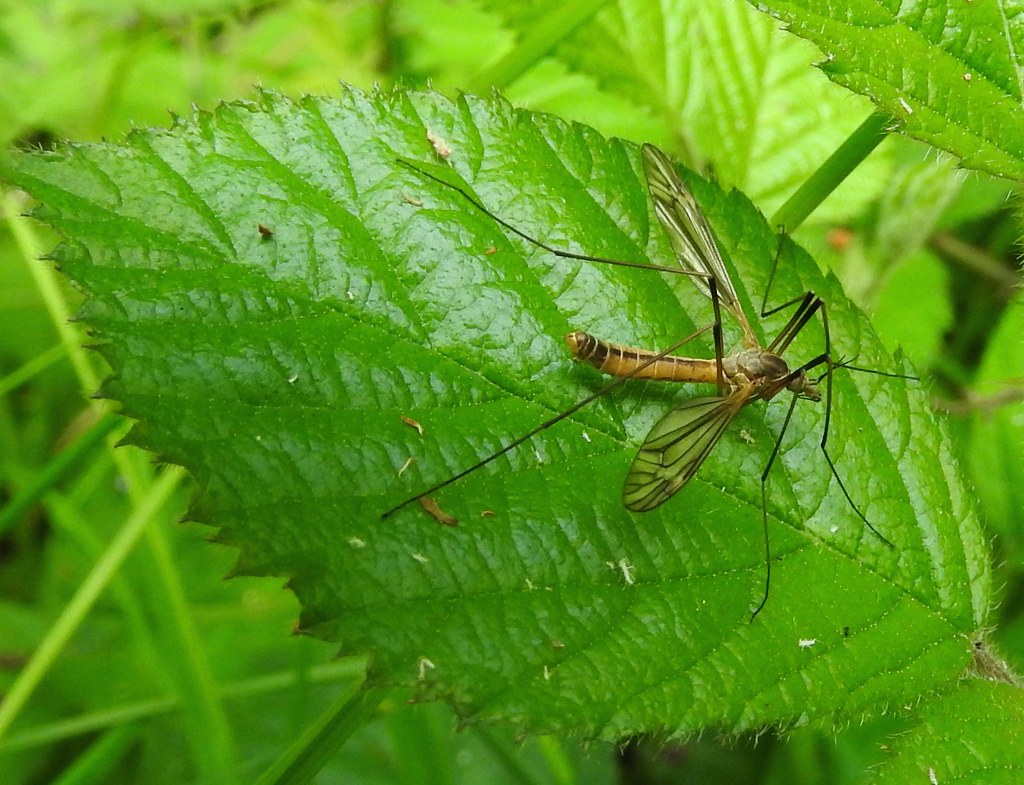
A large crane fly species in the family Tipulidae, distributed across northern and western North America. Adults are active during late spring and summer months. The species is distinguished by its distinctive wing patterning and robust body form compared to congeners.
Antocha is a genus of crane flies (Limoniidae) comprising approximately 161 species across three subgenera. The genus is globally distributed with highest diversity in the Oriental (83 species) and East Palearctic (53 species) regions. Larvae are aquatic and rheophilic, inhabiting fast-flowing streams and rivers where they construct silken tubes on submerged rocks. The genus exhibits notable sensitivity to hydrological disturbances, making it a potential indicator of stream ecosystem health.
Atarba is a genus of crane flies (Diptera: Limoniidae) established by Osten Sacken in 1869. The genus contains three recognized subgenera: Atarba, Atarbodes, and Ischnothrix. Species within this genus are slender, delicate flies characteristic of the Limoniidae family. The genus has been documented in North America, with records from the northeastern United States including Vermont.
Atarba picticornis is a limoniid crane fly whose larvae develop in decaying hardwood logs and stumps, where they feed on decomposing wood and associated fungi. The life cycle spans approximately one year, with adults emerging in spring to mate in swarms near larval habitat sites. This species functions as a decomposer in forest ecosystems and has been documented across eastern North America from Canada to the southern United States.
Austrolimnophila is a genus of crane flies (Diptera: Limoniidae) established by Charles Paul Alexander in 1920. The genus contains approximately 15 described species distributed across four subgenera: Archilimnophila, Austrolimnophila, Limnophilaspis, Mediophragma, and Phragmocrypta. Species occur in regions including Scandinavia, South America, and other localities. The genus is taxonomically well-defined within the Limnophilinae subfamily.
Austrolimnophila toxoneura is a Nearctic species of limoniid crane fly in the family Limoniidae. The species was originally described by Osten Sacken in the mid-19th century under the basionym Limnophila toxoneura. It occurs across a broad range of eastern North America, from Ontario and Newfoundland south to Tennessee and North Carolina. Like other members of Limoniidae, it belongs to a diverse family of slender-bodied crane flies often associated with moist habitats.
Eastern Phantom Crane Fly, Phantom Crane Fly
Bittacomorpha clavipes, the eastern phantom crane fly, is a distinctive fly in the family Ptychopteridae. Adults are small-bodied with exceptionally long, delicate black legs marked with white sheaths near the tips. The species is known for its unique flight behavior, using wind currents rather than wing beats for transportation, with legs spread to create air resistance. It inhabits shaded, moist environments near wetlands across eastern North America.
Cheilotrichia is a genus of crane flies in the family Limoniidae, subfamily Chioneinae. The genus was established by Rossi in 1848 and contains two recognized subgenera: Cheilotrichia and Empeda. Species within this genus have been documented across the Palearctic region, with some extending into the Nearctic. One species, C. (E.) umiat, was originally described from Alaska and has recently been recorded from the Putorana Plateau in northern East Siberia, representing a significant range extension.
Cheilotrichia stigmatica is a species of crane fly in the family Limoniidae, originally described as Empeda stigmatica by Osten Sacken in 1869. It belongs to a genus of small, delicate crane flies characterized by reduced wing venation. The species occurs in the Nearctic region across Canada and the eastern United States.
Snow Flies, Snow Crane Flies
Chionea is a genus of wingless crane flies in the family Limoniidae, commonly known as snow flies. The genus contains approximately 37-40 recognized species distributed across the northern hemisphere, with two subgenera: the Holarctic Chionea and the Palearctic Sphaeconophilus. Adults are uniquely adapted to cold environments and are active during winter months, walking across snow surfaces at sub-zero temperatures. The wingless condition is associated with energy conservation in freezing conditions, with flight muscles replaced by expanded egg storage capacity in females.
Chionea carolus is a wingless crane fly species in the family Limoniidae, commonly known as a "snow fly." It inhabits subnivean environments beneath snow in western North America, particularly in California and Nevada. Adults are active during winter months, crawling on snow surfaces when temperatures are mild enough. The species exhibits remarkable cold tolerance through glycerol-based antifreeze compounds and specialized enzymes that allow metabolic function at low temperatures.
Chionea obtusa is a wingless crane fly in the family Limoniidae, one of sixteen North American species in the genus Chionea commonly known as "snow flies." Described by George Byers in 1983, this species inhabits the Nearctic region of western North America. Like other Chionea species, adults are active during winter months and are adapted to cold environments, though specific biological details for C. obtusa remain largely unstudied.
Cryptolabis paradoxa is a species of crane fly in the family Limoniidae, first described by Osten Sacken in 1860. It belongs to a genus of small, delicate flies commonly found in moist terrestrial habitats. The species occurs across eastern North America from Ontario and the Canadian Maritimes south to Arkansas, Tennessee, and Florida.
Cylindrotoma is a genus of crane flies in the family Cylindrotomidae, first described by Macquart in 1834. The genus has a broad distribution across Asia, North America, and Europe, with China containing the highest species diversity. Larvae are associated with flowering plants, while adults inhabit damp wooded environments.
Dactylolabis cubitalis is a species of limoniid crane fly described by Osten Sacken in 1869. It is a small, delicate fly belonging to a genus characterized by distinctive leg modifications. The species has a documented but restricted distribution in the eastern United States.
Dactylolabis hudsonica is a crane fly species in the family Limoniidae. It inhabits madicolous environments—thin water films on vertical or overhanging rock surfaces—in eastern North America. The species was described by Alexander in 1931. Its larval and pupal stages have been documented, and larvae can be distinguished from the related D. montana using morphological characters.
Dactylolabis montana is a species of limoniid crane fly inhabiting madicolous environments in eastern North America. The species develops in thin water films on rock surfaces, with distinct larval and pupal stages described. It occurs from Ontario and Newfoundland south to Kansas, Arkansas, Mississippi, Tennessee, and South Carolina.
Dactylolabis vestigipennis is a small crane fly species in the family Limoniidae, first described by Charles Paul Alexander in 1950. The species is known from limited observations in the southwestern United States. Like other limoniid crane flies, it belongs to a diverse family of delicate, long-legged flies often found in moist habitats.
Decodes nr-horariana is a crane fly species in the family Limoniidae. The 'nr-' prefix indicates this is a near-reference specimen that closely resembles D. horariana but has not been formally confirmed as that species through detailed taxonomic examination. Limoniid crane flies are generally small to medium-sized flies with reduced wing venation compared to their larger relatives in Tipulidae.
Dicranoptycha is a genus of crane flies in the family Limoniidae, established by Osten Sacken in 1860. These insects belong to the diverse limoniid crane fly radiation, which are generally smaller and more delicate than the more familiar tipulid crane flies. The genus has been documented from parts of northern Europe including Denmark, Norway, and Sweden.
Dicranoptycha elsa is a species of limoniid crane fly in the family Limoniidae, first described by Alexander & Alexander in 1929. It belongs to a large genus of crane flies characterized by distinctive morphological features. The species occurs in eastern North America with a range extending from southern Canada to the southeastern United States.
Dicranota rivularis is a species of crane fly in the family Pediciidae, first described by Osten Sacken in 1860. It is a small to medium-sized nematoceran fly with a Nearctic distribution centered in the eastern United States. The species is associated with riparian habitats, as suggested by its specific epithet. Like other Pediciidae, it belongs to a group of crane flies formerly classified within Limoniidae. Very few observations exist in public databases, indicating it is either genuinely rare or underreported.
Dolichopeza carolus is a species of large crane fly in the family Tipulidae. It belongs to the genus Dolichopeza, a group characterized by exceptionally elongated legs and bodies among crane flies. The species was described by Charles Paul Alexander in 1940. It is distributed across eastern North America.
Elephantomyia is a genus of crane flies (Diptera: Limoniidae) characterized by an exceptionally elongated rostrum used for nectar feeding. The genus has a broad Palearctic distribution spanning Europe, Russia, East Asia, and fossil records from Baltic amber. Larvae are saproxylic, developing in moist decaying wood of hardwoods and conifers. Multiple subgenera have been described, including Elephantomyia, Elephantomyina, Elephantomyodes, and Xenoelephantomyia.
Elephantomyia westwoodi is a species of limoniid crane fly in the family Limoniidae. The species is known to have three recognized subspecies: E. w. adirondacensis, E. w. antillarum, and the nominate E. w. westwoodi. It belongs to the genus Elephantomyia, a group of small, delicate crane flies. Limited information is available regarding its specific biology and ecology.
Elliptera is a genus of crane flies in the family Limoniidae, established by Schiner in 1863. The genus comprises ten described species distributed across the Holarctic region, including North America, Europe, and East Asia. Immature stages have been described for only a few species, with larvae inhabiting aquatic, hygropetric environments on wet rocks in mountainous areas.
Elliptera tennessa is a species of limoniid crane fly described by Charles Paul Alexander in 1926. The species epithet references Tennessee, indicating its type locality. As a member of Limoniidae, it belongs to a diverse family of delicate, long-legged flies often mistaken for mosquitoes. Published records for this species are sparse.
Ellipteroides is a genus of crane flies (Diptera: Limoniidae: Chioneinae) comprising 122 extant species distributed across all biogeographical regions except Australasia. The genus includes five subgenera (Ellipteroides, Progonomyia, Protogonomyia, Ptilostenodes, Ramagonomyia, Sivagonomyia) plus three newly proposed subgenera (Afroellipteroides, Iberiopteroides, Photogonomyia) and a new fossil subgenus Jantares from Eocene Baltic amber. Species are small blackish insects with characteristic yellow thoracic bands and abdominal stripes. The fossil record includes two Eocene species: E. kishenehn from Middle Eocene Montana and E. hansi from Priabonian Baltic amber (38-34 million years ago).
Ellipteroides slossonae is a species of crane fly in the family Limoniidae, described by Alexander in 1914. It belongs to a genus characterized by distinctive wing venation patterns. The species occurs across a broad range in North and Central America, with records extending from the central United States through Mexico to Panama and Jamaica.
Epiphragma arizonense is a crane fly species described by Alexander in 1946. The species is known from the southwestern United States and northwestern Mexico. Like other members of the genus Epiphragma, it is distinguished by distinctive wing patterning and male genitalia morphology. The male was redescribed and illustrated in a 2012 taxonomic review of North American Epiphragma species.
Band-winged Crane Fly
Epiphragma fasciapenne is a species of limoniid crane fly native to North America. It is commonly known as the Band-winged Crane Fly, a name derived from the distinctive wing pattern that characterizes this species. The species was first described by Thomas Say in 1823 and is among the more frequently observed crane flies in its range, with over 2,800 citizen science records. It belongs to the family Limoniidae, a diverse group of crane flies often found in moist woodland habitats.
Erioptera is a genus of crane flies in the family Limoniidae, established by Meigen in 1803. The genus contains multiple subgenera and species distributed across temperate regions including North America, Europe, and Asia. At least one species, Erioptera squalida, has been documented as a root-piercing insect with specialized spiracular structures for accessing plant root gas spaces.
Erioptera parva is a species of limoniid crane fly in the family Limoniidae. The species was described by Osten Sacken in 1859. It belongs to the genus Erioptera, which comprises small to medium-sized crane flies. The species has two recognized subspecies: Erioptera parva parva and Erioptera parva brasiliensis.
Erioptera venusta is a species of limoniid crane fly in the family Limoniidae. It is currently treated as a synonym of Ilisia venusta. The species occurs in the Nearctic region, with records from Canada and the United States.
Erioptera vespertina is a species of crane fly in the family Limoniidae, first described by Osten Sacken in 1860. It belongs to a large genus of small, delicate flies commonly known as limoniid crane flies. The species is documented from the Nearctic region with records spanning eastern and central North America. Like other members of Limoniidae, it is presumed to have aquatic or semi-aquatic larval stages, though specific life history details for this species remain poorly documented.
Eugnophomyia is a genus of crane flies in the family Limoniidae, subfamily Chioneinae. The genus was established by Charles Paul Alexander in 1947 and contains approximately 30 described species distributed primarily in the Americas. Members are characterized by their relatively small to medium size and typical limoniid morphology. The genus shows greatest diversity in the Neotropical region, with several species extending into the Nearctic.
Eugnophomyia luctuosa is a species of limoniid crane fly in the family Limoniidae, order Diptera. It was described by Osten Sacken in 1860. The species is distributed across the Nearctic and Neotropical regions, with records from the United States, Mexico, Guatemala, and Colombia. Like other crane flies in this family, it belongs to a diverse group of delicate, long-legged flies commonly found in moist habitats.
Euphylidorea is a genus of crane flies in the family Limoniidae, established by Charles Paul Alexander in 1972. It belongs to the subfamily Limnophilinae, a group of small to medium-sized crane flies often associated with moist habitats. The genus has been recorded from Scandinavia and Denmark, with over 500 observations on iNaturalist. Species-level taxonomy and biology remain poorly documented in public sources.
Gnophomyia is a genus of crane flies (family Limoniidae) established by Osten Sacken in 1860. The genus contains species whose larvae are specialized bark-dwellers, feeding on phloem tissue. Immature stages have been described for several species including G. lugubris, G. acheron, G. viridipennis, and G. luctuosa. The genus is recorded from Europe and North America.
Gonomyia is a genus of crane flies in the family Limoniidae, established by Meigen in 1818. The genus contains numerous species organized into multiple subgenera, including Gonomyia, Gonomyina, Idiocerodes, Leiponeura, Megalipophleps, Neolipophleps, Paralipophleps, Prolipophleps, and Teuchogonomyia. Fossil evidence from Cretaceous amber deposits in Spain and Myanmar indicates the genus originated by at least the Upper Albian, approximately 100 million years ago. Species diversity spans multiple continents with modern records from Europe, Asia, and the Americas.
Gonomyia puer is a species of limoniid crane fly described by Alexander in 1913. It belongs to the family Limoniidae, a large group of generally small, delicate crane flies. The species has a broad distribution spanning the Nearctic and Neotropical regions, with records from the eastern United States through the Caribbean and into South America. Like other members of its family, it is likely associated with moist habitats where larvae develop in decaying organic matter.
Gonomyia sulphurella is a small crane fly in the family Limoniidae, described by Osten Sacken in 1860. The species is characterized by its yellowish coloration, reflected in its specific epithet 'sulphurella' (sulfur-yellow). It occurs across a broad range of eastern and central North America, from southern Canada through the eastern United States. Like other limoniid crane flies, it is a delicate, long-legged fly associated with moist terrestrial habitats.
Helius is a genus of crane flies (family Limoniidae) within the order Diptera. Species in this genus are small to medium-sized flies characterized by relatively short antennae and reduced wing venation compared to other crane fly groups. The genus has been recorded from northern Europe and has over 1000 observations on citizen science platforms.
Helius flavipes is a species of limoniid crane fly in the family Limoniidae. It occurs across a broad geographic range in North America, from Canada south through the United States. As a member of the crane fly family Limoniidae, it belongs to a diverse group of delicate, long-legged flies commonly found in moist terrestrial and semi-aquatic habitats.
Hesperoconopa is a genus of crane flies in the family Limoniidae, first described by Charles Paul Alexander in 1948. The genus contains eight recognized species distributed across three disjunct regions: North America, India, and the Russian Far East. Members belong to the subfamily Chioneinae, a diverse group of small to medium-sized crane flies. The genus name derives from Greek roots, with 'hespero-' referring to the west and 'conopa' relating to crane flies.
Hexatoma brevioricornis is a species of limoniid crane fly described by Charles Paul Alexander in 1941. The species belongs to the family Limoniidae, a diverse group of crane flies often characterized by relatively short antennae compared to other tipuloid families. It occurs in eastern North America, with records spanning from Quebec to Massachusetts and southward to Kansas, Texas, Tennessee, and North Carolina. The specific epithet 'brevioricornis' refers to the relatively short antennae characteristic of this species.
Hexatoma longicornis is a species of limoniid crane fly in the family Limoniidae, order Diptera. The species was originally described as Anisomera longicornis by Walker in 1848. It is distributed across the Nearctic region, ranging from Alaska through Canada to the eastern and central United States.
Hexatoma sculleni is a crane fly species in the family Limoniidae, described by Charles Paul Alexander in 1943. It belongs to a genus of small to medium-sized crane flies characterized by reduced wing venation and relatively short legs compared to true crane flies (Tipulidae). The species is known from a limited geographic range in the western United States. Very few observations exist, suggesting it is either genuinely rare or underreported.
Hexatoma wilsonii is a species of limoniid crane fly (family Limoniidae) first described by Osten Sacken in 1869. The species is known from the eastern United States, with records from Ohio to Delaware and south to North Carolina. Like other members of the genus Hexatoma, adults are characterized by reduced wing venation and distinctive leg structure. The species has been documented through a small number of observations on iNaturalist (7 records), suggesting it may be underreported or genuinely uncommon.
Ilisia armillaris is a crane fly species in the family Limoniidae, originally described as Erioptera armillaris by Osten Sacken in 1869. It is currently classified in the genus Ilisia based on morphological and phylogenetic revisions of the Chioneinae subfamily. The species is distributed across eastern North America, from the Great Plains to the Atlantic coast. Like other limoniid crane flies, adults are delicate and long-legged, though specific ecological details remain poorly documented.