
Eugnophomyia
Alexander, 1947
Species Guides
1Eugnophomyia is a of crane flies in the Limoniidae, Chioneinae. The genus was established by Charles Paul Alexander in 1947 and contains approximately 30 described distributed primarily in the Americas. Members are characterized by their relatively small to medium size and typical limoniid . The genus shows greatest diversity in the Neotropical region, with several species extending into the Nearctic.
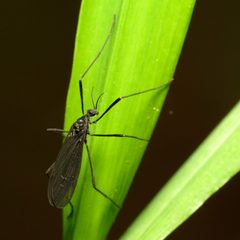
Pronunciation
How to pronounce Eugnophomyia: /juːɡnɒfəˈmaɪə/
These audio files are automatically generated. While they are not always 100% accurate, they are a good starting point.
Identification
Separation from related limoniid requires examination of wing venation details, particularly the arrangement of radial and the presence or absence of specific crossveins. The male hypopygium structure is critical for -level identification. Eugnophomyia species may be distinguished from superficially similar Chioneinae by combinations of antennal flagellomere structure, wing patterning, and genitalic . Exact distinguishing characters from congeneric require keys.
Images
Habitat
Occupies moist terrestrial typical of limoniid crane flies, including forested areas, riparian zones, and wetlands. Specific microhabitat preferences vary by ; larvae are presumed to develop in decaying organic matter, moist soil, or aquatic/semi-aquatic substrates as is common in the .
Distribution
Primarily Neotropical in distribution, with extension into the southern Nearctic. Documented from Mexico through Central America and South America, with particular concentration in the Andean region. Several described from Argentina (E. golbachi, E. vivasberthieri), Brazil, and other South American localities. North American records include E. apache from the southwestern United States.
Seasonality
activity patterns vary by and latitude; in tropical regions likely active year-round, while temperate-zone species show seasonal peaks corresponding to warmer, wetter periods. Specific phenological data are sparse in published sources.
Life Cycle
Complete with , larval, pupal, and stages. Larval is poorly documented for most ; based on -level patterns, larvae likely inhabit moist decaying vegetation, soil, or shallow aquatic environments. occurs in the substrate.
Behavior
are typically or , weak fliers that rest on vegetation during daylight hours. Males and females engage in mating swarms or encounter-based mating systems. Specific behavioral observations for Eugnophomyia are limited in published literature.
Ecological Role
Larvae likely contribute to decomposition processes in moist terrestrial and semi-aquatic . may serve as prey for spiders, birds, and other . Pollination role, if any, is minimal given the non-feeding or nectar-feeding habits typical of adult limoniids.
Human Relevance
No documented economic importance; neither beneficial nor pestiferous. occasionally encountered by entomologists and naturalists in field surveys. The is of interest to dipteran systematists studying limoniid and .
Similar Taxa
- ChioneaBoth belong to Chioneinae and share reduced wing venation; Chionea is distinguished by being wingless or nearly so in most , while Eugnophomyia possesses fully developed wings.
- LimoniaLarger limoniid with overlapping distribution; Limonia often show more complex wing patterning and different male genitalic structure, though definitive separation requires expert examination.
- NeolimoniaNeotropical limoniid with similar general appearance; separation based on details of wing venation and hypopygial structure.
More Details
Taxonomic History
The was established by Alexander in 1947, though some included were described earlier under other genera or as new species. Alexander described the majority of known species, with authorship dates spanning 1920–1976, indicating sustained taxonomic activity in the genus.
Species Diversity
Approximately 30 described are currently recognized, with the majority described from South America. The uneven distribution of descriptions suggests either genuine biogeographic concentration or collecting toward the Neotropics.