
Elephantomyia
Osten Sacken, 1860
Species Guides
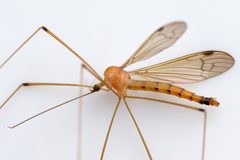
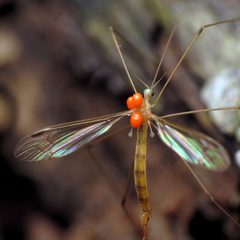
1Elephantomyia is a of crane flies (Diptera: Limoniidae) characterized by an exceptionally elongated rostrum used for nectar feeding. The genus has a broad Palearctic distribution spanning Europe, Russia, East Asia, and fossil records from Baltic amber. Larvae are saproxylic, developing in moist decaying wood of hardwoods and conifers. Multiple subgenera have been described, including Elephantomyia, Elephantomyina, Elephantomyodes, and Xenoelephantomyia.
Pronunciation
How to pronounce Elephantomyia: /ˌɛlɪˌfæntəˈmaɪə/
These audio files are automatically generated. While they are not always 100% accurate, they are a good starting point.
Identification
Distinguished from other limoniid by the extremely elongate rostrum, often equal in or exceeding body length. have reduced palpi associated with the elongated . Larvae are covered in long golden hairs with reduced, weakly sclerotized capsules.
Images
Habitat
occur in mesophytic forest , particularly near streams in dense vegetation with thick ground litter and decaying arboreous debris. Larvae are strictly saproxylic, inhabiting moist friable wood fiber of beech, spruce, and other decaying hardwoods and conifers.
Distribution
Europe (including Baltic region, Caucasus), Russia (North Caucasus, Far East), East Asia (Japan, China, South Korea including Jeju Island). Fossil known from Baltic amber.
Seasonality
collected primarily in May-June; specific timing varies by and latitude.
Diet
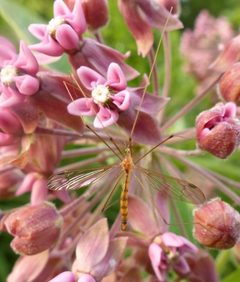
feed on nectar from tubular flowers using the elongated rostrum. Larval diet unknown, presumed to involve microbial or fungal components of decaying wood.
Host Associations
- Alnus glutinosa - collection site vegetationriverside black alder forest
- Fagus - larval development substratemoist friable wood fiber
- Picea - larval development substratemoist friable wood fiber
Life Cycle
Development includes saproxylic larval and pupal stages in decaying wood. emerge in late spring to early summer. Specific duration of developmental stages unknown.
Behavior
are active in dense vegetation near forest streams. Nectar-feeding facilitated by elongated rostrum adapted for accessing tubular flowers.
Ecological Role
Larvae contribute to wood decomposition in mesophytic forest . may serve as of tubular flowering plants.
Human Relevance
Some are rare tertiary relicts with restricted ranges, warranting conservation attention in regional Red Books. E. edwardsi is considered vulnerable due to small size and specificity.
Similar Taxa
- Other Limoniidae generaLack the distinctive extremely elongate rostrum; palpi structure differs
More Details
Subgeneric classification
Four subgenera recognized: Elephantomyia (type), Elephantomyina, Elephantomyodes, and Xenoelephantomyia.
Fossil record
Extensive fossil record from Eocene Baltic amber documents historical diversity and of the .
Conservation status
E. edwardsi exemplifies conservation concern: restricted to Kuban altitudinal zonation variant, very rare in European Russia, classified as relict .
Sources and further reading
- BugGuide
- Wikipedia
- GBIF taxonomy match
- iNaturalist taxon
- NCBI Taxonomy
- Catalogue of Life
- A new species of Elephantomyia crane fly (Diptera, Limoniidae) from Jeju Island, South Korea
- Elephantomyia edwardsi Lackschewitz, 1932 (Diptera: Limoniidae) in the fauna of the Caucasus: distribution and ecology
- New data on the ecology and morphology of xylobiont larvae of the genus Elephantomyia Ost.-Sack. (Diptera, Limoniidae)
- Author Correction: Recent discoveries of new Elephantomyia (Diptera, Limoniidae) fossils in Baltic amber.
- Recent discoveries of new Elephantomyia (Diptera, Limoniidae) fossils in Baltic amber.