
Bittacomorpha clavipes
(Fabricius, 1781)
Eastern Phantom Crane Fly, Phantom Crane Fly
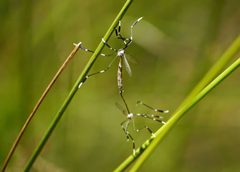
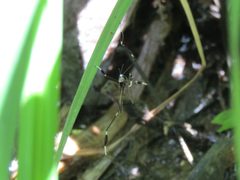
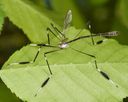
Bittacomorpha clavipes, the eastern phantom , is a distinctive fly in the Ptychopteridae. are small-bodied with exceptionally long, delicate black legs marked with white near the tips. The is known for its unique , using wind currents rather than wing beats for transportation, with legs spread to create air resistance. It inhabits shaded, moist environments near wetlands across eastern North America.
Pronunciation
How to pronounce Bittacomorpha clavipes: /ˌbɪtəkoʊˈmɔrfə ˈklævɪˌpez/
These audio files are automatically generated. While they are not always 100% accurate, they are a good starting point.
Identification
Distinguished from other phantom crane flies by range and thoracic markings: has more white on the than the western Bittacomorpha occidentalis, and larger legs and than the pygmy phantom crane fly Bittacomorphella jonesi. The eastern is found east of the Rocky Mountains, while B. occidentalis occurs in western North America. B. clavipes also has larger overall body size than Bittacomorphella species.
Images
Appearance
Small body approximately 12 mm (half inch) in length. Legs are thin, black, with distinctive white near the tips. Wings are present but used minimally during . The is light and delicate, with legs containing minimal tissue to reduce weight. The Ptychopteridae is characterized by a unique lobe at the base of the called the prehaltere.
Habitat
Shaded, moist environments along the edges of wetlands, including spring-fed . Found in fairly dense vegetation within riparian zones, alder swamps, and lentic shorelines. Larvae inhabit the top inch of aquatic substrate in these environments.
Distribution
Eastern North America, from the Atlantic coast west to the Rocky Mountains. Documented from the Ozark region, Vermont, and throughout the eastern United States.
Seasonality
active from late spring through early autumn. Multiple per year in northern portions of range; one generation per year in southern areas.
Life Cycle
deposited singly or in small bunches (up to 300 per female) by dipping into water; hatch in approximately 7 days. Larvae live in top inch of substrate, feeding on decaying organic material; breathe through a long, retractable breathing tube extended through the water surface film. Pupae possess a single greatly elongated spiracular horn protruding from the right side of the ; pupal stage lasts 5-12 days. One per year in southern range, two generations per year in northern areas.
Behavior
relies primarily on wind currents rather than wing beats, with legs spread to create air resistance and buoyancy. When flying, the black appear and disappear against the white , creating a shifting "phantom" appearance. move randomly through vegetation 2-3 feet above ground. Couples fly in tandem and mate while in flight or hanging from leaves. Adults are presumed to feed little, if at all.
Ecological Role
Larvae contribute to decomposition as in wetland substrate. may serve as prey items for various . The occupies a specific in shaded, moist riparian environments.
Human Relevance
Subject of entomological interest due to unique mechanics and distinctive appearance. Not a pest ; do not bite or sting. Sometimes mistaken for large mosquitoes or other crane flies, but poses no threat to humans.
Similar Taxa
- Bittacomorpha occidentalisWestern phantom with less white on ; distribution west of Rocky Mountains
- Bittacomorphella jonesiPygmy phantom crane fly with smaller legs and ; distinguished by size and pupal horn on left side (vs. right in Bittacomorpha)
More Details
Flight Mechanics
The exhibits a highly derived strategy where wind currents provide primary propulsion, with wings used minimally. The enlarged, lightweight legs create substantial air resistance without adding significant weight, enabling passive floating flight.
Pupal Morphology
In Bittacomorpha and Ptychoptera, the right spiracular horn is elongated; in Bittacomorphella, the left horn is elongated. This asymmetry is a diagnostic feature for distinguishing within the .
Sources and further reading
- BugGuide
- Wikipedia
- GBIF taxonomy match
- iNaturalist taxon
- NCBI Taxonomy
- Golden Orbweavers Ignore Biological Rules | Bug Squad
- Mosquito Hawk? Skeeter Eater? Giant Mosquito? No, No, and No
- How one hot spider keeps her cool in the tropics: Golden silk spider, Nephila clavipes — Bug of the Week
- Terrifying big spiders soon in the DMV? Meet the Jorō Spider, Trichonephila clavata, and its cousin the Golden Silk Spider, Trichonephila clavipes — Bug of the Week
- Is the Jorō spider coming to your neighborhood? Trichonephila clavata — Bug of the Week
- Jorō spiders enjoy their new home in the DMV: Jorō spider, Trichonephila clavata — Bug of the Week
- Life History of Bittacomorpha clavipes (Fabricius) (Diptera: Ptychopteridae) in an Ozark Spring, U.S.A.