
Ptychopteridae
Phantom Crane Flies
Genus Guides
3- Bittacomorpha(phantom crane flies)
- Bittacomorphella(pygmy phantom crane flies)
- Ptychoptera(phantom crane flies)
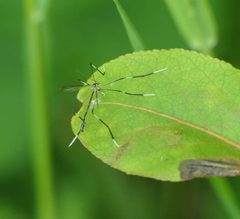
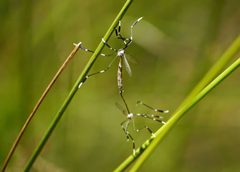
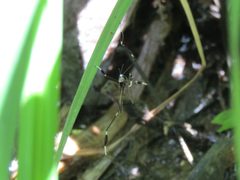
, the phantom crane flies, comprise three extant of primitive nematocerous Diptera. The is distinguished by the presence of a prehaltere—a lobe at the base of the —and is considered one of the most basal lineages within the order, preserving ancestral features that illuminate early dipteran evolution. are named for their distinctive appearance: dark legs with white tarsal create a phantom-like effect as they fly in shaded, moist . Larvae are aquatic with elongated caudal respiratory siphons, inhabiting shallow wetlands and margins of lentic water bodies.
Pronunciation
How to pronounce Ptychopteridae: //taɪˈkɒptəˌraɪdiː//
These audio files are automatically generated. While they are not always 100% accurate, they are a good starting point.
Identification
Distinguished from Trichoceridae by absence of ocelli; from Tanyderidae by lack of five-branched radial ; from Tipulidae by having only one anal vein reaching the wing margin. The prehaltere is diagnostic for the . identification: Ptychopterinae have 16 antennomeres and M1 present; Bittacomorphinae have 20 antennomeres with M1 and M2 veins (no M1 cell). Larvae identified by long caudal respiratory siphon and eucephalous ; pupae by single greatly elongated spiracular horn (right side in Ptychoptera and Bittacomorpha, left side in Bittacomorphella).
Images
Habitat
Larvae occur in moist aquatic or semi-aquatic : wet swales, meadows, lentic shorelines, alder swamps, and shallow vegetated wetlands with benthic deposits of plant detritus. Ptychoptera lenis lenis larvae found in stagnant pond margins where water depth does not exceed 4 cm and detritus exceeds 8 cm depth. frequent shaded, moist environments near larval habitats.
Distribution
Extant recorded from North America (eastern and western), Europe (including Denmark, Finland, Norway, Sweden), and Asia (China, Japan). Bittacomorpha clavipes ranges from eastern North America to the edge of the Rocky Mountains; B. occidentalis in Pacific Northwest. Bittacomorphella species in northeastern and north-central North America, plus Japan. Ptychoptera species widespread across North America with regional (e.g., P. lenis lenis in Pacific Northwest, P. l. coloradensis in Colorado/Utah). Fossil record extends to Early Jurassic (Hettangian) with global distribution including Europe, Asia, North America, and South America.
Seasonality
active from late spring through autumn. Ptychoptera lenis lenis has extended from late May to end of July. Two per year reported for some ; others (one generation annually).
Diet
Larvae feed as collector-gatherers on decaying organic matter in aquatic detritus. presumably feed little if at all; no confirmed feeding records for adults.
Life Cycle
Holometabolous with aquatic larval stage. stage approximately 7 days (Ptychoptera albimana mean 554 eggs). Larvae pass through four instars; first instar markedly different morphologically from instars 2–4. Larval growth rapid, from under 4 mm to nearly 80 mm in P. albimana. Pupae possess single elongated spiracular horn; pupal duration 5–12 days. pupal and pharate stages observed. Fourth instar larvae can survive up to 45 days without atmospheric oxygen contact, though development arrests. duration: (one year) or (two annually) depending on .
Behavior
of Bittacomorpha clavipes exhibit distinctive : spread legs while flying, using expanded, -rich to waft on air currents. This creates the 'phantom' effect—white tarsal spots appearing and disappearing against dark background in shaded flight paths. Adults generally weak fliers, remaining near moist, shaded .
Ecological Role
Larvae function as collector-gatherers in aquatic detritus-based , processing decaying organic matter in shallow wetland systems. Their presence indicates stable, unpolluted lentic with substantial organic detritus accumulation.
Human Relevance
None documented. do not bite or sting; do not feed on mosquitoes or function as . Occasionally encountered by humans in moist, shaded outdoor settings. Scientific interest due to phylogenetic significance as basal dipteran lineage.
Similar Taxa
- TipulidaeTrue crane flies share superficial 'tipuloid' appearance but possess two anal reaching wing margins and lack the prehaltere
- TrichoceridaeWinter crane flies possess ocelli, which lack; also differ in wing venation and structure
- TanyderidaePrimitive crane flies have five-branched radial and lack prehaltere; allied with as based on mesonotal similarities, but relationship unresolved
More Details
Phylogenetic significance
is regarded as one of the most basal within Diptera, retaining ancestral features that bridge primitive aquatic dipteran lineages and more derived higher flies. Fossil record extends to Early Jurassic (~200 million years), with numerous extinct documenting ancient diversity. Relationship with Tanyderidae as proposed based on mesonotal , but molecular and anatomical studies have not confirmed whether this represents true evolutionary relationship or convergence.
Subfamily divergence
Bittacomorphinae and Ptychopterinae exhibit strikingly different morphologies despite shared larval features. Bittacomorphinae parallel Tipulidae in size and shape with bold black-and-white coloration; Ptychopterinae resemble mycetophilid fungus gnats in their shiny black, often wing-patterned appearance. Larvae of Bittacomorphella possess unique absent in other .
Sources and further reading
- BugGuide
- Wikipedia
- GBIF taxonomy match
- iNaturalist taxon
- NCBI Taxonomy
- Catalogue of Life
- Mosquito Hawk? Skeeter Eater? Giant Mosquito? No, No, and No
- Life Cycle, Production and Survival Rates ofPtychoptera paludosa(Diptera: Ptychopteridae)
- Life Cycle, Production and Survival Rates of Ptychoptera paludosa(Diptera: Ptychopteridae)
- <strong>Crane flies—history, taxonomy and ecology (Diptera: Tipulidae, Limoniidae, Pediciidae, Trichoceridae, Ptychopteridae, Tanyderidae)</strong>
- Life History of Bittacomorpha clavipes (Fabricius) (Diptera: Ptychopteridae) in an Ozark Spring, U.S.A.
- THE IMMATURE STAGES OFPTYCHOPTERA LENIS LENIS(DIPTERA: PTYCHOPTERIDAE) WITH NOTES ON THEIR BIOLOGY
- Two new species of the genus Ptychoptera Meigen, 1803 (Diptera, Ptychopteridae) from Yunnan, China with remarks on the distribution of Chinese species
- Key to Ptychopteridae (Diptera) larvae of Northern Europe, with notes on distribution and biology
- Two new Ptychoptera Meigen, 1803 (Diptera, Ptychopteridae) from the Western Palaearctic.