
Tanyderidae
Alexander, 1919
Primitive crane flies
Genus Guides
2, commonly called , are a small of long, delicate nematoceran flies with about 40 extant . They represent a relict lineage within Diptera, retaining primitive wing venation including five complete branches of the radial . are recognized by their spotted or mottled wings and are typically found near streams, often resting on vegetation or hanging beneath bridges. Larvae inhabit wet, decaying wood or sandy and gravelly stream margins. The family has an extensive fossil record dating to the Late Triassic, with numerous extinct known from amber deposits.
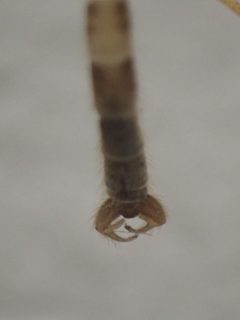
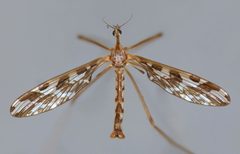
Pronunciation
How to pronounce Tanyderidae: /tænɪˈdɛrɪdiː/
These audio files are automatically generated. While they are not always 100% accurate, they are a good starting point.
Identification
Distinguished from Tipulidae (true crane flies) by retention of five complete radial wing branches versus reduced venation in most Tipulidae. Wing patterning with spots or mottling is distinctive. often found in characteristic hanging posture beneath bridges or streamside vegetation. Larval in wet decaying wood or gravelly stream margins differs from most Tipulidae larvae.
Images
Habitat
rest on vegetation near streams, often hanging beneath bridges or from overhanging plants. Larvae occur in wet, decaying submerged wood or along sandy and gravelly margins of flowing streams. Some inhabit coarse gravel substrates in streams.
Distribution
Fragmented distribution across temperate regions of both hemispheres. Recorded from southern Africa, Australia, New Zealand, North America, and South America. Relatively common in southern Chile and New Zealand; infrequently encountered elsewhere. Fossil known from Germany, United Kingdom, Spain, Lebanon, Myanmar, Kazakhstan, Mongolia, Russia, China, and Baltic amber deposits.
Life Cycle
Complete with , larva, pupa, and stages. Eggs of Araucoderus gloriosus are the first described for the , obtained from captive oviposition. Larvae develop in aquatic or semi-aquatic environments. Specific developmental duration unknown.
Behavior
frequently attracted to artificial lights at night. Females of some , including the fossil Dacochile microsoma, possess modified hind legs with sclerotized processes that allow them to support themselves from vegetation. Adults of Araucoderus gloriosus exhibit specific copulatory and oviposition in captivity.
Human Relevance
Occasionally attracted to artificial lights, bringing them into contact with humans. No economic or medical significance documented. Some considered vulnerable or of conservation concern due to restricted distributions and specific requirements.
Similar Taxa
- TipulidaeTrue crane flies share superficial resemblance in body form and long legs, but retain five complete radial wing branches and have more robust, patterned wings.
- PtychopteridaePhantom crane flies are another , but possess distinctive inflated and different wing .
- TrichoceridaeWinter crane flies are smaller, typically active in colder months, with different wing venation and preferences.
More Details
Fossil Record
has one of the most extensive fossil records among nematoceran . The oldest known member, Larvaderus triassicus, dates to the Late Triassic (Norian) of Germany. Numerous extinct are known from Jurassic and Cretaceous deposits, including Nannotanyderus, Praemacrochile, Protanyderus, and Dacochile from Burmese, Lebanese, Baltic, and Spanish amber. The family likely had much broader distribution in the Mesozoic.
Taxonomic Status
represents a relict lineage of Psychodomorpha with approximately 40 extant in 9 . The 's primitive wing venation and limited modern diversity suggest it is a remnant of a once more diverse group. Some authorities have questioned generic assignments of fossil species to extant genera.
Sources and further reading
- BugGuide
- Wikipedia
- GBIF taxonomy match
- iNaturalist taxon
- NCBI Taxonomy
- Catalogue of Life
- Mosquito Hawk? Skeeter Eater? Giant Mosquito? No, No, and No
- The enigmatic Dacochile microsoma Poinar & Brown: Tanyderidae or Bruchomyiinae?
- <strong>Crane flies—history, taxonomy and ecology (Diptera: Tipulidae, Limoniidae, Pediciidae, Trichoceridae, Ptychopteridae, Tanyderidae)</strong>
- The Neotropical tanyderid Araucoderus gloriosus (Alexander) (Diptera, Tanyderidae), with description of the egg, larva and pupa, redescription of adults, and notes on natural history
- Beyond the Valdivian Forest: expanding the distribution of the vulnerable Tanyderus pictus (Diptera: Psychodomorpha: Tanyderidae) to the endangered Maulino Forest ecosystem