
Trichoceridae
Rondani, 1841
winter crane flies, winter gnats
Genus Guides
2- Paracladura(winter crane flies)
- Trichocera(winter crane flies)
, commonly known as winter crane flies or winter gnats, is a small of delicate, long-legged flies in the order Diptera. are active primarily during cold seasons, including fall, winter, and early spring, with some observed in snow. They are distinguished from other crane fly families by the presence of three ocelli (simple ) on the crown of the . The family contains approximately 160 described species worldwide, with most diversity concentrated in non-tropical, Holarctic regions. Larvae inhabit moist terrestrial environments where they feed on decaying organic matter.
Pronunciation
How to pronounce Trichoceridae: /ˌtraɪkoʊˈsɛrɪdiː/
These audio files are automatically generated. While they are not always 100% accurate, they are a good starting point.
Identification
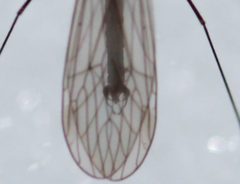
Distinguished from other crane fly (Tipulidae, Tanyderidae, Ptychopteridae) by the presence of three ocelli on the . The V-shaped on the and specific wing venation patterns provide additional diagnostic characters. Wing venation also distinguishes the three North American : Trichocera (27 ), Paracladura (western North America, 1 species), and Diazosma (transcontinental, 1 species). In the field, are difficult to distinguish from other crane flies without close examination; the winter activity period provides a contextual clue. Larvae are recognized by their well-developed head capsule and spiracular arrangement.
Images
Appearance
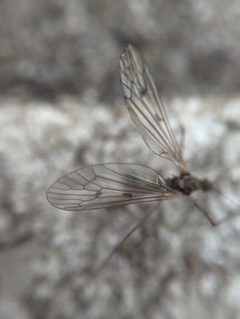
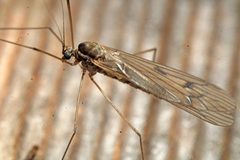
are medium-sized, slender flies with exceptionally long, delicate legs that can span three-fourths of an inch or more. Body length averages 6 millimeters. The most diagnostic feature is the presence of three ocelli (simple ) positioned between the on the crown of the —a trait absent in other crane fly . Additional distinguishing characters include a V-shaped on the and distinct wing venation patterns. Wings are typically clear with characteristic venation that aids in identification to . The overall body form is fragile and elongate, superficially resembling Tipulidae but more delicate. Larvae possess a well-developed head capsule, amphineustic spiracular arrangement, and an oblique or vertical body orientation.
Habitat
are associated with dark, sheltered situations including cave and mine shaft entrances, hollow trees, cellars, and the exterior walls of buildings. They are also found in open areas where males form swarms. Larvae require moist or wet terrestrial : decomposing leaves and vegetation, fungi, manure, decaying tubers in root cellars, and rodent burrows where they scavenge on organic debris and . Specific collection records include stream banks, rocky stream beds with bryophytes, seashore cliffs, open forest glades, and canyon vegetation.
Distribution
Distributed globally with strongest representation in non-tropical, Holarctic regions. In North America, 27 occur, predominantly in the Trichocera. The shows particular abundance in temperate and cold climates, with documented Arctic adaptations. European records include 11 species from the European part of Russia, with three species newly recorded. The Iberian Peninsula has 5 species. The Balearic Islands have recent records of Trichocera (Saltrichocera) saltator and T. (S.) annulata from Mallorca, plus one previous record of T. annulata from Menorca. Mediterranean distribution extends to Algeria, Asia Minor, Ethiopia, Malta, Morocco, and Sardinia. The Canary Islands T. annulata and T. maculipennis.
Seasonality
are active predominantly during cold seasons: fall, winter, and early spring. Some remain active even in winter conditions and snow. In Britain, Trichocera saltator larvae feed and grow during the coldest months (October–February) despite freezing, enter in March, and adults emerge September or later. Adult lifespan in laboratory conditions ranges from 5 to 59 days. Adults are most active at night.
Diet
Larvae feed on decaying organic matter including decomposing leaves, vegetables, fungi, manure, and debris in rodent burrows. Some scavenge on in rodent burrows. A few are minor pests of stored tubers in root cellars. have reduced mouthparts and feed little if at all; some may sponge up liquids such as dew.
Life Cycle
Larvae develop in moist terrestrial , feeding during cold months. In Trichocera saltator, larval growth occurs October–February despite freezing conditions, followed by in March and in September or later. occurs as larvae or pupae in the soil or organic substrate. Adults are short-lived, with laboratory lifespans of 5–59 days.
Behavior
Males form loose, dancing swarms to attract females, typically in sunny conditions. Swarming is primarily male-dominated. are often found resting on sun-warmed surfaces of buildings, fences, and walls. They show affinity for dark, sheltered microhabitats such as cave entrances, hollow logs, and cellars. Adults are most active at night. The exhibits cold-adapted with active winter , enabling survival in Arctic environments.
Ecological Role
Larvae function as decomposers in moist terrestrial , breaking down decaying organic matter and contributing to nutrient cycling. They are important contributors to winter , providing food resources during seasons when most insects are inactive. The represents a notable component of cold-season insect diversity in temperate and Arctic ecosystems.
Human Relevance
Of minimal direct economic importance. A few are minor pests of stored tubers in root cellars. The is valued by naturalists and entomologists as one of the few flying insects active during winter months. may enter buildings and accumulate on walls, but do not bite, sting, or transmit . They are frequently mistaken for other crane flies and sometimes called "snow swarms" when observed in winter.
Similar Taxa
- TipulidaeOther crane flies lack ocelli and have different wing venation; are typically active in warmer seasons
- TanyderidaePrimitive crane flies lack ocelli and have distinct wing venation and
- PtychopteridaePhantom crane flies lack ocelli and have highly modified, inflated for floating
- ChironomidaeNon-biting midges are smaller, lack the extremely long legs, and have different activity patterns
Sources and further reading
- BugGuide
- Wikipedia
- GBIF taxonomy match
- NCBI Taxonomy
- Catalogue of Life
- Bug Eric: Winter Crane Flies
- Bug Eric: New Year’s Insects and Spiders
- Mosquito Hawk? Skeeter Eater? Giant Mosquito? No, No, and No
- Bug Eric: 2026
- Bug Eric: January 2015
- Bug Eric: Compost Insects
- A world catalogue of Trichoceridae Kertész, 1902* (Diptera)
- Distribution, Phenology and Adaptation to Arctic Environment in Trichoceridae (Diptera)
- New records of Trichoceridae (Diptera) from the island of Mallorca
- ON THE LIFE HISTORY OF TRICHOCERA SALTATOR (HARRIS) (DIPTERA, TRICHOCERIDAE)
- New data on the distribution of winter gnats (Diptera, Trichoceridae) in Russia
- New data on the distribution of winter gnats (Diptera, Trichoceridae) in Russia
- <strong>Crane flies—history, taxonomy and ecology (Diptera: Tipulidae, Limoniidae, Pediciidae, Trichoceridae, Ptychopteridae, Tanyderidae)</strong>
- Observations on the diversity, flight periods, emergence, swarming, and microdistribution of crane‐flies at Salem creek, Ontario (Diptera: Tipulidae, ptychopteridae, and trichoceridae)
- Species composition and zoogeographic characteristics of winter gnats (Diptera, Trichoceridae) in the center of the European part of Russia