
Ptychoptera
Meigen, 1803
phantom crane flies
Species Guides
4- Ptychoptera metallica
- Ptychoptera quadrifasciata(phantom crane fly)
- Ptychoptera sculleni
- Ptychoptera townesi(phantom crane fly)
Ptychoptera is a of phantom crane flies comprising at least 70 described . The genus is characterized by larvae that are aquatic or semi-aquatic inhabiting freshwater environments. are recognized by their distinctive wing folding , giving rise to the "fold-winged crane flies." Species occur across the Holarctic and Oriental regions, with significant diversity in China.
Pronunciation
How to pronounce Ptychoptera: //ˌtaɪ.kəʊˈpiː.tə.rə//
These audio files are automatically generated. While they are not always 100% accurate, they are a good starting point.
Identification
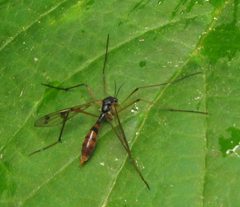
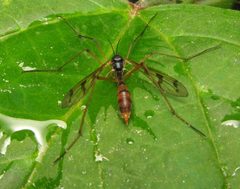
distinguished from other crane flies by wings folded longitudinally at rest, creating a narrow, blade-like profile. This contrasts with Tipulidae and other where wings are held horizontally or roof-like. Larvae possess four instars; first instar markedly different morphologically from instars 2-4, which are similar to each other. Larvae have elongated, cylindrical bodies adapted for burrowing in soft sediments.
Images
Habitat
Larvae inhabit stagnant or slow-flowing freshwater environments including pond margins, marshes, and first-order streams. Specific microhabitat requirements include shallow water depths (typically <4 cm) with substantial accumulations of benthic plant detritus (>8 cm depth). Larvae burrow to depths of approximately 3 cm in organic sediments.
Distribution
Holarctic and Oriental regions. Documented from Europe (Germany, Western Palaearctic), North America, and Asia. In China, at least 16 recorded across multiple provinces including Yunnan and Zhejiang, with ongoing discovery of new species.
Seasonality
season extends from late May through end of July for temperate . One-year documented for at least some species.
Diet
Larvae are selective . Laboratory studies demonstrate significant preference for sediments with high organic matter content and live bacteria. Larvae extract organic matter from sediments, concentrating it in fecal material (4-18× higher organic content than surrounding substrate).
Life Cycle
Four larval instars followed by pupal stage. Both pupal and pharate stages observed. Complete spans approximately one year in studied . Fourth instar larvae can survive up to 45 days without atmospheric oxygen contact, though development arrests under anoxic conditions. Mean gut passage time 7-8 hours.
Behavior
Larvae engage in selective feeding on organic-rich sediments and bacteria. Processed material egested as fecal pellets deposited on sediment surface, creating a vertical transport for organic matter. exhibit characteristic wing-folding when at rest.
Ecological Role
Larvae function as important detritus processors in slow-flowing freshwater reaches. production rates substantial: documented at 770 g dry weight m⁻² yr⁻¹ (approximately 16% organic matter) in studied stream. Contribute to secondary production and nutrient cycling through sediment reworking and organic matter concentration.
Similar Taxa
- Tipulidae (true crane flies)Superficially similar body plan but wings held horizontally or roof-like at rest, not longitudinally folded; larvae typically terrestrial or in different aquatic , not specialized in shallow organic sediments.
- ParaptychopteraClosely related in same ; distinguished by subtle morphological differences in and larval characters requiring examination of specific structural features.
Sources and further reading
- BugGuide
- Wikipedia
- iNaturalist taxon
- NCBI Taxonomy
- Catalogue of Life
- Life Cycle, Production and Survival Rates of Ptychoptera paludosa(Diptera: Ptychopteridae)
- Feeding ecology of the freshwater detritivore Ptychoptera paludosa (Diptera, Nematocera)
- Some aspects of the nutritional ecology of a detritus-feeding Diptera larva: Ptychoptera paludosa
- THE IMMATURE STAGES OFPTYCHOPTERA LENIS LENIS(DIPTERA: PTYCHOPTERIDAE) WITH NOTES ON THEIR BIOLOGY
- Figure 5 from: Zhang X, Kang Z (2021) Two new species of the genus Ptychoptera Meigen, 1803 (Diptera, Ptychopteridae) from Yunnan, China with remarks on the distribution of Chinese species. ZooKeys 1070: 73-86. https://doi.org/10.3897/zookeys.1070.58859
- Figure 1 from: Zhang X, Kang Z (2021) Two new species of the genus Ptychoptera Meigen, 1803 (Diptera, Ptychopteridae) from Yunnan, China with remarks on the distribution of Chinese species. ZooKeys 1070: 73-86. https://doi.org/10.3897/zookeys.1070.58859
- Figure 3 from: Zhang X, Kang Z (2021) Two new species of the genus Ptychoptera Meigen, 1803 (Diptera, Ptychopteridae) from Yunnan, China with remarks on the distribution of Chinese species. ZooKeys 1070: 73-86. https://doi.org/10.3897/zookeys.1070.58859
- Two new species of the genus Ptychoptera Meigen, 1803 (Diptera, Ptychopteridae) from Yunnan, China with remarks on the distribution of Chinese species
- Figure 4 from: Zhang X, Kang Z (2021) Two new species of the genus Ptychoptera Meigen, 1803 (Diptera, Ptychopteridae) from Yunnan, China with remarks on the distribution of Chinese species. ZooKeys 1070: 73-86. https://doi.org/10.3897/zookeys.1070.58859
- The genome sequence of a phantom cranefly, Ptychoptera contaminata (Linnaeus, 1758).
- Two new Ptychoptera Meigen, 1803 (Diptera, Ptychopteridae) from the Western Palaearctic.
- Three new fold-winged crane flies of the genus Ptychoptera Meigen, 1803 (Diptera, Ptychopteridae) from southern China.
- Helen's twins in the Balkans: discovery of two new Paraptychoptera Tonnoir, 1919 species closely related to P.helena Peus, 1958, with systematic revision of the "lacustris" group (Diptera, Ptychopteridae).
- New species of the genus Ptychoptera Meigen, 1803 (Diptera, Ptychopteridae) from Zhejiang, China with an updated key to Chinese species.