
Tipula colei
Alexander, 1942
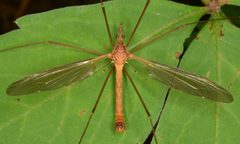
Tipula colei is a crane fly first described by Alexander in 1942. It belongs to the subgenus Triplicitipula within the large Tipula. The species has been documented from residential areas in Baton Rouge, Louisiana, and is distributed across parts of the eastern United States and Mexico. Detailed behavioral studies reveal complex male genital courtship functions involving rhythmic stimulation of females during extended copulation periods lasting approximately three hours.
Pronunciation
How to pronounce Tipula colei: /ˈtɪpjʊlə ˈkoʊlaɪ/
These audio files are automatically generated. While they are not always 100% accurate, they are a good starting point.
Identification
Closely related to and largely sympatric with Tipula quadrifasciata; definitive separation requires examination of male genitalia. Male genital structures are distinctive, featuring outer gonostyles with long setae, an adminiculum, and sternite 8 lateral lobes with stiff setae bundles. The intromittent organ () is thin and unadorned.
Images
Habitat
Residential areas; documented from urban/suburban environments in Baton Rouge, Louisiana at low elevation (15 m).
Distribution
United States (Louisiana, Pennsylvania, Tennessee) and Mexico. Specific collection locality: Baton Rouge, LA (30.409416°N, -91.154519°W).
Behavior
Males exhibit elaborate genital courtship during copulation. The outer gonostyle performs rapid brushing movements with long setae sweeping across the female hypovalve in three distinct patterns: single brief - movements (0.03 seconds each direction), bursts of 3-9 repeated brushing movements lasting 30-120 seconds with gradual slowing, and single brushing movements that trigger female 'squeezing' responses. The adminiculum remains mostly motionless with occasional strong thrusting bursts. Tergites 7-8 show rhythmic sliding movements. Females respond with 'squeezing' movements involving and hypovalves, movements that appear designed to increase rather than avoid male stimulation. Copulation duration averages approximately three hours.
Similar Taxa
- Tipula quadrifasciataClosely related and largely sympatric; can only be separated with certainty by examination of male genitalia.
Sources and further reading
- BugGuide
- GBIF taxonomy match
- iNaturalist taxon
- Platystomatidae | Beetles In The Bush
- Ted C. MacRae | Beetles In The Bush | Page 8
- Pensoft Editorial Team | Blog - Part 153
- Stimulatory Functions of Male Genitalia in Tipula (Triplicitipula) colei Alexander and Tipula (Lunatipula) translucida Doane (Diptera: Tipulidae) and Implications for Theories of Genital Evolution