
Pseudolimnophila contempta
(Osten Sacken, 1869)
Pseudolimnophila contempta is a of crane fly in the Limoniidae, described by Osten Sacken in 1869. It belongs to a characterized by reduced wing venation and aquatic or semi-aquatic larval . The species occurs across eastern North America, from Ontario and Newfoundland south to Kansas and Florida. Like other limoniid crane flies, are delicate, long-legged flies with slender bodies. The genus name refers to its superficial resemblance to true limoniids of the genus Limnophila.
Pronunciation
How to pronounce Pseudolimnophila contempta: //ˌsjuːdoʊˌlɪmˈnɒfɪlə kənˈtɛmptə//
These audio files are automatically generated. While they are not always 100% accurate, they are a good starting point.
Identification
Distinguished from other Limoniidae by the combination of reduced wing venation (fewer crossveins than related ), 16-segmented , and the absence or extreme reduction of the wing stigma. Separated from the similar genus Limnophila by subtle differences in wing venation pattern and male genitalia structure. Differs from larger Tipulidae by its smaller size and more delicate proportions. Identification to level typically requires examination of male terminalia or detailed wing venation analysis.
Images
Appearance
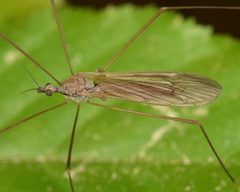
are small to medium-sized crane flies with elongated, slender bodies and exceptionally long, fragile legs. Wings are narrow with reduced venation, a characteristic feature of the Pseudolimnophila. The body is generally dark-colored with possible pale markings on the . are relatively short with 16 segments. The wing tip typically lacks a distinct stigma or has a very faint one. Overall build is more delicate than larger tipulid crane flies.
Habitat
Associated with moist or wetland environments. Larvae likely develop in aquatic or semi-aquatic such as marshes, seeps, and shallow standing water with abundant organic matter. are found in vegetation near larval habitats.
Distribution
Eastern North America: from Ontario and Newfoundland south through the eastern United States to Kansas and Florida. Primarily distributed in the Nearctic region with records concentrated in the northeastern and north-central United States and adjacent Canada.
Seasonality
activity period not well documented; likely spring through summer based on related .
Behavior
are weak fliers typically found resting on vegetation near water. Males may form mating swarms. Like other crane flies, adults probably do not feed or consume only nectar or water. Larvae are presumed to be aquatic or semi-aquatic .
Ecological Role
Larvae likely contribute to nutrient cycling in wetland through detritivory. may serve as prey for birds, spiders, and other . The forms part of the diverse limoniid in eastern North American wetlands.
Human Relevance
No direct economic importance. Like most crane flies, are harmless and do not bite or sting. May be encountered by wetland biologists and entomologists conducting biodiversity surveys.
Similar Taxa
- LimnophilaSimilar name and general appearance; distinguished by more complete wing venation with additional crossveins and typically longer with more segments.
- EriopteraAnother limoniid with reduced venation; separated by differences in wing venation details, particularly the arrangement of radial , and often smaller body size.
- TipulaMuch larger crane flies in Tipulidae; distinguished by larger size, more robust build, V-shaped on the , and more complex wing venation with distinct stigma.
More Details
Taxonomic history
Originally described by Carl Robert Osten Sacken in 1869. The Pseudolimnophila was established to accommodate intermediate between typical Limoniidae and more primitive groups, with wing venation serving as a key diagnostic character.
Conservation status
Not evaluated by IUCN. Appears to be widespread and relatively common within its range based on GBIF and iNaturalist records, though specific trends are unknown.