Olophrum obtectum is a rove beetle in the subfamily Omaliinae, endemic to eastern North America. It was formally revised and recognized as distinct from holarctic congeners in a 1983 taxonomic treatment. The species is one of seven North American Olophrum species and is distinguished by its restricted eastern distribution.
clown beetles
Omalodes is a genus of clown beetles in the family Histeridae, comprising approximately 63-68 described species distributed across three subgenera. It represents the largest genus within the tribe Omalodini and has an exclusively Neotropical distribution, with some species extending into the southern United States. One species, Omalodes (Omalodes) fassli, has been reported on banana crops in Colombia where it may play a role in controlling the banana weevil. The genus is characterized by morphological features including complete apical stria on the elytra in some subgenera.
clown beetles
Omalodini is a tribe of clown beetles (family Histeridae) comprising at least two genera and more than 60 described species. The tribe was redefined in 2015 to include only the genera Ebonius and Omalodes. Members are distributed across Latin America with some species extending into the southern United States. Available ecological data are limited to a few species in the genus Scapomegas, which are associated with carrion and decomposing organic matter in forest biomes.
Omalonomus relictus is a rove beetle species in the family Staphylinidae, described by Campbell and Peck in 1990. The species has been recorded from western Canada (Alberta, Saskatchewan) and the northwestern United States (Utah, Washington). As a member of the subfamily Omaliinae, it belongs to a group of rove beetles often associated with forest floor habitats and decaying organic matter.
Omalorphanus aenigma is a species of rove beetle in the family Staphylinidae, described by Campbell and Chandler in 1987. It belongs to the subfamily Omaliinae and tribe Anthophagini. The species is known from the Pacific Northwest region of the United States, with records from Oregon.
Omethes marginatus is a species of soft-bodied plant beetle in the family Omethidae, first described by John Lawrence LeConte in 1861. The genus Omethes comprises a small group of beetles within the Elateriformia infraorder, characterized by their soft elytra and association with vegetation. Omethes marginatus is known from North America, though detailed biological information remains limited. The family Omethidae is a small group historically allied with Cantharidae (soldier beetles) and related soft-bodied beetle families.
Omias is a genus of broad-nosed weevils (Curculionidae) established by Germar in 1817. The genus comprises more than 50 described species, placing it among the more species-rich genera within the tribe Omiini. These weevils belong to the subfamily Entiminae, a diverse group of root-feeding weevils characterized by their short, broad rostrum and elbowed antennae. The genus has been documented across 368 iNaturalist observations, indicating moderate levels of citizen science engagement.
wrinkled bark beetle
A small beetle in the family Rhysodidae, described by John Lawrence LeConte in 1875. Adults measure 6–7 mm in length. The common name 'wrinkled bark beetle' applies to this species but also refers to the entire family Rhysodidae.
Shiny Round Sand Beetle
Omophron nitidum is a small ground beetle native to the United States. Adults are nocturnal, sheltering in burrows and leaf litter during daylight hours. The species has been recorded breeding from late summer through December. It is one of several North American species in the genus Omophron, which are adapted to sandy habitats.
Howell's hide beetle
Omorgus howelli is a hide beetle in the family Trogidae, native to the southern United States. First described in 1957, it was historically classified under the genus Trox but was reassigned to Omorgus in 2006 based on morphological and phylogenetic evidence. The species occurs in Florida and Texas, with additional records from Mexico and Peru. Like other Trogidae, it is associated with decomposing animal remains.
Omorgus inflatus is a species of hide beetle in the family Trogidae, described by Loomis in 1922. Members of this genus are commonly known as skin beetles and are associated with decomposing animal matter. The species has been recorded from the southwestern United States and northern Mexico.
skin beetle
Omorgus nodosus is a species of skin beetle in the family Trogidae. It has been documented in sandy habitats of the southwestern United States and northern Mexico, where it is active nocturnally. The species feeds on dried animal matter, with observations of individuals feeding on dried dog feces. It occurs in association with sand dune ecosystems, where it has been found walking on sand surfaces at night.
Omorgus tytus is a skin beetle in the family Trogidae, a group of beetles commonly associated with decomposing organic matter. The species has been documented across multiple U.S. states in the Nearctic region. Like other members of the genus, it is presumed to be a detritivore or scavenger, though specific ecological details remain poorly documented in the literature.
Omorgus umbonatus is a species of skin beetle in the family Trogidae, first described by LeConte in 1854. Members of this family are commonly known as hide beetles or skin beetles, and are typically associated with dry animal remains. The species is known from the southwestern United States and northern Mexico.
Omosita colon is a sap-feeding beetle in the family Nitidulidae. The species has been documented across Europe, Northern Asia (excluding China), Central America, and North America. Detailed morphological studies have examined its antennae and mouthpart sensilla, revealing specialized sensory structures associated with its feeding ecology.
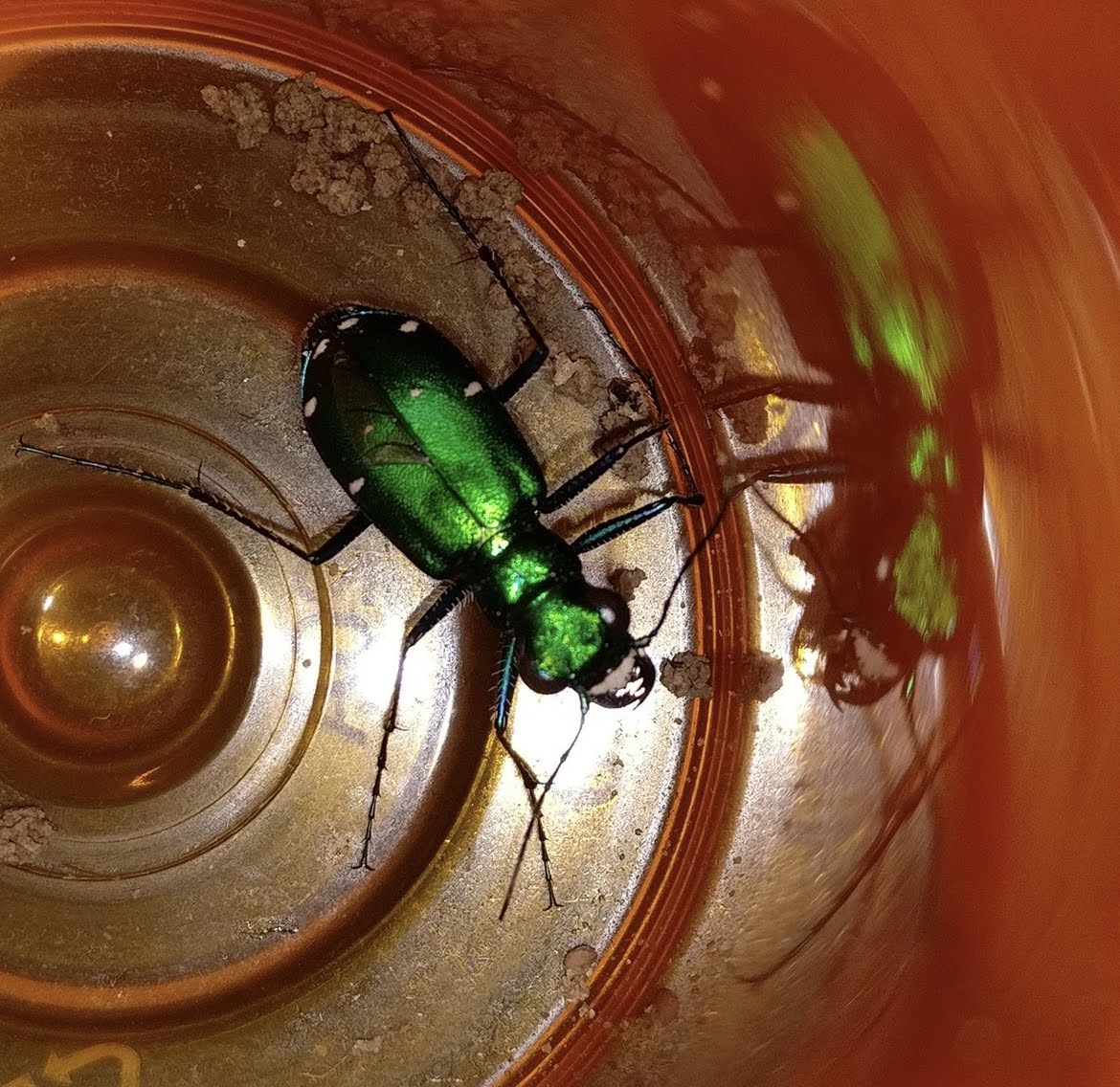
Night-stalking Tiger Beetles
Omus is a genus of flightless, nocturnal tiger beetles (subfamily Cicindelinae) endemic to the west coast of North America. Members are uniformly dark-colored and characterized by reduced or absent hind wings, restricting them to ground-dwelling locomotion. The genus comprises at least five recognized species, including O. audouini, O. californicus, O. cazieri, O. dejeanii, and O. submetallicus. These beetles occupy diverse habitats from forest floors to upper salt marshes, with some species showing strong associations with specific plant communities.
Narrow Night-stalking Tiger Beetle
Omus californicus angustocylindricus is a subspecies of night-stalking tiger beetle endemic to California. It is one of several subspecies within the Omus californicus complex, characterized by its narrow, elongated body form. Adults are nocturnal and difficult to observe, with activity patterns tied to seasonal conditions. Larvae construct burrows in forested habitats, typically found along logging roads or under cover objects. The subspecies is considered rare and has been documented from limited localities in northern California, particularly in Plumas County.
Omus sequoiarum is a species of flightless tiger beetle in the genus Omus, described by Crotch in 1874. It is currently treated as a synonym of Omus californicus californicus, though some sources maintain it as a distinct species. Like other Omus species, it is nocturnal and associated with forested habitats in western North America. The species epithet 'sequoiarum' references its association with sequoia (redwood) forests.
Onichodon rugicollis is a species of ground beetle in the family Carabidae. It belongs to the tribe Lebiini, a diverse group of small to medium-sized carabid beetles. The species is characterized by its distinctive sculptured pronotum, which contributes to its specific epithet. Like other members of its genus, it is likely associated with ground-level habitats in forested or vegetated environments.
Oniticellini is a tribe of scarab beetles within the subfamily Scarabaeinae, commonly known as true dung beetles. The tribe comprises one of the largest and most ecologically significant groups of dung beetles globally, accounting for approximately half of the world's dung beetle fauna. Species in this tribe exhibit diverse nesting behaviors, with most acting as tunnelers that bury dung below droppings, while some genera such as Oniticellus and Tragiscus function as dwellers that create brood cavities within or beneath dung. Oniticellini and the related tribe Onthophagini share a single common ancestor and have achieved worldwide distribution except for Antarctica.
Onthophagus arnetti is a dung beetle species in the family Scarabaeidae, first described by Howden and Cartwright in 1963. Like other members of the genus Onthophagus, it is likely associated with mammal dung, though specific ecological details remain poorly documented. The species is known from Arizona in the southwestern United States.
Onthophagus browni is a species of dung beetle in the family Scarabaeidae, first described by Howden and Cartwright in 1963. It belongs to the large and diverse genus Onthophagus, which contains over 2,000 species worldwide. Like other members of its genus, this species is associated with mammal dung, playing a role in nutrient cycling. The species is distributed across parts of the southwestern United States and northern Mexico.
Cave-dwelling Dung Beetle
Onthophagus cavernicollis is a dung beetle species in the family Scarabaeidae, first described by Howden and Cartwright in 1963. The species epithet "cavernicollis" suggests a possible association with cave or subterranean habitats, though specific ecological details remain limited. Like other members of the genus Onthophagus, it is presumed to be a dung-feeding beetle involved in nutrient recycling. The species has been documented in the south-central United States.
Onthophagus cochisus is a species of dung beetle in the family Scarabaeidae, described by Brown in 1927. It belongs to the genus Onthophagus, a large and diverse group of tunneler dung beetles found worldwide. The species is known from limited distribution records in the southwestern United States and northern Mexico.
Onthophagus cynomysi is a species of dung beetle in the family Scarabaeidae, first described by Brown in 1927. It is part of the large and diverse genus Onthophagus, which contains hundreds of species distributed worldwide. Like other members of this genus, it is likely associated with mammalian dung as a food and breeding resource, though specific ecological details remain poorly documented. The species is known from scattered records in the south-central United States.
Onthophagus knausi is a dung beetle species in the family Scarabaeidae, first described by Brown in 1927. It belongs to the large genus Onthophagus, which contains numerous species known for their role in dung decomposition and distinctive male horn polymorphisms. The species is recorded from the central United States, with distribution records from Illinois, Iowa, Kansas, Nebraska, and Texas.
Onthophagus schaefferi is a species of dung beetle in the family Scarabaeidae, described by Howden and Cartwright in 1963. It belongs to the genus Onthophagus, a large and diverse group of dung beetles known for their ecological role in nutrient recycling and their complex sexual selection dynamics involving horned males. The species has been recorded from Texas in the United States and Veracruz in Mexico, placing it within the Nearctic and Neotropical biogeographic realms. Like other members of its genus, it likely participates in dung burial behavior, though specific details for this species remain limited.
Onthophagus subopacus is a dung beetle species in the family Scarabaeidae, described by Robinson in 1940. The species is recorded from the southwestern United States (Arizona) and western Mexico (Durango, Jalisco, Sonora). As a member of the genus Onthophagus, it likely participates in dung burial and nutrient cycling, though specific ecological details remain poorly documented.
Onthophilus giganteus is a species of clown beetle in the family Histeridae, described by Helava in 1978. It belongs to the subfamily Onthophilinae, a group of histerid beetles often associated with dung and decaying organic matter. The species is known from Florida, USA, and represents one of the larger members of the genus Onthophilus.
clown beetle
Onthophilus kirni is a species of clown beetle in the family Histeridae, first described by Ross in 1944. It belongs to the genus Onthophilus, a group of small histerid beetles. The species is documented from several states in the southern and central United States. Like other members of its family, it is likely predatory, though specific ecological details remain limited.
clown beetle
Onthophilus wenzeli is a species of clown beetle in the family Histeridae, described by Helava in 1978. The species is known from the central United States, with records from Iowa, Illinois, and Nebraska. Like other members of the genus Onthophilus, it is associated with dung and decaying organic matter. The specific epithet honors an individual with the surname Wenzel.
Onychobaris depressa is a species of flower weevil in the beetle family Curculionidae. It was described by Thomas Lincoln Casey in 1892. The species is found in North America. As a member of the Curculionidae, it possesses the characteristic elongated snout (rostrum) typical of weevils. Beyond these basic taxonomic details, specific information about its biology, ecology, and distribution within North America remains poorly documented in available sources.
flower weevil
Onychobaris millepora is a species of flower weevil in the family Curculionidae. It was described by Thomas Lincoln Casey in 1892. The species is recorded from North America, though specific details about its biology remain poorly documented in published literature.
Onychomira floridensis is a darkling beetle (family Tenebrionidae) described by Campbell in 1984. The genus Onychomira is part of the speciose family Tenebrionidae, commonly known as darkling beetles, which are primarily detritivores and are abundant in arid and semi-arid environments. No specific ecological or behavioral studies have been published for this species.
marsh weevils
Onychylis is a genus of marsh weevils established by LeConte in 1876. The genus contains approximately 12 described species. These beetles are classified in the family Brachyceridae, though some sources place them in Erirhinidae. The genus is characterized by its association with marsh habitats.
Onychylis texanus is a species of weevil in the family Brachyceridae, described by Burke in 1959. The specific epithet 'texanus' indicates a likely association with Texas. Very little is known about this species; it belongs to a genus of small weevils within the Curculionoidea superfamily. The species is provisionally accepted in taxonomic databases, suggesting some uncertainty regarding its status or circumscription.
Oodes amaroides is a ground beetle species in the family Carabidae, first described by Dejean in 1831. It belongs to the subfamily Licininae and tribe Oodini. The species is documented from North America, with occurrence records from Canada and the United States. As a member of the genus Oodes, it shares characteristics with other oodine ground beetles, though specific biological details remain limited in published literature.
Oodes fluvialis is a ground beetle species in the family Carabidae, first described by LeConte in 1863. It belongs to the tribe Oodini within the subfamily Licininae. The species occurs in North America, with documented presence in Canada and the United States. Very little specific biological information has been published for this species.
Oodinus alutaceus is a ground beetle species in the family Carabidae, originally described by Henry Walter Bates in 1882. It belongs to the tribe Oodini within the subfamily Licininae. The species has a documented distribution spanning parts of North and Central America, including Mexico and the United States.
flower weevil
Oomorphidius erasus is a species of flower weevil in the beetle family Curculionidae. The species was described by T.L. Casey in 1892. It is recorded from North America. Very little is known about its biology or ecology.
antlike weevils
Oopterinus is a genus of antlike weevils in the family Curculionidae, containing approximately 12 described species. The genus was established by Thomas Lincoln Casey in 1892. Species in this genus are characterized by their ant-like appearance, a trait that distinguishes them from other weevil genera. The genus includes species described by multiple authors spanning from 1873 to 1985.
Oopterinus distinctus is a species of weevil in the family Curculionidae, described by O'Brien in 1985. The species was initially known from only four counties in Arkansas at its discovery but has since been documented in additional counties in Arkansas as well as Louisiana and Alabama by 2016. As a member of the diverse Curculionidae family, it belongs to one of the largest groups of beetles, though specific ecological details remain limited.
Oosternum costatum is a species of water scavenger beetle in the family Hydrophilidae. It is a small beetle found in North America, with records from the eastern and central United States and Mexico. The species was described by John Lawrence LeConte in 1855.
Oosternum pubescens is a species of water scavenger beetle in the family Hydrophilidae, described by John Lawrence LeConte in 1855. It belongs to the subfamily Sphaeridiinae, a group of small to minute beetles often associated with moist or aquatic environments. The species is known from eastern and central North America, with records spanning from the northeastern United States through the Midwest and south to Florida and Texas. Like other members of its genus, it is presumed to inhabit moist microhabitats, though detailed ecological studies remain limited.
Opatrina is a subtribe of darkling beetles (family Tenebrionidae) established by Brullé in 1832. It belongs to the tribe Opatrini within the subfamily Blaptinae. The subtribe contains multiple genera distributed in Southern Africa, including Helibatus (with two known species: H. morio and H. banaszkiewiczae) and Planostibes. Members of this subtribe are characterized by morphological features of the metaventrum used in species-level identification.
clown beetle
Operclipygus marginellus is a small clown beetle in the family Histeridae. It is one of the earliest-described species in a genus that has expanded dramatically with recent taxonomic revision. The species occurs in North America and is part of a group known for predatory habits and potential forensic applications.
Ophryastes is a genus of broad-nosed weevils in the family Curculionidae, first described by Germar in 1829. The genus contains at least 30 described species and belongs to the tribe Ophryastini within the subfamily Entiminae. These weevils are part of the diverse group of root-feeding weevils characterized by their broad, short rostrums.
broad-nosed weevil
Ophryastes cinerascens is a species of broad-nosed weevil in the beetle family Curculionidae, first described by Pierce in 1913. It belongs to the tribe Ophryastini within the subfamily Entiminae. The species is native to western North America, with documented occurrences in British Columbia, Oregon, and Washington. As a member of the broad-nosed weevil group, it possesses the characteristic elongated snout typical of the family Curculionidae.
Ophryastes sordidus is a species of broad-nosed weevil in the family Curculionidae, described by LeConte in 1853. It is found in North America. As a member of the subfamily Entiminae, it possesses the characteristic broad snout typical of this group. The genus Ophryastes contains multiple species of weevils distributed across western North America.
broad-nosed weevil
Ophryastes speciosus is a broad-nosed weevil in the family Curculionidae, first described by LeConte in 1853. It belongs to the subfamily Entiminae and tribe Ophryastini. The species is distributed in southwestern North America, with confirmed records from New Mexico and Texas. As a member of the broad-nosed weevil group, it possesses the characteristic elongated rostrum typical of Curculionidae.