
Omorgus howelli
Howden & Vaurie, 1957
Howell's hide beetle
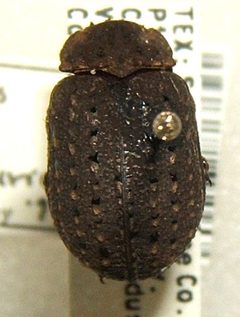
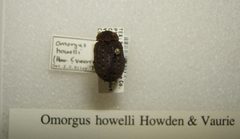
Omorgus howelli is a hide beetle in the Trogidae, native to the southern United States. First described in 1957, it was historically classified under the Trox but was reassigned to Omorgus in 2006 based on morphological and phylogenetic evidence. The occurs in Florida and Texas, with additional records from Mexico and Peru. Like other Trogidae, it is associated with decomposing animal remains.
Pronunciation
How to pronounce Omorgus howelli: /oʊˈmɔːrɡəs haʊˈɛli/
These audio files are automatically generated. While they are not always 100% accurate, they are a good starting point.
Identification
This can be distinguished from other Omorgus by its geographic restriction to the southeastern United States. Formerly placed in Trox, it shares with other Omorgus species the characteristic pronotal and elytral sculpturing typical of the . Identification to species level requires examination of male genitalia and detailed comparison with closely related .
Images
Habitat
Arid and semi-arid environments including sand dunes and sandy soils. Associated with vertebrate carrion and dry animal remains.
Distribution
United States: Florida and Texas. Mexico: San Luis Potosí, Sinaloa, Tamaulipas, Veracruz, Yucatán. Peru.
Diet
Feeds on dry animal remains, hides, and keratinous materials.
Behavior
Nocturnally active. have been observed feeding on dried dog , suggesting opportunistic feeding on protein-rich organic matter.
Ecological Role
Contributes to decomposition of animal remains and nutrient cycling in arid .
Human Relevance
Of minor forensic interest due to association with carrion. No significant economic impact.
Similar Taxa
- Omorgus nodosusOccurs in similar sandy in the southwestern United States; distinguished by distribution and subtle morphological differences in pronotal .
- Omorgus suberosusWidespread Neotropical with overlapping range in Texas; differs in elytral sculpturing pattern.