
Omorgus
Erichson, 1847
Carcass Beetles, Skin Beetles
Species Guides
16- Omorgus asper(Rough Hide Beetle)
- Omorgus carinatus
- Omorgus fuliginosus
- Omorgus howelli(Howell's hide beetle)
- Omorgus inflatus
- Omorgus monachus
- Omorgus nodosus(skin beetle)
- Omorgus punctatus
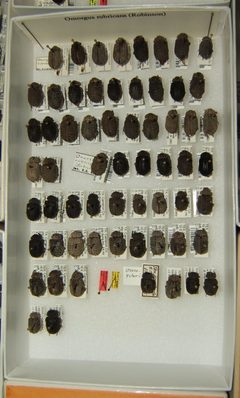
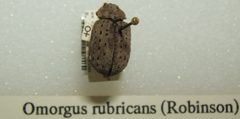
- Omorgus rubricans
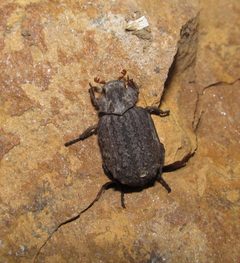
Omorgus is a of skin beetles ( Trogidae) comprising approximately 140 worldwide. These beetles are necrophagous, feeding on dried animal remains and associated with carrion in various . The genus is characterized by its robust, heavily sculptured body form and is classified within the Omorginae. Species range from 9 to 20 mm in length and occur across Afrotropical, Australian, and Madagascan biogeographic regions, with additional representation in the Americas and Asia.
Pronunciation
How to pronounce Omorgus: /oʊˈmɔrɡəs/
These audio files are automatically generated. While they are not always 100% accurate, they are a good starting point.
Images
Habitat
Found in diverse terrestrial including sand dunes, shortgrass prairie, juniper chaparral, and woodland edges. In North America, documented from gypsum-capped mesas, red clay soils, and riparian zones. In China, recorded from Yaoluoping National Nature Reserve in Anhui province. Habitats typically feature exposed substrates where carrion becomes desiccated.
Distribution
Afrotropical, Australian, and Madagascan regions (primary centers of diversity). Additional records from North America (southwestern United States, Mexico), South America, and Asia (China). Approximately 140 worldwide distributed across three subgenera: Omorgus (Omorgus), Omorgus (Afromorgus), and Omorgus (Haroldomorgus).
Seasonality
have been observed active from spring through fall depending on region. In southwestern North America, active during May–June. activity documented, with adults observed on sand at night and attracted to ultraviolet lights.
Diet
Necrophagous. Feeds on dried animal remains including carrion, hides, and desiccated carcasses. Has been observed feeding on dried dog .
Behavior
Nocturnally active. walk on sandy substrates at night and have been observed making tracks in sand. Attracted to ultraviolet lights. Some exhibit gregarious feeding on carrion.
Ecological Role
Necrophagous decomposer contributing to nutrient cycling through consumption of dried animal remains. Facilitates breakdown of carrion in arid and semi-arid environments where desiccation occurs rapidly.
Human Relevance
Minor forensic significance due to association with carrion. Occasionally collected by entomologists using pitfall traps, ultraviolet light traps, and by searching sandy at night.
Similar Taxa
- TroxAlso in Trogidae and similarly necrophagous, but Omorgus distinguished by different body sculpturing and antennal club structure; Omorgus has more pronounced pronotal and elytral in most
- GeotrupesBoth Scarabaeoidea with robust bodies, but Geotrupes ( Geotrupidae) are dung beetles with different ecological habits and morphological features including distinct antennal
More Details
Subgeneric classification
The is divided into three subgenera: Omorgus (Omorgus) with primarily New World and Asian distribution, Omorgus (Afromorgus) predominantly Afrotropical, and Omorgus (Haroldomorgus) with limited representation.
Mitochondrial genome
Complete mitogenome of Omorgus chinensis sequenced: 18,682 circular with 13 protein-coding genes, 22 tRNAs, 2 rRNAs, and control region; AT content 76.22%. Phylogenetic analysis places Omorgus as sister to Geotrupidae within Scarabaeoidea.
Sources and further reading
- BugGuide
- Wikipedia
- GBIF taxonomy match
- iNaturalist taxon
- NCBI Taxonomy
- Catalogue of Life
- Coreidae | Beetles In The Bush | Page 2
- Sapotaceae | Beetles In The Bush
- First collecting trip of the season! | Beetles In The Bush
- The first complete mitogenome of skin beetles Omorgus chinensis (Coleoptera: Trogidae) with the phylogenetic implications.