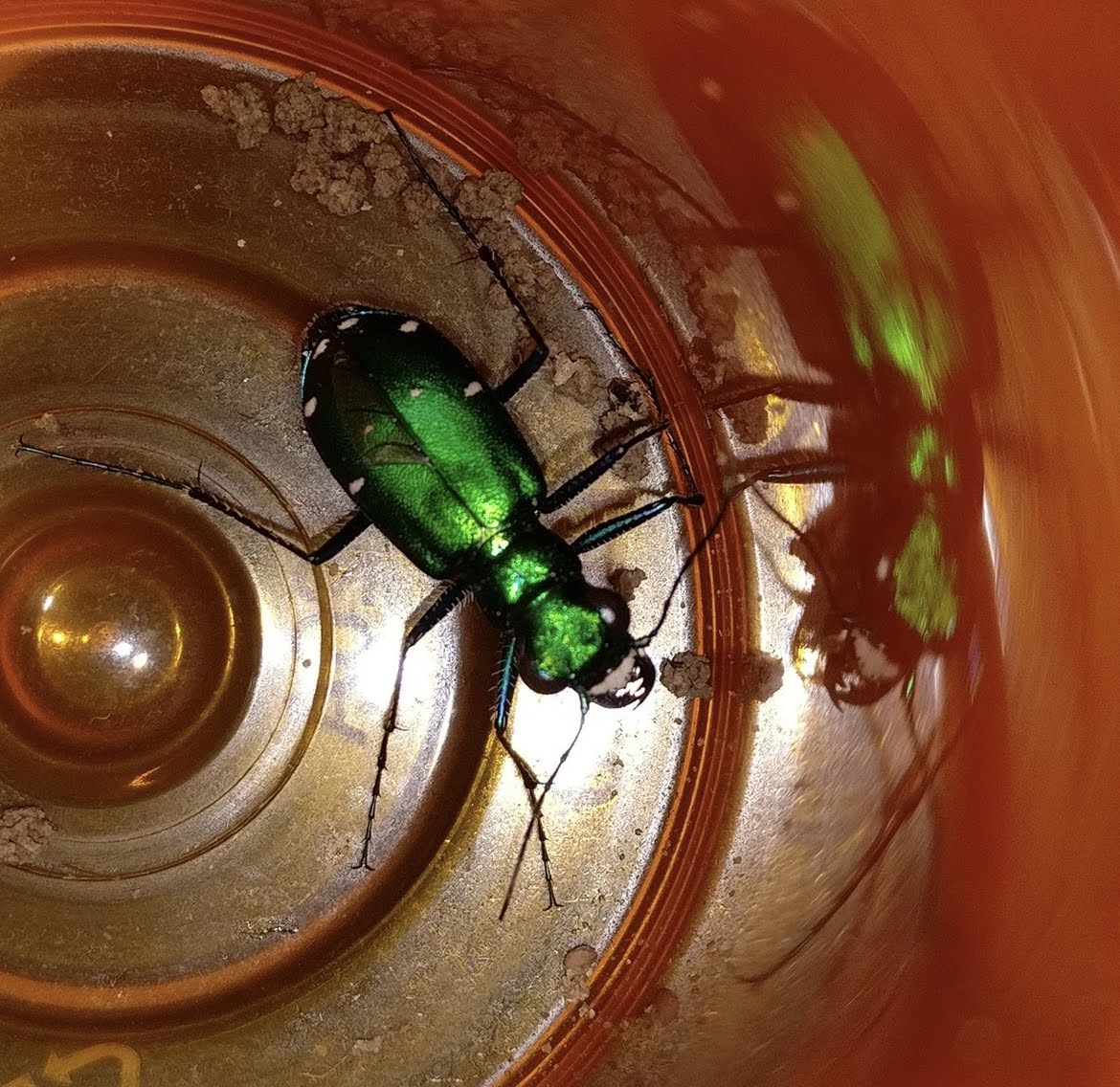
Glyptina cyanipennis is a species of flea beetle in the family Chrysomelidae, first described by Crotch in 1873. It is found in North America, with confirmed records from Ontario, Canada. As a member of the subfamily Alticinae, it possesses the enlarged hind femora characteristic of flea beetles, which enable jumping locomotion. The species epithet 'cyanipennis' refers to blue-colored wings.
Glyptina nivalis is a species of flea beetle in the family Chrysomelidae, first described by George Henry Horn in 1889. The species is distributed across Central America and North America. As a member of the flea beetle subfamily Alticinae (tribe Alticini), it possesses enlarged hind femora adapted for jumping.
Glyptina spuria is a flea beetle in the family Chrysomelidae, first described by LeConte in 1859. It belongs to a genus of small leaf beetles characterized by enlarged hind femora adapted for jumping. The species has been recorded from central and eastern Canada.
Glyptina texana is a species of flea beetle in the family Chrysomelidae. It is known from North America. As a member of the subfamily Alticinae, it possesses the enlarged hind femora characteristic of flea beetles, which enable jumping locomotion.
Glyptoscelimorpha marmorata is a species of false jewel beetle in the family Schizopodidae, described by Horn in 1893. It belongs to the superfamily Buprestoidea, which includes jewel beetles and related families. The species is documented from North America, though detailed biological information remains limited.
false jewel beetle
Glyptoscelimorpha viridis is a species of false jewel beetle in the family Schizopodidae. The species was described by Chamberlin in 1931 and is found in North America. Schizopodidae is a small family of beetles commonly referred to as false jewel beetles, distinct from the true jewel beetles (Buprestidae). The specific epithet "viridis" refers to the green coloration typical of the species.
Glyptoscelis alternata is a species of leaf beetle in the family Chrysomelidae, described by Crotch in 1873. The species is native to the western United States. As a member of the genus Glyptoscelis, it belongs to a group of leaf beetles whose members are generally associated with vegetation.
Gnaphalodes is a genus of longhorn beetles in the family Cerambycidae, established by Thomson in 1861. It is monotypic, containing only the species Gnaphalodes trachyderoides. The genus belongs to the tribe Bothriospilini within the subfamily Cerambycinae.
clown beetle
Gnathoncus barbatus is a species of clown beetle in the family Histeridae, first described by Bousquet and Laplante in 1999. It is known from North America, with records from Canada and the northern United States. Like other histerid beetles, it is likely associated with decomposing organic matter, though specific ecological details remain poorly documented.
Gnathoweisea texana is a species of lady beetle (Coccinellidae) described by Gordon in 1985. It is native to North America, with the specific epithet suggesting a connection to Texas. Like other members of its family, it is likely a small, predatory beetle, though detailed ecological studies appear limited.
Gnatocerus guatemalensis is a species of darkling beetle in the family Tenebrionidae. The genus Gnatocerus is known for species with enlarged mandibles in males, which function as weapons in male-male combat for mating opportunities. This species is native to Mexico and belongs to a genus closely related to the well-studied flour beetle Tribolium.
Gnostus is a monotypic genus of spider beetles in the family Ptinidae, containing a single described species, G. floridanus. The genus was established by Westwood in 1855. As a member of Ptinidae, it belongs to a group of beetles commonly associated with stored products and dry organic materials.
Gnostus floridanus is a spider beetle (family Ptinidae) described by Blatchley in 1930. The species is known from new geographic records extending its previously documented range. Behavioral observations have been published in primary literature, though detailed ecological data remain limited.
Gondwanocrypticus pictus is a species of darkling beetle (family Tenebrionidae) described by Gebien in 1928. The genus name Gondwanocrypticus suggests a Gondwanan distribution pattern, though specific details about this species' biology, ecology, and distribution remain poorly documented in available literature. The species epithet 'pictus' (Latin for 'painted') likely refers to distinctive coloration or markings.
fungus weevils
Goniocloeus is a genus of fungus weevils in the beetle family Anthribidae, established by Karl Jordan in 1904. The genus contains at least 40 described species. Members of this genus are classified within the weevil superfamily Curculionoidea, though fungus weevils in Anthribidae are distinguished from true weevils (Curculionidae) by their less elongated rostrum. The genus has been documented in at least 107 iNaturalist observations.
fungus weevil
Goniocloeus bimaculatus is a species of fungus weevil in the beetle family Anthribidae. It is known to occur in North America. The species was described by A.G. Olivier in 1800. Members of the genus Goniocloeus are associated with fungal associations, consistent with the common name "fungus weevil" applied to this group.
Eucalyptus Weevils, Eucalyptus Snout Beetles, Eucalyptus Snout Weevils
Gonipterus is a genus of weevils in the family Curculionidae, comprising approximately 20 described species native primarily to Australia. These insects are obligate plant feeders, with many species exhibiting high host specificity. Several species, notably Gonipterus platensis, G. pulverulentus, and G. gibberus, have become significant pests of Eucalyptus plantations globally, having spread to regions where these trees have been introduced. Taxonomic confusion has historically plagued the genus, with DNA studies in 2012 clarifying that populations previously identified as G. scutellatus in New Zealand, North America, western Europe, Africa, and eastern Europe actually represent distinct species. The genus has substantial economic importance in forestry, driving research into biological control agents such as the egg parasitoid Anaphes nitens.
fungus weevil
Gonotropis dorsalis is a species of fungus weevil in the family Anthribidae, characterized by an elongated rostrum typical of weevils. This beetle is associated with fungal substrates, reflecting the ecological habits common to members of its family. It is found in parts of northern Europe including Latvia, Norway, and Sweden.
Grammoptera exigua is a small flower longhorn beetle (Cerambycidae: Lepturinae) first described by Newman in 1841. It belongs to a genus of beetles commonly found on flowers, where adults feed on pollen. The species occurs in eastern North America, with records from Ontario, Québec, and Manitoba in Canada. Like other Grammoptera species, it is associated with woody vegetation and is most often encountered on freshly cut logs or flowering plants.
predacious diving beetle
Graphoderus perplexus is a predaceous diving beetle in the family Dytiscidae, described by Sharp in 1882. It is distributed across the Holarctic region, occurring in both North America and the Palearctic. Like other members of its genus, it is an aquatic predator inhabiting freshwater environments. The species is part of the tribe Aciliini, which includes other medium to large diving beetles.
Graphops cavani is a species of leaf beetle in the family Chrysomelidae. The genus Graphops contains species commonly known as flea beetles or leaf beetles, many of which are associated with specific host plants. Very little published information exists specifically for G. cavani, with only two observations recorded on iNaturalist as of the source date. The species appears to be rarely encountered or underreported.
Graphops exilis is a species of leaf beetle in the family Chrysomelidae, described by Blake in 1955. The genus Graphops belongs to the diverse leaf beetle family, whose members are primarily associated with feeding on plant foliage. This species is part of the North American fauna, though specific details about its biology remain limited.
Graphops simplex is a species of leaf beetle in the family Chrysomelidae, described by John Lawrence LeConte in 1884. It is native to North America. As a member of the leaf beetle family, it likely feeds on plant foliage, though specific host plants have not been documented in the available sources.
Net-winged beetle
A species of net-winged beetle in the family Lycidae, characterized by soft elytra with distinctive net-like venation. The thoracic region shows notable structural features that contribute to its specific epithet. Adults are active during warmer months and are associated with forested habitats.
bark-gnawing beetles
Grynocharis is a genus of bark-gnawing beetles in the family Lophocateridae, established by C.G. Thomson in 1859. The genus contains at least four described species distributed across Europe and North America. These beetles are associated with dead wood habitats. The family placement has been subject to taxonomic revision, with some sources historically placing Grynocharis in Trogossitidae.
marsh weevils
Grypus is a genus of marsh weevils (family Brachyceridae) comprising approximately 10 described species. These beetles are associated with wetland and marsh habitats. The genus was established by Germar in 1817. Species in this genus include G. equiseti, G. brassicae, and G. brunnirostris, among others.
Gyascutus dianae is a species of metallic wood-boring beetle in the family Buprestidae. It occurs in Central America and North America. As a member of the genus Gyascutus, it belongs to a group of buprestid beetles known for their large size and often distinctive waxy bloom covering the elytra. The species was originally described as Hippomelas dianae by Helfer in 1954.
Gymnetina borealis is a species of flower chafer beetle (Cetoniinae) described from the southwestern United States. The species was formally described by Ratcliffe and Warner in 2011. As a member of the Gymnetini tribe, it belongs to a group of scarab beetles often associated with flowers and fruit. Very little biological information has been published for this species specifically.
Gymnochthebius fossatus is a species of minute moss beetle in the family Hydraenidae, first described by LeConte in 1855. It is one of the smallest beetles in North America, with adults typically measuring less than 2 mm in length. The species has a broad geographic distribution spanning the Caribbean Sea, Central America, North America, and South America. As a member of Hydraenidae, it belongs to a family of beetles commonly known as moss beetles or minute moss beetles, which are primarily associated with moist microhabitats.
whirligig beetles, gyrinine beetles
Gyrininae is the largest subfamily of Gyrinidae, containing over 740 described extant species. These beetles are commonly known as whirligig beetles for their characteristic circling behavior on water surfaces. The subfamily comprises three tribes: Dineutini, Gyrinini, and Orectochilini, with genera distributed across all major biogeographic regions. Members occupy diverse freshwater habitats from lentic to lotic systems.
whirligig beetle
Gyrinus dichrous is a species of whirligig beetle in the family Gyrinidae. It is found in North America, with distribution records from Canada (Nova Scotia, Ontario, Québec) and the United States. Whirligig beetles in the genus Gyrinus are generally smaller than those in the related genus Dineutus, with Gyrinus species typically measuring 5–8 mm in length compared to 10–12 mm for Dineutus. Members of this genus are distinguished by their visible scutellum, unlike Dineutus where the scutellum is concealed.
whirligig beetle
Gyrinus marginellus is a species of whirligig beetle in the family Gyrinidae, described by Fall in 1922. It occurs in North America, with records from Canada (Québec) and the United States. Like other members of the genus Gyrinus, it is an aquatic beetle that lives on the water surface. The species is part of a taxonomically challenging group where identification often requires examination of ventral characters.
whirligig beetle
Gyrinus plicifer is a species of whirligig beetle in the family Gyrinidae. It occurs in North America, with records from British Columbia, Canada. Like other members of the genus, it inhabits the surface of freshwater bodies where it forms aggregations. The species was described by LeConte in 1852.
whirligig beetle
Gyrinus pugionis is a species of whirligig beetle in the family Gyrinidae, found in North America. Like other members of the genus, it inhabits the surface of freshwater bodies where it exhibits characteristic erratic, circular swimming patterns. The species was described by Fall in 1922. Specific details regarding its biology and ecology remain limited in published literature.
Gulf Beach Tiger Beetle
Habroscelimorpha dorsalis venusta, commonly known as the Gulf Beach Tiger Beetle, is a subspecies of tiger beetle in the family Carabidae (subfamily Cicindelinae). It is one of several subspecies within the Habroscelimorpha dorsalis species complex. Tiger beetles in this genus are typically associated with sandy coastal habitats. The specific epithet 'venusta' suggests an attractive or elegant appearance, consistent with the often colorful and patterned nature of tiger beetles in this group.
Hadrobregmus quadrulus is a small beetle species in the family Ptinidae, first described by LeConte in 1859 from specimens collected in California. It belongs to a group commonly known as death-watch and spider beetles, many of which are associated with wood or stored products. The species is documented from western North America, with records from British Columbia and California.
Hadromorphus is a genus of click beetles (family Elateridae) established by Motschulsky in 1859. The genus belongs to the diverse elaterid fauna, characterized by the family-defining prosternal process that enables the clicking mechanism for righting when overturned. Species within this genus are documented primarily from the Palearctic region, with records from Europe and Asia. The genus contains multiple described species, though comprehensive taxonomic revision and ecological study remain limited in the published literature.
Haematochiton is a genus of pleasing fungus beetles in the family Erotylidae, established by Gorham in 1888. The genus contains at least three described species: H. bisculptum, H. carbonarius, and H. elateroides. These beetles belong to a family commonly associated with fungal associations. Knowledge of this genus is limited, with few observations documented.
pleasing fungus beetle
Haematochiton carbonarius is a species of pleasing fungus beetle in the family Erotylidae. The species is known from Central America and North America. Beyond its taxonomic placement and geographic distribution, detailed information about its biology remains limited in available sources.
clown beetle
Haeterius californicus is a species of clown beetle in the family Histeridae, first described by Horn in 1870. It is a member of the subfamily Haeteriinae, a group of histerid beetles commonly known as clown beetles. The species is found in North America, with confirmed records from California, USA. Like other members of its genus, it is likely associated with social insects, though specific ecological details remain poorly documented.
clown beetle
Haeterius wagneri is a species of clown beetle in the family Histeridae, described by Ross in 1938. It belongs to the subfamily Haeteriinae, a group commonly known as clown beetles. The species is known from North America, with records from California, USA.
Haeterius zelus is a species of clown beetle in the family Histeridae. It was described by Fall in 1917. The species is known from North America, with records from California, USA. Like other members of the genus Haeterius, it is likely associated with social insects, though specific ecological details for this species remain poorly documented.
Haida is a genus of rove beetles (family Staphylinidae) described by Keen in 1897. It belongs to the subfamily Omaliinae and tribe Coryphiini. The genus is rarely encountered, with limited observational records.
clown beetle
Halacritus maritimus is a species of clown beetle in the family Histeridae, first described by John Lawrence LeConte in 1851. The species is distributed in North America, with records from California and potentially other regions of the United States. As a member of the Histeridae, it belongs to a family of beetles commonly known as clown beetles or hister beetles, characterized by their compact bodies and clubbed antennae.
crawling water beetles
Haliplus is a genus of small crawling water beetles comprising at least 180 described species. Members range from 1.75 to 5 mm in length and inhabit freshwater margins worldwide except Antarctica. The genus has been subject to recent taxonomic revision, including synonymization of H. wehnckei with H. sibiricus based on morphometric and genetic evidence.
Haliplus apicalis is a species of water beetle in the family Haliplidae, first described by Thomson in 1868. It is distributed across the British Isles and northwestern Europe, with records also indicating presence in North America. The species belongs to a genus of small aquatic beetles commonly known as crawling water beetles.
Haliplus cylindricus is a species of crawling water beetle in the family Haliplidae, described by Roberts in 1913. The species belongs to a genus of small aquatic beetles commonly found in freshwater habitats. Very few observations of this species have been documented, with only two records in iNaturalist as of the available data. Like other haliplids, it is presumed to inhabit shallow, vegetated waters where it feeds on algae and small aquatic organisms.
Haliplus leopardus is a crawling water beetle in the family Haliplidae, first described by Roberts in 1913. The species is recorded from eastern North America, with confirmed observations in New Brunswick and Nova Scotia, Canada. As a member of Haliplidae, it inhabits freshwater environments. Very few observations of this species have been documented, with only three records in iNaturalist as of the knowledge cutoff.
Disjunct Crawling Water Beetle
Haliplus nitens is a species of crawling water beetle in the family Haliplidae, first described by LeConte in 1850. It is commonly known as the Disjunct Crawling Water Beetle. The species is found in North America, with distribution records from Canada including Ontario and the Northwest Territories. As a member of the Haliplidae family, it is adapted to aquatic habitats, though specific ecological details for this species remain limited in available sources.
Haliplus parvulus is a species of crawling water beetle in the family Haliplidae. Members of this genus are small, semi-aquatic beetles associated with freshwater habitats. Very few observations of this species exist in public databases.