
Gonipterus
Schönherr, 1833
Eucalyptus Weevils, Eucalyptus Snout Beetles, Eucalyptus Snout Weevils
Species Guides
1- Gonipterus scutellatus(eucalyptus snout beetle)
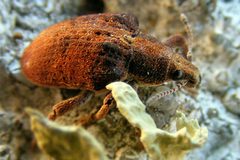
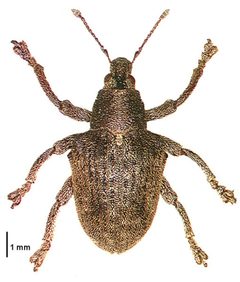
Gonipterus is a of weevils in the Curculionidae, comprising approximately 20 described native primarily to Australia. These insects are obligate plant feeders, with many species exhibiting high specificity. Several species, notably Gonipterus platensis, G. pulverulentus, and G. gibberus, have become significant pests of Eucalyptus plantations globally, having spread to regions where these trees have been introduced. Taxonomic confusion has historically plagued the genus, with studies in 2012 clarifying that previously identified as G. scutellatus in New Zealand, North America, western Europe, Africa, and eastern Europe actually represent distinct species. The genus has substantial economic importance in forestry, driving research into agents such as the Anaphes nitens.

Pronunciation
How to pronounce Gonipterus: //ɡoʊˈnɪptərəs//
These audio files are automatically generated. While they are not always 100% accurate, they are a good starting point.
Identification
Accurate -level identification within Gonipterus requires molecular analysis, as morphological distinctions are subtle. Historical misidentifications were common: formerly called G. scutellatus in New Zealand, North America, and western Europe are now recognized as G. platensis, while African and eastern European populations represent an undescribed species. South American populations previously identified as G. gibberus are now classified as G. pulverulentus. possess the characteristic elongated snout (rostrum) typical of Curculionidae. Larvae feed on Eucalyptus foliage and can be distinguished by their feeding damage patterns on leaves.
Images
Habitat
Native to Australian Eucalyptus forests and woodlands. Introduced occupy Eucalyptus plantations and naturalized Eucalyptus stands in Africa, Europe, North America, South America, and parts of Asia. The is strictly associated with Eucalyptus ; individual show varying degrees of host specificity, with some restricted to single Eucalyptus species while others utilize multiple host species.
Distribution
Native: Australia (widespread across mainland states and Tasmania). Introduced: New Zealand, North America (USA, California), South America (Argentina, Brazil, Chile, Uruguay), Africa (Kenya, Lesotho, Madagascar, Malawi, Mauritius, Mozambique, South Africa, Swaziland, Uganda, Zimbabwe, St. Helena), Europe (France, Italy, Portugal, Spain, including Corsica and Canary Islands), and Asia (China, India). Specific distributions vary: G. platensis occurs in New Zealand, North America, and western Europe; an undescribed species occurs in Africa and eastern Europe; G. pulverulentus occurs in South America.
Diet
All are herbivorous, feeding exclusively on Eucalyptus. Larvae consume leaves, causing characteristic notching damage to foliage. feed on leaves and young shoots. Many species show specificity to particular Eucalyptus species, though some feed on multiple Eucalyptus hosts.
Host Associations
- Eucalyptus - primary plantObligate association; all Gonipterus feed exclusively on Eucalyptus species
- Eucalyptus globulus - plantPrimary for several introduced pest , particularly in Europe
- Eucalyptus grandis - plantSupports complete of G. platensis; longer larval duration observed compared to other
- Eucalyptus urophylla - plantSupports complete of G. platensis; longer pre-pupal and pupal stages observed
- Eucalyptus × urograndis - plantHybrid ; lower larval viability and survival for G. platensis compared to parental
- Anaphes nitens - agent; specific used against Gonipterus in multiple countries
- Anaphes inexpectatus - agent; complementary to A. nitens in some regions
Life Cycle
Complete with four stages: , larva, pupa, and . For G. platensis: embryonic period averages 9.10 days. Larval development includes multiple instars; duration varies by (longer on E. grandis). Pre-pupal and pupal stages also vary by host (longer on E. urophylla). Total duration approximately 86 days on E. grandis under natural conditions. Larvae feed externally on leaves before pupating in soil or leaf litter. Adults emerge and feed on host foliage before .
Behavior
Females deposit in clusters () on Eucalyptus foliage. Larvae feed gregariously on leaves, causing severe defoliation in conditions. are capable of and disperse to locate suitable trees. When disturbed, adults may drop from foliage or use their rostrum to grip substrate.
Ecological Role
Native function as herbivores in Australian Eucalyptus , contributing to nutrient cycling and serving as prey for native and . In introduced ranges, they become significant pests, causing defoliation, reduced tree growth, and economic losses in plantation forestry. Their presence has driven the introduction and establishment of agents, particularly parasitoids in the Anaphes, which can achieve rates of 80-100% and contribute to .
Human Relevance
Major economic pest of Eucalyptus plantations worldwide, causing defoliation, growth reduction, and tree mortality in severe . Management relies heavily on using Anaphes nitens and A. inexpectatus, which have been introduced to multiple countries. Taxonomic confusion has complicated management efforts, requiring -based identification for accurate determination. Research continues on susceptibility, cold storage of for rearing, and strategies.
Similar Taxa
- Gonipterus scutellatusHistorically confused with G. platensis and other ; studies confirmed that most pest previously identified as G. scutellatus are actually distinct species
- Gonipterus platensisOften misidentified as G. scutellatus; distinguished by molecular markers and subtle morphological differences
- Gonipterus pulverulentusFormerly misidentified as G. gibberus in South America; clarified through taxonomic revision
- Gonipterus gibberusDistinct from G. pulverulentus, which was previously confused with it; true G. gibberus distribution differs
Sources and further reading
- BugGuide
- Wikipedia
- GBIF taxonomy match
- iNaturalist taxon
- NCBI Taxonomy
- Catalogue of Life
- Publications | Entomology Research Museum
- Gonipterus scutellatus . [Distribution map].
- Gonipterus scutellatus . [Distribution map].
- Gonipterus gibberus . [Distribution map].
- Gonipterus scutellatus . [Distribution map].
- Host susceptibility to Gonipterus platensis (Coleoptera: Curculionidae) of Eucalyptus species
- Table 4: Reproductive parameters of Gonipterus platensis on Eucalyptus hosts .
- Table 1: Duration, viability of larval and pupal stages of Gonipterus platensis on Eucalyptus hosts .
- Table 2: Lifespan and longevity of Gonipterus platensis on Eucalyptus hosts .
- Table 3: Pre-oviposition and oviposition periods of Gonipterus platensis on Eucalyptus hosts .
- Figure 1: Larval stage and larva to adult period of Gonipterus platensis on Eucalyptus hosts.
- CICLO DE VIDA DE Gonipterus platensis (MARELLI, 1926) (COLEOPTERA: CURCULIONIDAE) EN TRES ESPECIES COMERCIALES DE Eucalyptus PARA COLOMBIA LIFE CYCLE OF Gonipterus platensis (MARELLI, 1926) (COLEOPTERA: CURCULIONIDAE) IN THREE COMMERCIAL SPECIES OF Eucalyptus IN COLOMBIA
- Table 1: Factors, distribution and link function used in the statistical analyses of each of the response variables measured for the Gonipterus platensis egg storage experiments.
- PRIMER REGISTRO DE Anaphes nitens (Hymenoptera: Mymaridae) PARASITOIDE DE Gonipterus spp. (Coleoptera: Curculionidae) EN ECUADOR
- In search for Gonipterus platensis (Marelli, 1926) (Coleoptera: Curculionidae) egg parasitoids in Antioquia, Colombia
- Patasson nitens, parasite spécifique de Gonipterus scutellatus en France1
- Cold storage of Gonipterus platensis (Coleoptera: Curculionidae) eggs for Anaphes nitens (Hymenoptera: Mymaridae) rearing.
- Observations on iNaturalist reveal the establishment of non-native Eucalyptus weevil Gonipterus platensis (Coleoptera: Curculionidae) in Tamil Nadu, India.
- Inside the Belly of the Beast: Exploring the Gut Bacterial Diversity of Gonipterus sp. n. 2.