
Gonipterus scutellatus
Gyllenhal, 1833
eucalyptus snout beetle, eucalyptus weevil, gum tree weevil
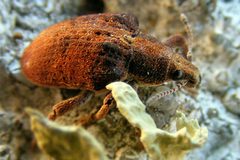
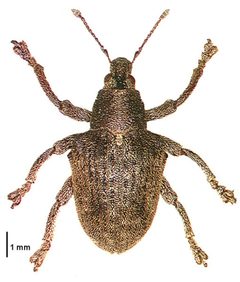
Gonipterus scutellatus is a weevil to Australia that feeds and breeds exclusively on Eucalyptus trees. It is greyish-brown with a light-colored transverse band and measures approximately 13 mm in length. The species is frequently confused with closely related weevils—G. gibberus, G. platensis, and G. pulverulentus—which share and were historically misidentified as G. scutellatus. outside Australia previously attributed to this species have been reidentified through analysis: those in New Zealand, North America, and western Europe are G. platensis, while African and eastern European populations represent an undescribed species.

Pronunciation
How to pronounce Gonipterus scutellatus: /ɡəʊˈnɪptərəs skuːˈtɛlətəs/
These audio files are automatically generated. While they are not always 100% accurate, they are a good starting point.
Identification
Externally indistinguishable from Gonipterus gibberus, G. platensis, and G. pulverulentus; definitive identification requires examination of genital or molecular analysis. The 2012 -based revision clarified that true G. scutellatus is restricted to Australia, with elsewhere belonging to other in the complex.
Images
Appearance
Greyish-brown body with a distinct light-colored transverse band. Approximately 13 mm in length. Not readily distinguishable from closely related Gonipterus based on external alone.
Habitat
Associated with Eucalyptus forests and plantations. Occupies the where Eucalyptus trees occur.
Distribution
to Australia (New South Wales, Queensland, South Australia, Tasmania, Victoria, Western Australia). Not established outside Australia; historical records from other regions refer to misidentified .
Diet
Feeds exclusively on Eucalyptus . Both and larvae consume Eucalyptus foliage.
Host Associations
- Eucalyptus - exclusive Only known ; both feeding and breeding occur on Eucalyptus trees
Life Cycle
Complete with , larval, pupal, and stages. Eggs are laid in capsules on Eucalyptus foliage. Larvae feed on leaves before pupating. Developmental requirements have been studied in laboratory conditions, but specific details for wild remain limited.
Ecological Role
Herbivore and defoliator of Eucalyptus in its native range. Natural enemy in Australia regulate its abundance, limiting economic impact. Serves as for the Anaphes nitens, which has been introduced to other regions for of related Gonipterus .
Human Relevance
Of minimal economic significance in Australia due to presence of natural enemies. Frequently confused with pest (G. platensis, undescribed African species) that cause substantial damage to Eucalyptus plantations in Africa, South America, North America, Europe, and New Zealand. Much pre-2012 literature erroneously attributes pest to G. scutellatus.
Similar Taxa
- Gonipterus platensisHistorically confused with G. scutellatus; pest in New Zealand, North America, and western Europe. Distinguished by genital and .
- Gonipterus pulverulentusHistorically confused with G. scutellatus; pest in eastern South America. Distinguished by genital and .
- Gonipterus gibberusClosely related Australian sharing and external ; distinguished by genital morphology.
- Undescribed Gonipterus sp.African and eastern European represent a distinct, undescribed species previously misidentified as G. scutellatus.
Misconceptions
The most significant misconception is that G. scutellatus is a major worldwide pest of Eucalyptus. This error stems from historical taxonomic confusion: pre-2012 literature, and much subsequent work, attributes pest damage and to G. scutellatus when the actual pests are G. platensis (New Zealand, Americas, western Europe), G. pulverulentus (eastern South America), or an undescribed species (Africa, eastern Europe). True G. scutellatus is to Australia and of limited economic concern there.
More Details
Taxonomic Revision
A 2012 molecular phylogenetic study using COI, EF-1α, and 18S rDNA sequences resolved the G. scutellatus complex into 10 cryptic , only four of which were formally described at that time. This revision fundamentally altered understanding of which species occur where and which are responsible for damage.
Biological Control Context
Anaphes nitens, a mymarid , was introduced from Australia to multiple countries for control of what was then called G. scutellatus. The parasitoid has established on the Gonipterus in these regions, though effectiveness varies. The parasitoid's -specificity to the true G. scutellatus complex has implications for control programs.
Sources and further reading
- BugGuide
- Wikipedia
- GBIF taxonomy match
- iNaturalist taxon
- NCBI Taxonomy
- Catalogue of Life
- Bug Eric: Mate Guarding and Oviposition in the White-spotted Sawyer, Monochamus scutellatus (Coleoptera: Cerambycidae)
- Ascalaphidae | Beetles In The Bush
- August | 2022 | Beetles In The Bush
- entomology | Beetles In The Bush | Page 5
- Gonipterus scutellatus . [Distribution map].
- Gonipterus scutellatus . [Distribution map].
- Gonipterus scutellatus . [Distribution map].
- Eucalypt hybrid susceptibility to Gonipterus scutellatus (Coleoptera: Curculionidae)
- Protein Profiles of Gonipterus Scutellatus (Coleoptera: Curculionidae) Development Stages
- The Biological Control of Gonipterus scutellatus Gyll. (Col. Curculionidae) in Mauritius
- Patasson nitens, parasite spécifique de Gonipterus scutellatus en France1
- Parasitism of the Eucalyptus weevil, Gonipterus scutellatus Gyllenhal, by the egg parasitoid, Anaphes nitens Girault, in Eucalyptus globulus plantations in southwestern Australia
- The host range of the Eucalyptus Weevil, Gonipterus “scutellatus” Gyllenhal (Coleoptera: Curculionidae), in South Africa
- Host finding and host discrimination ability in Anaphes nitens Girault, an egg parasitoid of the Eucalyptus snout-beetle Gonipterus scutellatus Gyllenhal
- Winter and spring ecology of Anaphes nitens, a solitary egg-parasitoid of the Eucalyptus snout-beetle Gonipterus scutellatus
- Thermal requirements and phenology of the Eucalyptus snout beetle Gonipterus scutellatus Gyllenhal
- Phenology of Eucalyptus weevil, Gonipterus scutellatus Gyllenhal (Coleoptera: Curculionidae), and chrysomelid beetles in Eucalyptus globulus plantations in south‐western Australia
- Egg load and adaptive superparasitism in Anaphes nitens, an egg parasitoid of the Eucalyptus snout‐beetle Gonipterus scutellatus
- Identification and molecular phylogenetics of the cryptic species of theGonipterus scutellatuscomplex (Coleoptera: Curculionidae: Gonipterini)