
Haliplus
Latreille, 1802
crawling water beetles
Species Guides
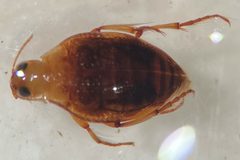
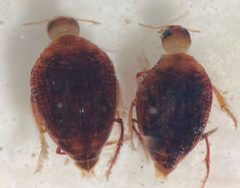
28Haliplus is a of small crawling water beetles comprising at least 180 described . Members range from 1.75 to 5 mm in length and inhabit freshwater margins worldwide except Antarctica. The genus has been subject to recent taxonomic revision, including synonymization of H. wehnckei with H. sibiricus based on morphometric and genetic evidence.
Pronunciation
How to pronounce Haliplus: /ˈhæ.lɪˌplʊs/
These audio files are automatically generated. While they are not always 100% accurate, they are a good starting point.
Identification
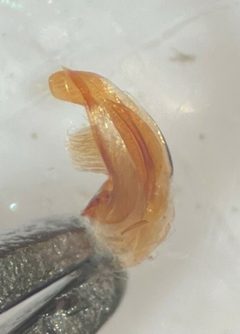
Distinguished from other haliplid by combination of small size, crawling habit, and preference for vegetated pond and lake margins. Specific identification requires examination of male genitalia; paramere shape is taxonomically informative. -level identification is complicated by geographic variation and potential clinal .
Images
Habitat
Edges of ponds, lakes, and streams with abundant and aquatic vegetation. Inhabits shallow, vegetation-rich wetlands where substrates support algal growth.
Distribution
Worldwide distribution except Antarctica. Documented from the Palearctic (including Europe), Afrotropical region, Near East, Nearctic, and North Africa. GBIF records indicate presence in Colombia (Antioquia, Arauca, Atlántico, Cesar, Chocó, Magdalena), Denmark, Norway, and Sweden.
Seasonality
Activity patterns vary by . At least one species (H. basinotatus) shows cycle with breeding in late summer, larval growth through autumn and winter, and new adult the following summer.
Life Cycle
One studied (H. basinotatus) has : laid in late summer, larvae hatch in autumn and develop over 8 months, emerge the following summer. Larval development occurs through winter, requiring persistent aquatic .
Behavior
of some disperse to surrounding water bodies during summer and congregate in breeding-suitable ponds in autumn. Primarily among vegetation rather than active swimmers.
Ecological Role
Haliplidae contributes to bioturbation in wetland and serves as prey within . Specific ecosystem functions at level not separately documented.
Human Relevance
Some are of conservation concern; H. basinotatus is listed on the Japanese Red List and requires connectivity and winter aquatic habitat preservation. Taxonomic studies on Haliplus have clarified species boundaries and geographic variation.
Similar Taxa
- PeltodytesAlso in Haliplidae; distinguished by different body proportions and preferences
- BrychiusAnother haliplid ; differs in and ecological requirements
More Details
Taxonomic complexity
Recent work on H. sibiricus and H. wehnckei demonstrates that paramere shape variation can represent clinal geographic variation rather than -level divergence, with morphologically intermediate specimens occurring in contact zones. This has implications for species identification across the .
Conservation needs
For threatened like H. basinotatus, conservation requires maintaining aquatic through winter, managing vegetation to support charophyte , and ensuring habitat connectivity among pond networks to allow for seasonal .
Sources and further reading
- BugGuide
- Wikipedia
- GBIF taxonomy match
- iNaturalist taxon
- NCBI Taxonomy
- Catalogue of Life
- Taxonomy of the crawling water beetle Haliplus zacharenkoi, with notes on its ecology, phenology, and distribution (Coleoptera: Haliplidae)
- First record and diagnosis of a male Haliplus (Liaphlus) madagascariensis Vondel & Bergsten and additional faunistic records of African Haliplidae (Coleoptera: Adephaga)
- Morphometric and genetic analysis shows that Haliplus wehnckei is a junior synonym of H. sibiricus (Coleoptera: Haliplidae)
- Life cycle of the endangered crawling water beetle Haliplus basinotatus (Coleoptera: Haliplidae) in an irrigation pond and implications for its conservation