
Peltodytes
Régimbart, 1879
Species Guides
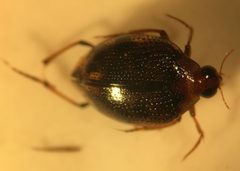
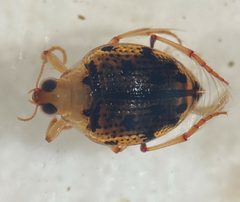
17Peltodytes is a of small water beetles in the Haliplidae, first described by Régimbart in 1879. The genus contains approximately 35 described distributed across the Nearctic, Europe, the Near East, and North Africa. Members of this genus are aquatic and closely related to the genus Haliplus, from which they are distinguished by specific pronotal markings.
Pronunciation
How to pronounce Peltodytes: /ˌpɛl.toʊˈdaɪtiːz/
These audio files are automatically generated. While they are not always 100% accurate, they are a good starting point.
Identification
Peltodytes can be distinguished from the similar Haliplus by the presence of a pair of spots on the margin of the pronotum. This character is consistent across in the genus and serves as the primary diagnostic feature for identification.
Images
Habitat
Aquatic environments including freshwater .
Distribution
Native to the Nearctic, Europe, the Near East, and North Africa. Specific distribution records include Denmark, Norway, Sweden, and Vermont in the United States.
Similar Taxa
- HaliplusSimilar in overall and shared Haliplidae; distinguished by the absence of the pair of spots on the margin of the pronotum that characterizes Peltodytes.
More Details
Taxonomic Status
Some sources (Catalogue of Life) list Peltodytes as a subgenus, while others (GBIF, NCBI, iNaturalist) recognize it as a full . The authorship is consistently cited as Régimbart, 1879.
Species Diversity
The contains at least 35 described , with significant diversity in North America and the Palearctic region. Several species were described by Young in 1961, indicating a period of taxonomic revision in the mid-20th century.