
Haliplidae
Aubé, 1836
Crawling Water Beetles, haliplids
Genus Guides
3- Brychius(crawling water beetles)
- Haliplus(crawling water beetles)
- Peltodytes
is a of small aquatic beetles comprising approximately 200 in five , representing the sole extant member of the superfamily Haliploidea. These beetles are characterized by their distinctive swimming using alternating leg movements, which renders them relatively clumsy swimmers compared to other aquatic beetles. Consequently, they predominantly move by crawling along substrates rather than swimming. The family exhibits a distribution in freshwater worldwide.
Pronunciation
How to pronounce Haliplidae: /həˈlɪplɪdiː/
These audio files are automatically generated. While they are not always 100% accurate, they are a good starting point.
Identification
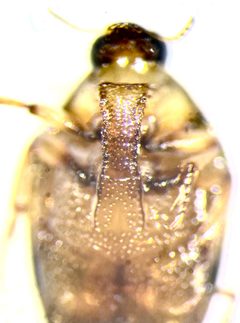
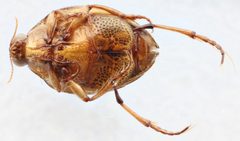
can be distinguished from other aquatic by the combination of enlarged, immobile hind leg coxal plates that serve as air storage organs and the characteristic alternating leg motion during swimming. Unlike Dytiscidae (predaceous diving beetles) and Hydrophilidae (water scavenger beetles), which swim with simultaneous leg strokes and possess flattened, paddle-like hind legs, haliplids have slender legs with swimming hairs but no flippers. The rolled (not folded) hindwing apices and absence of -cleaning apparatus on the foreleg tibiae further separate them from other Adephaga. Larvae are recognized by their specialized mouthparts with mandibular channels for fluid extraction and either long filamentous gills or short microtracheal extensions on the thoracic and abdominal tergites.
Images
Habitat
Inhabits freshwater environments including small ponds, lakes, and quiet streams. and larvae are typically found in aquatic vegetation along the margins and edges of water bodies rather than in open water. The shows a strong association with vegetated shallows where crawling locomotion is facilitated.
Distribution
distribution wherever freshwater occurs. Documented from North America (including Michigan and Ontario where the endangered Brychius hungerfordi occurs), Europe (including Russia's Lipetsk Oblast), South America (Iberá wetlands), and other regions with suitable freshwater habitats. GBIF records indicate presence in Colombia, Denmark, Norway, and Sweden among other locations.
Diet
are , consuming insect , small crustaceans, hydrozoan polyps, and . Larvae are exclusively algivorous, feeding on algae using specialized mouthparts adapted for manipulating and extracting fluids from algal .
Life Cycle
Development includes three larval instars. occurs on land in a chamber constructed by the final instar larva. In Peltodytes, are deposited on the surface of aquatic plants; in Haliplus, females chew cavities in aquatic vegetation to receive eggs. Larval respiration occurs through gills—either long and filamentous or short microtracheal extensions—borne on thoracic and abdominal tergites; the terminal abdominal segment may bear two prongs in some . The third instar possesses functional on the and first through seventh abdominal segments.
Behavior
Primarily crawls rather than swims due to the inefficiency of alternating leg strokes in water. Swimming, when it occurs, is clumsy and slow compared to other aquatic beetles. The enlarged coxal plates function as auxiliary air storage, supplementing the subelytral air supply and facilitating extended underwater activity.
Ecological Role
function as omnivores and of small in freshwater . Larvae serve as specialized algivores. The contributes to nutrient cycling and serves as prey for larger aquatic organisms. Their preference for vegetated margins makes them characteristic components of .
Human Relevance
Minimal direct interaction with humans due to small size and non-pest status. Brychius hungerfordi (Hungerford's crawling water beetle) is a federally in the United States and Canada, known only from specific localities in Michigan and Ontario. The is understudied relative to other aquatic beetles due to limited economic importance.
Similar Taxa
- DytiscidaeBoth are aquatic Adephaga, but Dytiscidae swim with simultaneous leg strokes, possess flattened hind legs modified as paddles, and lack the enlarged, immobile coxal plates characteristic of . Dytiscidae are generally more streamlined and efficient swimmers.
- HydrophilidaeBoth occur in freshwater , but Hydrophilidae are Polyphaga (not Adephaga), have clubbed , and typically swim with surface upward. They lack the distinctive coxal plates and alternating leg swimming motion of .
- NoteridaeSmall aquatic Adephaga with some superficial similarities, but Noteridae possess different hind leg structure with swimming hairs arranged differently and lack the diagnostic coxal plates of .
More Details
Phylogenetic Position
represents an early-diverging lineage within Adephaga, forming the superfamily Haliploidea. Their phylogenetic relationship to Dytiscidae remains unresolved—whether they are sister or originated independently from basal Adephaga is not yet established. They retain several plesiomorphic features including grooved and a tentoriolacinial muscle that does not attach to the mesal stipial base.
Generic Diversity
The contains only five , with Peltodytes considered the most ancestral despite possessing autapomorphies. Haliplus is the most -rich genus and includes lineages formerly treated as separate genera. The family's low generic diversity contrasts with its relatively broad species-level diversity (~200 species).
Respiratory Adaptations
The coxal plates represent a unique among aquatic beetles, serving as auxiliary air that extend the duration of submergence. This, combined with the subelytral air store, allows to remain submerged for extended periods while crawling through vegetation.
Sources and further reading
- BugGuide
- Wikipedia
- GBIF taxonomy match
- iNaturalist taxon
- NCBI Taxonomy
- Catalogue of Life
- Revision of the Nearctic Haliplidae (Coleoptera)
- NEW RECORDS OF HALIPLIDAE, DYTISCIDAE, HYDROPHILIDAE AND SCIRTIDAE (COLEOPTERA) FROM LIPETSK OBLAST
- Revision of the Nearctic Haliplidae (Coleoptera). Corrections and additions I
- The Hydradephaga (Coleoptera, Dytiscidae, Gyrinidae, Haliplidae, Noteridae) of the Iberá wetlands, the second largest wetland area of South America.