Small Carpenter Bees
Ceratina is a cosmopolitan genus of small carpenter bees comprising over 300 species in approximately 23 subgenera. These bees nest in dead wood, stems, or pith, excavating linear galleries with partitioned brood cells. Social behavior varies widely within the genus, ranging from solitary to facultatively eusocial, with some species exhibiting cooperative brood care and others demonstrating biparental care. The genus originated in the Afrotropics and has achieved global distribution except Antarctica. Ceratina serves as an important model for studying the evolutionary origins of social behavior in insects.
Cobalt Small Carpenter, cobalt ceratina
Ceratina cobaltina is a species of small carpenter bee in the family Apidae, first described by Cresson in 1878. It is native to Central America and belongs to the genus Ceratina, which comprises small, often metallic bees that nest in pithy or hollow plant stems. Like other members of its genus, it is a solitary bee that contributes to pollination services in its native range.
Cockerell's ceratina
Ceratina cockerelli is a small carpenter bee in the family Apidae, described by H. S. Smith in 1907. Like other members of the genus Ceratina, it is a solitary bee that nests in preexisting cavities such as hollow plant stems. The species occurs in the Caribbean and North America, where it contributes to wild bee diversity and pollination services. It is one of many Ceratina species that collectively represent important pollinators in various ecosystems.
Dalla Torre's ceratina
Ceratina dallatorreana is a small carpenter bee in the family Apidae, first described by Friese in 1896. The species exhibits a rare reproductive strategy among bees: it reproduces exclusively by parthenogenesis and never produces males. This bee has been documented across three continents—Africa, Europe and Northern Asia (excluding China), and North America—making it one of the more broadly distributed Ceratina species. Its wide geographic range and unique reproductive biology distinguish it from most other small carpenter bees.
Florida Small Carpenter Bee
Ceratina floridana is a small carpenter bee endemic to Florida, described by Mitchell in 1962. As a member of the genus Ceratina, it belongs to a group of diminutive bees that nest in dead twigs and stems rather than excavating wood like their larger carpenter bee relatives (Xylocopa). The species has been documented through 226 iNaturalist observations, indicating moderate levels of contemporary detection. Like other Ceratina species, it likely exhibits solitary or weakly social nesting behavior, though specific behavioral details for this species remain poorly documented in published literature.
small carpenter bee
Ceratina mikmaqi is a small carpenter bee native to eastern North America, described in 2011. It belongs to a genus of solitary bees that nest in the pith of dead twigs. In southern Ontario, it has been documented as locally common, where it constructs linear nests primarily in Fuller's teasel (Dipsacus fullonum). The species is genetically distinct from its congener C. dupla, with which it was previously confused, separated by five fixed nucleotide differences and approximately 1.86% sequence divergence in DNA barcode analysis.
Tiny Small carpenter, dwarf ceratina
Ceratina nanula is a species of small carpenter bee in the family Apidae, described by Cockerell in 1897. It is one of the smallest members of the genus Ceratina, commonly known as the "dwarf ceratina" or "tiny small carpenter." The species has been documented in Central America and North America. Like other Ceratina species, it is a solitary bee that nests in pithy or hollow plant stems.
nimble ceratina, nimble small carpenter bee
Ceratina strenua, commonly known as the nimble ceratina, is a species of small carpenter bee in the family Apidae. It is native to North America, with confirmed records from Vermont and other regions. As a member of the genus Ceratina, it belongs to a group of small, solitary bees that nest in hollow plant stems or other pre-existing cavities. The species has been documented as a pollinator of multiple flowering plants, including Penstemon digitalis, Monarda fistulosa, and Eryngium yuccifolium, and exhibits flexible foraging preferences that vary depending on flower identity and competitive context.
Large Carpenter Bees, Carpenter Bees
Xylocopa is a large genus of bees comprising approximately 500 species in 31 subgenera, commonly known as carpenter bees for their distinctive nesting behavior in wood and bamboo. The genus exhibits remarkable diversity in size, coloration, and social organization, ranging from solitary to incipiently social species. Recent research has revealed that Xylocopa species harbor gut microbiomes remarkably similar to those of eusocial bees like honey bees and bumble bees, challenging assumptions that advanced sociality is required for such microbial communities. Carpenter bees are important pollinators of wild plants and crops, with some species demonstrating greater pollination efficiency than honey bees for certain large-flowered crops such as passion fruit.
Appendiculate Carpenter Bee, Asian Carpenter Bee
Xylocopa appendiculata is a large carpenter bee native to eastern Asia, first reported in the United States in 2013 with established populations in northern California. It belongs to the subgenus Alloxylocopa. The species has been studied using distribution modeling to predict its potential spread across North America. Like other carpenter bees, it nests in wood and serves as a pollinator, though specific ecological details for this species remain limited.
Arizona Carpenter Bee
Xylocopa californica arizonensis is a subspecies of carpenter bee in the family Apidae, recognized as the Arizona Carpenter Bee. It belongs to a genus of large, robust bees known for nesting in wood and exhibiting incipient social behavior. Research on related Xylocopa species has revealed surprising microbiome similarities to highly social bees like honey bees and bumble bees, suggesting that advanced sociality is not required for maintaining complex gut bacterial communities.
Northern California Carpenter Bee
Xylocopa californica californica is a subspecies of carpenter bee native to western North America. It is one of three recognized carpenter bee species in California and is distinguished by its bluish metallic body reflections. The subspecies is found in mountain foothill regions of northern and southern California. Like other carpenter bees, it nests by tunneling into wood and serves as an important pollinator in native plant communities.
Southern California Carpenter Bee
Xylocopa californica diamesa is a subspecies of the California carpenter bee (Xylocopa californica), a large solitary bee in the family Apidae. It occurs in southern California and parts of the southwestern United States and northwestern Mexico. Like other carpenter bees, it nests by excavating tunnels in wood, including dead tree limbs and occasionally wooden structures. Females are capable of stinging but are generally non-aggressive; males lack stingers entirely. The species is an important pollinator in native plant communities and contributes to the pollination of some agricultural crops.
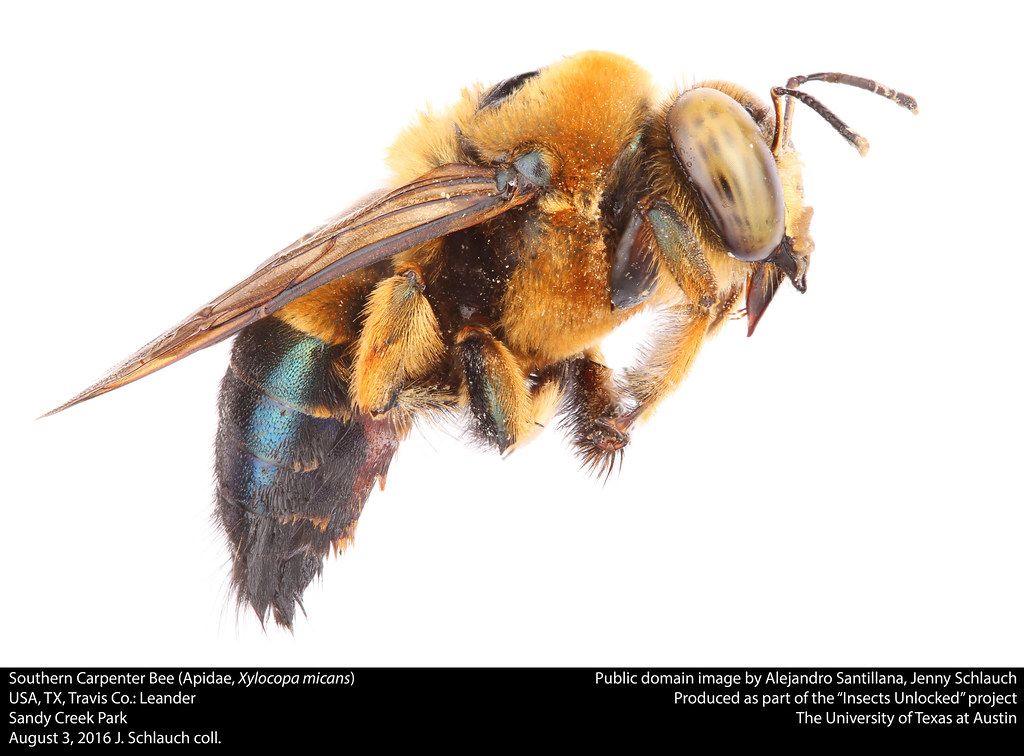
Southern Carpenter Bee
Xylocopa micans, the southern carpenter bee, is a large solitary bee in the subgenus Schonnherria. It excavates nests in dead wood but, unlike the sympatric X. virginica, has not been documented nesting in structural timbers. The species exhibits a unique polymorphic mating strategy, shifting from resource defense polygyny in early spring to lek polygyny in mid-summer. It is an important generalist pollinator capable of buzz pollination.
Michener's Carpenter Bee
Xylocopa micheneri is a carpenter bee species in the family Apidae, described by Hurd in 1978. The species is distributed across Central America and North America. Two subspecies are recognized: X. m. micheneri and X. m. decipiens. As a member of the genus Xylocopa, it shares the characteristic wood-nesting behavior of carpenter bees, though specific biological details for this species remain limited in published literature.
Valley Carpenter Bee, Hawaiian Carpenter Bee
Xylocopa sonorina is one of the largest bees in California and Hawaii, reaching approximately 25 mm in length. The species exhibits strong sexual dimorphism: females are entirely black, while males are golden-brown with distinctive green eyes. Native to the southwestern United States and adjacent Mexico, it has been introduced to the Hawaiian Islands (since before 1874), French Polynesia, the Samoan Islands, and other Pacific archipelagoes through human-mediated transport of nesting wood. DNA analysis confirmed in 2020 that X. varipuncta is a synonym of X. sonorina. The species is a significant pollinator, including commercial pollination of passion fruit in Hawaii, though its wood-nesting behavior can cause structural damage.
horsefly-like carpenter bee, mountain carpenter bee, foothill carpenter bee
Xylocopa tabaniformis, commonly known as the horsefly-like carpenter bee or mountain carpenter bee, is a medium-sized carpenter bee native to the Americas. The species ranges from 12–18 mm in length and exhibits strong sexual dimorphism: females are entirely black with light smoky-colored wings, while males display yellow hair on the thorax and yellow markings on the lower face. This bee is one of three carpenter bee species found in California and is the smallest of the trio. Research has revealed that despite being solitary, X. tabaniformis hosts a gut microbiome remarkably similar to social bees like honey bees and bumble bees, challenging assumptions about the drivers of microbiome structure in bees.
Pale-male Horse-fly Carpenter
Xylocopa tabaniformis androleuca is a subspecies of the mountain carpenter bee, distinguished by its pale male coloration. As part of the Xylocopa tabaniformis species complex, it shares the incipiently social behavior and distinctive gut microbiome characteristic of this group. Research has shown that carpenter bees in this complex harbor bacterial communities more similar to eusocial bees like honey bees and bumble bees than to solitary bees, challenging assumptions about sociality as the main driver of microbiome structure. The subspecies occurs in western North America, where females nest in wood and males exhibit the pale facial markings that give this taxon its common name.
Foothill Carpenter Bee, Mountain Carpenter Bee
Xylocopa tabaniformis orpifex, commonly known as the foothill or mountain carpenter bee, is the smallest of three carpenter bee species in California. Females are solid black with light smoky-colored wings, while males display bright yellow markings on the lower face and yellow hairs on the top front of the thorax. This subspecies exhibits incipient social behavior—lacking queens, hives, and honey production—yet research has revealed it harbors gut bacterial communities remarkably similar to those of highly social bees like honey bees and bumble bees. It nests by tunneling into dead wood and serves as an important pollinator in native plant communities.
Xylocopa tabaniformis parkinsoniae is a subspecies of mountain carpenter bee in the family Apidae. It belongs to a species group known for nesting in wood and exhibiting incipient social behavior. Research on related populations has revealed distinctive gut bacterial communities similar to those of eusocial bees, challenging assumptions about microbiome evolution. This subspecies is part of a complex that includes some of the smallest carpenter bees in California.
South Florida Eastern Carpenter Bee
Xylocopa virginica krombeini is a subspecies of the eastern carpenter bee restricted to southern Florida. As part of the Xylocopini tribe, it shares the robust body form and wood-nesting behavior characteristic of large carpenter bees. The subspecies designation reflects geographic isolation and potential morphological differentiation from nominate X. virginica populations in the eastern United States. Like other Xylocopa, it is a solitary bee with incipient social traits, including prolonged maternal care and cohabitation of daughters with mothers.
Texas Carpenter Bee
Xylocopa virginica texana is a subspecies of the eastern carpenter bee, distinguished as the Texas Carpenter Bee. Like other carpenter bees in the genus Xylocopa, females excavate nesting galleries in wood, while males defend territories near these sites. The subspecies occurs in Texas and adjacent regions, representing the southwestern extent of Xylocopa virginica's range. Research on related carpenter bees has revealed that these bees host gut bacterial communities similar to social bees like honey bees and bumble bees, despite lacking eusocial organization.
Virginia Carpenter Bee, Eastern Carpenter Bee
Xylocopa virginica virginica is a large carpenter bee native to eastern North America. It is facultatively social, forming small colonies with linear dominance hierarchies where one female monopolizes both reproduction and foraging. Females excavate tunnels in wood to create brood galleries, provisioning cells with bee bread (pollen and nectar mixture). Males defend nest-side territories and mate in early spring, then die; females may live two years. The subspecies is distinguished by the nominate form's distribution and morphology.