
Xylocopa tabaniformis
Smith, 1854
horsefly-like carpenter bee, mountain carpenter bee, foothill carpenter bee
Species Guides
3- Xylocopa tabaniformis androleuca(Pale-male Horse-fly Carpenter)
- Xylocopa tabaniformis orpifex(Foothill Carpenter Bee)
- Xylocopa tabaniformis parkinsoniae
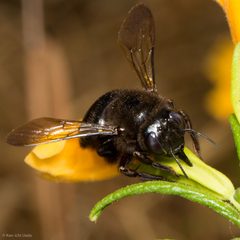
Xylocopa tabaniformis, commonly known as the horsefly-like or mountain carpenter bee, is a medium-sized carpenter bee native to the Americas. The ranges from 12–18 mm in length and exhibits strong : females are entirely black with light smoky-colored wings, while males display yellow hair on the and yellow markings on the lower . This is one of three carpenter bee species found in California and is the smallest of the trio. Research has revealed that despite being solitary, X. tabaniformis a gut microbiome remarkably similar to social bees like honey bees and bumble bees, challenging assumptions about the drivers of microbiome structure in bees.
Pronunciation
How to pronounce Xylocopa tabaniformis: /zɪˈlɒkəpə təˌbænɪˈfɔːrmɪs/
These audio files are automatically generated. While they are not always 100% accurate, they are a good starting point.
Identification
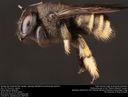
Distinguished from bumble bees (Bombus) by the relatively hairless, shiny —bumble bees have densely hairy abdomens. Separated from other Xylocopa by size and coloration: smaller than X. varipuncta (Valley carpenter bee) and X. californica (California carpenter bee), and lacking the bluish metallic reflections of X. californica. Males distinguished from females by yellow thoracic hair and facial markings; females are entirely black. The X. t. orpifex in California is specifically noted for males having bright yellow marks on the lower .
Images
Appearance
Medium-sized , 12–18 mm in length, with a robust, somewhat flattened body. Females are entirely black with light smoky-colored wings. Males have bright yellow hair on the top front of the and yellow marks on the lower part of the . The is relatively hairless and shiny, distinguishing carpenter bees from the densely hairy bumble bees. Wings are dark and opaque in females, lighter in males.
Habitat
Mountain and foothill areas; associated with woodland and forest-edge environments. In California, found in mountain foothill areas of northern and southern regions. Utilizes dead wood for nesting, including dead limbs and untreated wooden structures.
Distribution
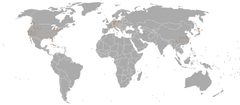
Widespread across the Americas: North America (southwestern United States, particularly California), Central America, and South America. In the United States, documented from California (including Davis, Anza Borrego, and Tucson area ) and the Southwest. The X. t. orpifex is specifically associated with California's foothill regions.
Seasonality
Active primarily in spring through fall. emerge in spring (observed as early as March in California) and remain active into autumn. Adults may be found on flowers into late fall, with individuals observed as late as December 27 in mild conditions. Overwinters as adults in previously constructed galleries, emerging the following spring.
Diet
and nectar feeder. Documented visiting salvia (Salvia spp.), bulbine, and other flowering plants. Engages in nectar-robbing by piercing flower corollas to access nectar, particularly on long-tubed flowers. Pollen collected from diverse floral sources for provisioning .
Life Cycle
Solitary nesting in dead wood. Females excavate tunnels in dead limbs, untreated fence posts, or other wooden substrates, creating galleries provisioned with pollen. are laid in individual within these galleries. Larvae develop through summer, feeding on stored pollen, then pupate and emerge as in late summer or fall. Newly emerged adults feed on flowers to build fat reserves before entering brood galleries to overwinter. No social colony structure; each female independently provisions her own nest.
Behavior
Males are highly territorial and actively patrol flowers and nesting areas, sometimes aggressively approaching intruders. Both sexes engage in nectar-robbing by piercing flower corollas, bypassing pollination mechanisms. often roost on flowers overnight, particularly in autumn, rather than returning to a central nest. Inactive during cold periods but may emerge during warm winter days. Limited social interactions compared to eusocial bees, though males and females may be observed in close proximity on flowers during mating season.
Ecological Role
Important in native plant , including effective buzz pollination of tomatoes and eggplants. Contributes to pollination of passion fruit, blueberries, melons, and hybrid cotton. Nectar-robbing may enhance out-crossing by forcing legitimate pollinators to visit more flowers. Wood-excavating behavior initiates decomposition of dead wood, contributing to nutrient cycling in natural . a distinctive gut microbiome (including Bombilactobacillus, Bombiscardovia, and Lactobacillus) that may contribute to nutrition and .
Human Relevance
Considered both beneficial and occasionally problematic. Valued as a of crops and native plants. Wood-boring nesting can damage untreated wooden structures, leading to control efforts in some situations. Does not produce honey and lacks the colonial structure of honey bees. Males cannot sting and are harmless despite territorial bluffing; females can sting but rarely do unless handled. Some threatened by loss and competition for nesting substrates.
Similar Taxa
- Xylocopa varipunctaLarger size (approximately 25 mm); female solid black but male has green and blond (not yellow) thoracic hair; 'teddy bear ' for male
- Xylocopa californicaLarger size; distinctive bluish metallic reflections on body; females have dark smoky brown wings; found in mountain foothill areas but readily distinguished by metallic coloration
- Bombus spp.Densely hairy (carpenter bees have shiny, relatively hairless abdomen); smaller relative to width; social colony structure with nests
More Details
Gut Microbiome Research
A 2023 study using full-length 16S rRNA sequencing revealed that X. tabaniformis shares core gut bacteria (Bombilactobacillus, Bombiscardovia, Lactobacillus, Gilliamella, Apibacter) with social corbiculate bees, despite being solitary. This challenges the assumption that sociality is the main driver of microbiome structure in bees. The microbiome shows geographical structure among , with some bacterial lineages exhibiting population-level differentiation.
Subspecies Diversity
Ten are recognized, including X. t. orpifex (California), X. t. azteca, X. t. androleuca, and others distributed across the ' broad American range. Behavioral differences among subspecies have been documented in Mexico.
Sources and further reading
- BugGuide
- Wikipedia
- GBIF taxonomy match
- iNaturalist taxon
- NCBI Taxonomy
- Catalogue of Life
- Innovative Research by RSPIB Scholar: Surprising Find About Carpenter Bees | Bug Squad
- Carpenter Bee: Beneficial Insect or Pest? | Bug Squad
- UC Davis Bee Haven: Celebrating a Year of Bloom, Stewardship and Community Impact | Bug Squad
- Love at First Flight | Bug Squad
- Sold on the Salvia | Bug Squad
- Bumble bee, carpenter bee, he bee, she bee: Bombus spp., Xylocopa spp. — Bug of the Week
- Notes on the Behavior of Four Subspecies of the Carpenter Bee, Xylocopa (Notoxylocopa) tabaniformis, in Mexico1