
Xylocopa tabaniformis parkinsoniae
Cockerell, 1917
Xylocopa tabaniformis parkinsoniae is a of mountain carpenter bee in the Apidae. It belongs to a group known for nesting in wood and exhibiting incipient social . Research on related has revealed distinctive gut bacterial similar to those of eusocial bees, challenging assumptions about microbiome evolution. This subspecies is part of a complex that includes some of the smallest carpenter bees in California.
Pronunciation
How to pronounce Xylocopa tabaniformis parkinsoniae: /ɪˌzaɪləˈkoʊpə təˌbænɪˈfɔrmɪs pɑrkɪnsəˈneɪiː/
These audio files are automatically generated. While they are not always 100% accurate, they are a good starting point.
Identification
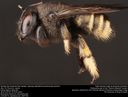
Distinguished from bumble bees by the shiny, sparsely haired and broader relative to width. Males identified by yellow facial markings; females by all-black . Among carpenter bees, X. tabaniformis is smaller than the Valley (X. sonorina) and California carpenter bee (X. californica). Separation from other X. tabaniformis requires examination of subtle morphological characters.
Images
Habitat
Associated with foothill and mountain environments. Nests in dead wood, including limbs of dead trees and untreated wooden structures. Occupies galleries constructed in wood, which serve as nurseries in spring and summer and winter in colder months.
Distribution
Recorded from Middle America and North America. Specific range boundaries relative to other of X. tabaniformis require further documentation.
Seasonality
active in spring through autumn. New adults emerge in summer and early fall, with activity continuing until killing frost. Individuals have been observed in winter taking in nest galleries or hotels.
Diet
Feeds on nectar and pollen from diverse flowering plants. Documented nectar sources include Salvia . Known to engage in nectar-robbing by piercing flower corollas to access nectar directly, bypassing pollination mechanisms.
Life Cycle
Females construct galleries in wood over several weeks, provision with pollen, and deposit . Larvae develop through summer, consuming pollen provisions, then pupate and emerge as in late summer or early fall. Adults overwinter in vacated galleries. time spans approximately one year.
Behavior
Exhibits incipient social —lives in small groups with limited social interactions but lacks - differentiation and cooperative care found in eusocial bees. Males cannot sting; females possess stingers and will sting if handled. sometimes rest on flowers overnight, particularly in cool conditions. Males may be observed sleeping on blossoms in early morning.
Ecological Role
Important in native plant , including buzz pollination of crops such as tomatoes and eggplants. Contributes to pollination of passion fruit, blueberries, melons, and hybrid cotton. Nectar-robbing may incidentally transfer pollen or enhance out-crossing by forcing legitimate pollinators to visit additional flowers. Wood-nesting activity initiates decomposition of dead limbs in natural communities.
Human Relevance
Generally considered beneficial due to pollination services, though sometimes perceived as pests when nesting in untreated wooden structures. Damage to human constructions should be weighed against positive ecological contributions. Males pose no sting risk; females will sting if provoked.
Similar Taxa
- Xylocopa sonorinaLarger body size; females solid black, males green-eyed with blond coloration ('teddy bear ')
- Xylocopa californicaLarger with distinctive bluish metallic body reflections; females have dark smoky brown wings
- Xylocopa virginicaEastern ; males have white (not yellow) facial patches; larger body size
- Bombus spp.Hairy ; smaller relative to ; fully social colony structure with and
More Details
Gut Microbiome Research
of Xylocopa tabaniformis studied in the southwestern United States harbor gut bacterial dominated by Bombilactobacillus, Bombiscardovia, and Lactobacillus, with Gilliamella and Apibacter also present. These communities resemble those of eusocial corbiculate bees (honey bees and bumble bees) more than solitary bees, despite Xylocopa lacking advanced sociality. This similarity is hypothesized to result from long lifespans and limited but consistent social interactions that facilitate microbiome transmission.
Sources and further reading
- BugGuide
- GBIF taxonomy match
- iNaturalist taxon
- Catalogue of Life
- Innovative Research by RSPIB Scholar: Surprising Find About Carpenter Bees | Bug Squad
- Carpenter Bee: Beneficial Insect or Pest? | Bug Squad
- UC Davis Bee Haven: Celebrating a Year of Bloom, Stewardship and Community Impact | Bug Squad
- Sold on the Salvia | Bug Squad
- Bumble bee, carpenter bee, he bee, she bee: Bombus spp., Xylocopa spp. — Bug of the Week
- Bumble bee, carpenter bee, redux: Bombus spp. and Xylocopa spp. — Bug of the Week