
Xylocopa sonorina
Smith, 1874
Valley Carpenter Bee, Hawaiian Carpenter Bee
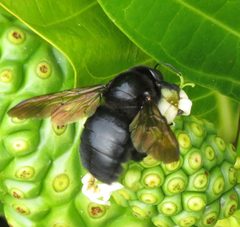
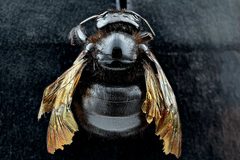
Xylocopa sonorina is one of the largest bees in California and Hawaii, reaching approximately 25 mm in length. The exhibits strong : females are entirely black, while males are golden-brown with distinctive green . Native to the southwestern United States and adjacent Mexico, it has been introduced to the Hawaiian Islands (since before 1874), French Polynesia, the Samoan Islands, and other Pacific archipelagoes through human-mediated transport of nesting wood. analysis confirmed in 2020 that X. varipuncta is a synonym of X. sonorina. The species is a significant , including commercial pollination of passion fruit in Hawaii, though its wood-nesting can cause structural damage.

Pronunciation
How to pronounce Xylocopa sonorina: //zɪˈlɒkəpə səˈnɔrɪnə//
These audio files are automatically generated. While they are not always 100% accurate, they are a good starting point.
Identification
Distinguished from other southwestern Xylocopa by its large size and the striking : black females versus golden-brown males with green . In California, it is the largest . Xylocopa tabaniformis (mountain carpenter bee) is smaller and occurs at higher elevations. Xylocopa virginica (eastern carpenter bee) is not native to the same range. Males of X. sonorina can be distinguished by their mesosomal gland, which produces species-specific . Females may be confused with other large black carpenter bees but are identified by geographic range and association with valley and foothill .
Images
Appearance
Large, robust approximately 25 mm (1 inch) in length. Females are entirely black with closely punctured and , smooth and shining disk, and finely punctured shining with black except ferruginous hairs on beneath. Wings are fusco-hyaline with darker cloud beyond enclosed , displaying bright purple and coppery iridescence. Males are golden-brown with large green . Both sexes have large heads and flattened dorso- abdomens.
Habitat
Valleys and foothills with deciduous trees dominated by oaks in its native range. Nests in fence posts, telephone poles, structural timbers, and dead wood. Avoids painted or stained wood. In Hawaii, occupies tropical agricultural and urban environments. Tunnels average 15-25 cm in length.
Distribution
Native to southwestern United States (Arizona, California, New Mexico, Nevada, Texas, Utah) and adjacent Mexico. Introduced and established in Hawaiian Islands (all main islands, since before 1874), French Polynesia, Samoan Islands, Marianas Islands, Java, New Zealand, and Midway Atoll. Single unestablished record from Vancouver, British Columbia (1949).
Seasonality
Year-round activity in tropical climates (Hawaii) with potential decline during winter months. In temperate native range, emerge in spring, with reproductive activity during warmer months. Young adults hibernate in tunnels during winter. Males exhibit territorial during mating season.
Diet
Nectar and pollen from flowers. Observed visiting Asystasia gangetica (Chinese violet) and other flowering plants. In Hawaii, used as of Passiflora edulis (passion fruit). Capable of buzz pollination on Solanaceae with closed anthers.
Host Associations
- Passiflora edulis - Used in tropical agriculture in Hawaii and Niue Island
- Asystasia gangetica - nectar sourcePrimary and secondary nectar robber; visits 16 flowers per minute, spending 1.5 seconds per flower
- Solanaceae - pollen sourceUses buzz pollination on flowers with closed anthers
Life Cycle
Females excavate tunnels in wood using , creating linear series of partitioned . Each cell provisioned with (pollen-nectar mixture), receiving one sealed with sawdust partition. Eggs hatch in 2-3 days; larval development approximately 2 weeks; prepupal and pupal stages 3-4 weeks. females fed by mother; capable of buzzing in ~1 week, in 2-3 weeks. Most nests contain single female and her brood, though offspring may later join. bees hibernate in tunnels during winter. In Hawaii, egg laying occurs year-round with seasonal decline.
Behavior
Females are not aggressive, stinging only when provoked; males lack stingers entirely. Males exhibit non-resource-based territoriality, establishing territories at prominent sites (hilltops, protrusions, trees) marked with mesosomal gland . Males patrol or hover, producing loud buzzing and pheromonal signals to attract females. Females may engage in exploratory foraging , responding to visual and olfactory male signals. Nests defended through well-constructed partitions, blocking entrances, and covering partitions with liquid substances rather than aggression. In Hawaii, multiple females may cohabit tunnels with division of labor: one pollen-collecting -layer, others performing guard and nest-cleaning duties.
Ecological Role
Important in native and introduced ranges. In Hawaii, classified as non-native causing damage to trees and timber. Serves as model for studying incipient sociality and microbiome evolution—gut bacteria resemble social bees (honey bees, bumble bees) despite solitary nesting, suggesting factors beyond sociality maintain distinctive microbiomes. Contributes to passion fruit production through managed pollination services.
Human Relevance
Valued for tropical agriculture, particularly passion fruit in Hawaii. Considered a structural pest due to wood-nesting in fence posts, telephone poles, and building timbers. In 1934, blister beetle Cissites auriculata was introduced to Hawaii as but failed to establish. Subject of research on microbiomes, , and communication. Frequently observed in urban gardens and educational programs.
Similar Taxa
- Xylocopa tabaniformisMountain carpenter bee; smaller, occurs at higher elevations, native to same general region but distinct preference
- Xylocopa virginicaEastern carpenter bee; distribution (eastern North America), similar nesting but not overlapping in range
- Xylocopa varipunctaFormerly considered separate , synonymized under X. sonorina in 2020 based on analysis; names now
- Xylocopa clarionensisClarion Island ; thought to be most closely related , found on Revillagigedo Islands
Misconceptions
Often perceived as aggressive due to large size and loud ; females are actually non-aggressive and males cannot sting. Frequently mistaken for bumble bees. The name '' leads to assumption that wood is consumed; bees excavate but do not ingest wood. Hawaiian were long thought to represent a distinct or to originate from Sunda Islands rather than North America.
More Details
Thermoregulation
Unusual capacity to thermoregulate across extreme temperatures. Maintains thoracic temperatures of 33.0-46.5°C while flying through environments of 12.0-40.0°C. Achieves this through physiological heat transfer to and , plus forced convective cooling via modified speed. Large head provides surface area for convective cooling; flattened abdomen facilitates rapid heat loss.
Microbiome Research
2023 research revealed gut bacterial (core : Bombilactobacillus, Bombiscardovia, Lactobacillus) are more similar to social bees than to solitary bees, despite X. sonorina's solitary lifestyle. This challenges assumptions that sociality is the main driver of microbiome structure. Long-read 16S rRNA sequencing showed geographic structure in bacterial variants among .
Taxonomic History
Described by Frederick Smith in 1874 from Hawaiian specimens; he misread 'Sandwich Islands' as 'Sunda Islands', causing long-standing distributional confusion. R.C.L. Perkins described same as X. aeneipennis in 1899. P.H. Timberlake in 1922 suggested Hawaiian bees were with mainland X. varipuncta. in 2020 confirmed synonymy, with X. sonorina having nomenclatural priority.
Sources and further reading
- BugGuide
- Wikipedia
- GBIF taxonomy match
- iNaturalist taxon
- NCBI Taxonomy
- Innovative Research by RSPIB Scholar: Surprising Find About Carpenter Bees | Bug Squad
- 'Am I Even a Bee?' Identity Crisis Unfolds in This Charming Book | Bug Squad
- Learn About the Diversity of Bees in This UC Davis Biodiversity Museum Month Program | Bug Squad
- UC Davis Picnic Day: Let's Go on an Insect Scavenger Hunt! | Bug Squad
- Take a Bug Break--and Bring Along This Book | Bug Squad
- Going Native: Do You Know the Native Bees of California? | Bug Squad
- Individual variation in male pheromone production in Xylocopa sonorina correlates with size and gland color
- Xylocopa sonorina Smith, 1874 from Vancouver, British Columbia, Canada (Hymenoptera: Apidae, Xylocopinae) with comments on its taxonomy