
Xylocopa appendiculata
Smith, 1852
Appendiculate Carpenter Bee, Asian Carpenter Bee
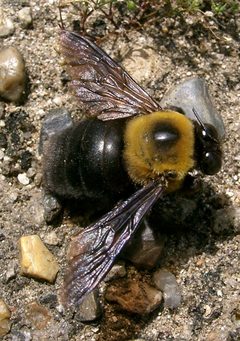
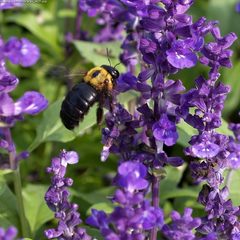
Xylocopa appendiculata is a large native to eastern Asia, first reported in the United States in 2013 with established in northern California. It belongs to the subgenus Alloxylocopa. The has been studied using distribution modeling to predict its potential spread across North America. Like other carpenter bees, it nests in wood and serves as a , though specific ecological details for this species remain limited.
Pronunciation
How to pronounce Xylocopa appendiculata: //ˌzaɪ.ləˈkoʊ.pə əˌpɛnˌdɪˈkjuː.lə.tə//
These audio files are automatically generated. While they are not always 100% accurate, they are a good starting point.
Identification
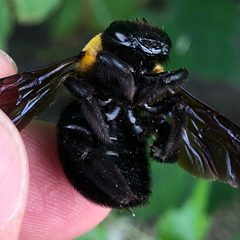
Belongs to subgenus Alloxylocopa Hurd and Moure; diagnostic features for this subgenus and are documented in Smith-Pardo et al. (2020) to enable identification and reporting to authorities. As a large , it likely shares traits with : robust body, shiny hairless (distinct from the hairy abdomen of bumble bees), and typical of the .
Images
Distribution
Native to eastern Asia; established in northern California, USA since 2013. Potential distribution in the contiguous United States has been estimated using plant hardiness zones and maximum entropy (Maxent) modeling based on specimen records from literature, museum collections, Discover Life.org, and iNaturalist.org.
Human Relevance
Introduced in North America with established in California; monitoring and identification encouraged for potential management. First non-native documented in the USA.
Similar Taxa
- Xylocopa sonorinaBoth large carpenter bees in California; X. sonorina is native to western North America and distinguished by distribution and likely morphological differences
- Xylocopa tabaniformisBoth large carpenter bees with overlapping range in California; X. tabaniformis is native and belongs to different subgenus
- Xylocopa varipunctaNative Valley in California; males have distinctive green and blond coloration not reported for X. appendiculata
- Xylocopa virginicaEastern North American native; similar size and nesting but geographically separated from established X. appendiculata
Sources and further reading
- BugGuide
- GBIF taxonomy match
- iNaturalist taxon
- NCBI Taxonomy
- Catalogue of Life
- Innovative Research by RSPIB Scholar: Surprising Find About Carpenter Bees | Bug Squad
- Sold on the Salvia | Bug Squad
- Carpenter Bee: Beneficial Insect or Pest? | Bug Squad
- 'P' is for People, Partners and Pollinators! | Bug Squad
- Bumble bee, carpenter bee, he bee, she bee: Bombus spp., Xylocopa spp. — Bug of the Week
- Bumble bee, carpenter bee, redux: Bombus spp. and Xylocopa spp. — Bug of the Week
- Status and potential distribution of the Asian carpenter bee, Xylocopa appendiculata Smith (Apidae, Xylocopini), in the United States
- Figure 2 from: Smith-Pardo AH, Fowler GA, Kumar S (2020) Status and potential distribution of the Asian carpenter bee, Xylocopa appendiculata Smith (Apidae, Xylocopini), in the United States. Journal of Hymenoptera Research 76: 99-111. https://doi.org/10.3897/jhr.76.49518
- Figure A1 from: Smith-Pardo AH, Fowler GA, Kumar S (2020) Status and potential distribution of the Asian carpenter bee, Xylocopa appendiculata Smith (Apidae, Xylocopini), in the United States. Journal of Hymenoptera Research 76: 99-111. https://doi.org/10.3897/jhr.76.49518
- Figure A2 from: Smith-Pardo AH, Fowler GA, Kumar S (2020) Status and potential distribution of the Asian carpenter bee, Xylocopa appendiculata Smith (Apidae, Xylocopini), in the United States. Journal of Hymenoptera Research 76: 99-111. https://doi.org/10.3897/jhr.76.49518
- Figure 1 from: Smith-Pardo AH, Fowler GA, Kumar S (2020) Status and potential distribution of the Asian carpenter bee, Xylocopa appendiculata Smith (Apidae, Xylocopini), in the United States. Journal of Hymenoptera Research 76: 99-111. https://doi.org/10.3897/jhr.76.49518
- Polymorphism in the deutonymph and adult ofSennertia alfkeni(Acari: Chaetodactylidae) associated with the large carpenter bee,Xylocopa appendiculata circumvolans(Hymenoptera: Apidae)
- Figure 3 from: Smith-Pardo AH, Fowler GA, Kumar S (2020) Status and potential distribution of the Asian carpenter bee, Xylocopa appendiculata Smith (Apidae, Xylocopini), in the United States. Journal of Hymenoptera Research 76: 99-111. https://doi.org/10.3897/jhr.76.49518