
Xylocopa californica arizonensis
Cresson, 1879
Arizona Carpenter Bee
Xylocopa californica arizonensis is a of in the Apidae, recognized as the Arizona Carpenter Bee. It belongs to a of large, robust bees known for nesting in wood and exhibiting incipient social . Research on related Xylocopa has revealed surprising microbiome similarities to highly social bees like honey bees and bumble bees, suggesting that advanced sociality is not required for maintaining complex gut bacterial .
Pronunciation
How to pronounce Xylocopa californica arizonensis: //zaɪˈlɒkəpə ˌkælɪˈfɔːrnɪkə ˌærɪˌzoʊˈnɛnsɪs//
These audio files are automatically generated. While they are not always 100% accurate, they are a good starting point.
Identification
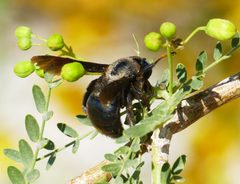
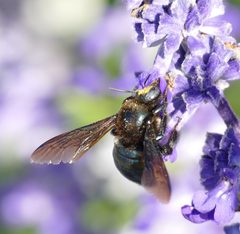
Distinguished from other carpenter bees by its geographic range in Arizona and the southwestern United States. Females are large, robust, and typically dark-colored with smoky brown wings. Males may show distinctive coloration patterns. The can be separated from the nominate form Xylocopa californica californica by distribution and subtle morphological differences, though specific diagnostic features require expert examination.
Images
Distribution
Arizona and southwestern United States; also recorded from Middle America. The occurs in arid and semi-arid regions of the American Southwest.
Behavior
Exhibits incipient social : lacks a , does not produce honey, and does not live in hives like eusocial bees. Females excavate tunnels in dead wood or untreated wooden structures for nesting. Both sexes have been observed nectar-robbing by piercing flower corollas to access nectar without pollinating, though they also engage in legitimate pollination.
Ecological Role
Important in native plant . Serves as an effective buzz pollinator of certain crops including tomatoes and eggplants. Contributes to passion fruit, blueberry, melon, and hybrid cotton pollination. Initial wood excavation contributes to decomposition and nutrient cycling in natural communities.
Human Relevance
Controversial status as beneficial insect versus pest. Positive contributions include crop pollination and native plant support. Negative impacts involve tunneling in untreated wooden structures and nectar-robbing from some long-tubed flowers. Any control measures should be weighed against ecological benefits.
Similar Taxa
- Xylocopa californica californicaNominate with overlapping but different geographic distribution; occurs in California rather than Arizona
- Xylocopa sonorinaLarger Valley carpenter bee with similar incipient social and microbiome characteristics; females solid black, males green-eyed blond
- Xylocopa tabaniformisMountain carpenter bee of similar size and ; research shows shared core gut bacterial with other Xylocopa
Sources and further reading
- BugGuide
- GBIF taxonomy match
- iNaturalist taxon
- NCBI Taxonomy
- Catalogue of Life
- Carpenter Bee: Beneficial Insect or Pest? | Bug Squad
- 'Am I Even a Bee?' Identity Crisis Unfolds in This Charming Book | Bug Squad
- This BOG in the Heart of UC Davis Is a Treasure | Bug Squad
- Innovative Research by RSPIB Scholar: Surprising Find About Carpenter Bees | Bug Squad
- Sold on the Salvia | Bug Squad
- 'P' is for People, Partners and Pollinators! | Bug Squad