
Xylocopa virginica texana
Cresson, 1872
Texas Carpenter Bee
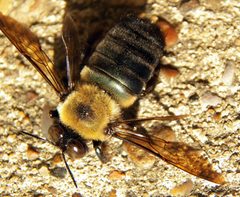
Xylocopa virginica texana is a of the eastern carpenter bee, distinguished as the Texas . Like other carpenter bees in the Xylocopa, females excavate nesting galleries in wood, while males defend territories near these sites. The subspecies occurs in Texas and adjacent regions, representing the southwestern extent of Xylocopa virginica's range. Research on related carpenter bees has revealed that these bees gut bacterial similar to social bees like honey bees and bumble bees, despite lacking eusocial organization.
Pronunciation
How to pronounce Xylocopa virginica texana: /zaɪloʊˈkoʊpə vɜrˈdʒɪnɪkə tɛkˈsɑːnə/
These audio files are automatically generated. While they are not always 100% accurate, they are a good starting point.
Identification
As a of Xylocopa virginica, distinguishing X. v. texana from the nominate subspecies requires examination of subtle morphological differences, typically in coloration and distribution. Males of Xylocopa virginica can be identified by a white facial patch between the ; females lack this marking. The black distinguishes carpenter bees from the hairy-bodied bumble bees (Bombus) they resemble in size and general form.
Images
Habitat
Associated with wooden structures for nesting, including dead limbs, untreated fence posts, decks, railings, and cedar siding. Requires flowering plants for foraging resources.
Distribution
Texas and adjacent southwestern United States, representing the western portion of the eastern carpenter bee's range. GBIF records also indicate presence in Belgium, likely representing introduced or vagrant individuals.
Seasonality
Active primarily in spring through fall. Males emerge and establish territories in early spring (approximately May in temperate regions), with mating occurring as females emerge from galleries. New emerge from in late summer, forage until autumn, then return to galleries to overwinter.
Diet
feed on nectar and pollen from diverse flowering plants. Has been observed engaging in nectar robbing by piercing flower corollas to access nectar without entering the flower. Goldenrod is a favored late-season nectar source.
Life Cycle
Females excavate tunnels in wood, creating a nearly perfectly round entrance hole approximately 6 mm in diameter. After penetrating about 13 mm, the tunnel turns parallel to the wood grain, extending 30 cm or more with branching secondary galleries possible. Each tunnel contains up to 13 individual constructed sequentially from the far end. Cells are provisioned with —a mixture of pollen, nectar, and glandular secretions—before an is deposited. Larvae develop through spring and summer, with those in cells completing development first. New emerge in late summer, forage until autumn, then overwinter in natal galleries.
Behavior
Males exhibit strong territoriality, defending wooden nesting sites against rival males and other intruders including humans. Territorial defense involves aerial combat with swooping, grappling, and biting that may result in combatants tumbling to the ground. Males lack stingers and cannot sting. Females are equipped to sting but rarely do so. Both sexes return to galleries overnight during active seasons and remain in galleries through winter.
Ecological Role
Important of native plant and some crop plants including passion fruit, blueberries, melons, hybrid cotton, tomatoes, and eggplant. Serves as effective buzz pollinator for solanaceous crops. Wood excavation initiates decomposition of dead wood in natural communities. Nectar robbing may enhance out-crossing by forcing legitimate pollinators to visit additional flowers.
Human Relevance
Considered both beneficial and potentially pestiferous. Positive contributions include pollination services; negative impacts include tunneling in untreated wooden structures and nectar robbing from some long-tubed flowers. Damage to wooden structures may be exacerbated by woodpeckers seeking larvae. Most damage occurs in untreated or weathered wood rather than painted or pressure-treated lumber.
Similar Taxa
- Xylocopa virginica virginicaNominate of the eastern carpenter bee, overlapping in range with X. v. texana; distinguished by subtle differences in and coloration requiring close examination
- Xylocopa sonorinaValley of western North America; larger size with females solid black and males green-eyed blond with yellowish
- Xylocopa californicaCalifornia carpenter bee with distinctive bluish metallic body reflections and dark smoky brown wings in females
- Xylocopa tabaniformisMountain carpenter bee; smaller than X. virginica with females black and light smoky-colored wings, males with bright yellow facial markings
- Bombus speciesBumble bees share similar size and general appearance but have densely hairy bodies rather than the black of carpenter bees
More Details
Gut Microbiome Research
Research on related (X. sonorina and X. tabaniformis) has revealed that Xylocopa gut bacterial dominated by Bombilactobacillus, Bombiscardovia, and Lactobacillus— shared with social corbiculate bees like honey bees and bumble bees. This finding challenges the assumption that sociality is the primary driver of microbiome structure in bees, suggesting that long lifespan and limited social interactions may suffice to maintain these communities.
Nomenclatural Note
Originally described as Xylocopa texana by Cresson in 1872, later treated as a of Xylocopa virginica. The basionym Xylocopa texana is now synonymized under X. virginica texana.
Sources and further reading
- BugGuide
- GBIF taxonomy match
- iNaturalist taxon
- NCBI Taxonomy
- Catalogue of Life
- 'Am I Even a Bee?' Identity Crisis Unfolds in This Charming Book | Bug Squad
- Carpenter Bee: Beneficial Insect or Pest? | Bug Squad
- Innovative Research by RSPIB Scholar: Surprising Find About Carpenter Bees | Bug Squad
- Carpenter bees defending territories: Large carpenter bee, Xylocopa virginica — Bug of the Week
- Guardians of the galleries: Male Eastern Carpenter Bees, Xylocopa virginica — Bug of the Week
- What is that bee and why is it divebombing me? Male eastern carpenter bees, Xylocopa virginica — Bug of the Week