
Anurida
Laboulbène, 1865
Species Guides
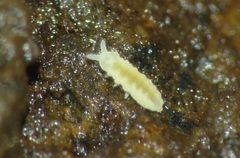
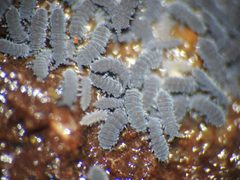
2- Anurida granaria(granary short-legged springtail)
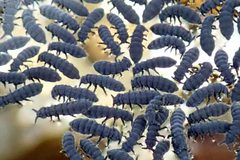
- Anurida maritima(seashore springtail)
Anurida is a of springtails (Collembola) in the Neanuridae, established in 1865 by Laboulbène. The genus has distribution with occupying diverse including intertidal marine zones, river floodplains, riparian areas, and forest . Well-studied species include the intertidal Anurida maritima, which exhibits complex tidal-entrained , and the terrestrial A. granaria, which has documented mycophagous associations. The genus shows notable morphological diversity in chaetotaxy and reduction, with some species groups exhibiting cryptic genetic divergence despite morphological similarity.
Pronunciation
How to pronounce Anurida: /æn.jʊˈriː.də/
These audio files are automatically generated. While they are not always 100% accurate, they are a good starting point.
Identification
-level identification within Anurida relies heavily on chaetotaxy patterns, particularly the arrangement and number of setae on tergites. The hammerae-group species are characterized by reduced axial chaetotaxy, notably the absence of setae p1 on Th.2 to Abd.4. Ocelli number varies among species, with some low-ocelli species distinguishable by this trait combined with maxillary structure. Anurida maritima and related in the species group show minimal morphological differentiation despite substantial genetic divergence, making molecular methods necessary for definitive identification.
Images
Habitat
varies considerably by . Anurida maritima occupies intertidal marine environments, inhabiting vertical clay-walls of creeks and salt marshes where it constructs nests in air-filled cavities as tidal . Anurida granaria occurs in riparian zones. Anurida riverina is restricted to river floodplains. Forest-dwelling species such as A. octoculata inhabit coniferous-broadleaved forests.
Distribution
distribution with records from Andean, Arctic and Sub-arctic, Cape, Caribbean mainland, and Central Australian regions. Anurida maritima has Holarctic distribution. Specific show more restricted ranges: A. riverina is known from Poland, A. octoculata from Primorsky Krai (Russian Far East).
Seasonality
In temperate intertidal of A. maritima, hatch in April following winter , with new in early May. become mature by July and die primarily in autumn. Activity patterns are tide-dependent rather than strictly seasonal, with behavioral rhythms entrained by inundation cycles.
Life Cycle
Anurida maritima is . undergo obligate , with diapause termination requiring temperatures below 5°C in autumn; further development is suppressed by winter cold until spring warming. Moulting occurs in nest . In A. granaria, oviposition and moulting have been observed in association with fungal substrates.
Behavior
Anurida maritima exhibits rhythmic entrained by tidal inundation, with synchronized group movement into nest cavities before high water. Clumping in air-filled cavities provides during submersion. Weather affects activity: sunshine limits nest-marsh exchange, while darkening skies and temperature drops increase movement; rainfall drives animals toward nests due to rising marsh moisture. in foraging: females prevail among animals wandering onto marshes. In A. granaria, courtship behavior and colonial aggregation on fungal substrates have been documented.
Ecological Role
Anurida granaria contributes to fungal spore through mycophagous associations, as documented with Peziza arvernensis in riparian zones. Intertidal participate in organic matter processing in salt marsh .
Similar Taxa
- Anurida bisetosaFormerly synonymized with A. maritima in 1953, but -wide analyses support separation; distinguished by genetic divergence despite minimal morphological differentiation, with mitochondrial lineage association providing diagnostic differentiation.
More Details
Endosymbionts
Anurida maritima carries two maternally-inherited endosymbionts: (supergroup A) and Spiroplasma (sister to Citri-Chrysopicola-Mirum lineage). The Wolbachia contains homologues of cifA and cifB prophage genes (Type V clade) associated with , and wmk associated with male-killing, though no male-killing gene SpAID was detected in Spiroplasma. Both endosymbiont lineages occur in both genetic lineages of the A. maritima group, with identical cifA and cifB sequences between lineages.
Cryptic speciation
Anurida maritima represents a group with at least two distinct genetic lineages showing substantial nuclear and mitochondrial divergence across a narrow geographic range (United Kingdom, The Netherlands), demonstrating that genetic divergence in Collembola does not necessarily produce morphological change. Further cryptic lineages likely exist across the Holarctic range.
Physiological constraints
Autumn mortality in A. maritima appears linked to starvation risk: declining body size, , and lipid content in late autumn correlate with reduced foraging at low temperatures, when limited low-tide periods restrict food acquisition. This physiological constraint explains the evolution of -stage strategy.
Sources and further reading
- BugGuide
- Wikipedia
- GBIF taxonomy match
- iNaturalist taxon
- NCBI Taxonomy
- Catalogue of Life
- Some observations on the biology of Anurida maritima (Guérin), (collembola)
- Turning the tide: Rhythmic aggregation behaviour in Anurida maritima (Collembola) is entrained by inundation
- A New Species of the Genus Anurida Laboulbéne, 1865 from River Floodplains of Poland (Collembola: Neanuridae)
- Genome Wide Analyses Corroborate Cryptic Speciation in Anurida maritima (Collembola, Poduromorpha)
- Wolbachia and Spiroplasma endosymbionts in the Anurida maritima (Collembola) species group
- Anurida granaria (Collembola) and Peziza arvernensis (Ascomycota) in Mycophagy Association at Riparian Zone in Southern Brazil
- Mitochondrial genome divergence supports an ancient origin of circatidal behaviour in the Anurida maritima (Collembola: Neanuridae) species group
- Life history strategy and egg diapause in the intertidal collembolan Anurida maritima
- A NEW SPECIES OF THE HAMMERAE-GROUP OF THE GENUS ANURIDA LABOULBÈNE, 1865 (COLLEMBOLA: NEANURIDAE) FROM PRIMORSKY KRAI
- Is the Current Systematic Subdivision of the Subfamily Neanurinae (Collembola, Neanuridae) Still Valid? Testing the Monophyly and Phylogenetic Relationships of Currently Established Tribes of the Neanurinae.