
Anurida maritima
(Guérin-Méneville, 1836)
seashore springtail, rock springtail
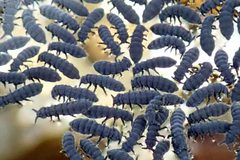
Anurida maritima is a cosmopolitan springtail confined to the intertidal zone, where it forms dense of up to several hundred individuals on rock-pool surfaces. This wingless collembolan exhibits unique adaptations to marine conditions, including a that prevents jumping and hydrophobic body hairs that enable it to remain on water surfaces. The demonstrates complex behavioral rhythms synchronized with tidal cycles and survives winter through . Recent genetic studies have revealed cryptic speciation within this morphospecies, with distinct mitochondrial and nuclear lineages now recognized.
Pronunciation
How to pronounce Anurida maritima: //ˌæn.jʊˈraɪ.də məˈrɪt.ɪ.mə//
These audio files are automatically generated. While they are not always 100% accurate, they are a good starting point.
Identification
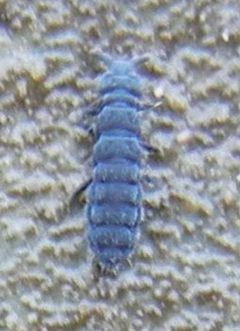
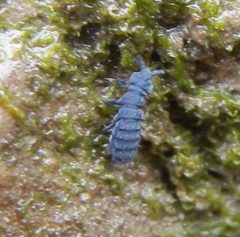
Distinguished from other springtails by its intertidal association and the combination of dark slaty blue coloration with dense white hydrophobic hairs covering the body. Unlike most springtails, it cannot leap due to its . The rounded, slightly posteriorly expanded body shape differs from more elongate terrestrial collembolan forms. Similar marine or shore-dwelling springtails occupy different microhabitats or exhibit different color patterns.
Images
Habitat
Strictly intertidal zone, inhabiting rocky shores and tidal marshes. Found on vertical clay-walls of creeks where individuals construct air-filled nest cavities that serve as during high tide. At low tide, forages on salt marsh surfaces and rock-pool surfaces.
Distribution
distribution in marine intertidal zones worldwide. Present in Arctic and Sub-arctic regions, Cape region, Caribbean mainland, Europe, and Mediterranean. In the British Isles, absent from north-east Scotland and south-east Ireland; absent from the Baltic Sea. in northern Europe may represent a distinct cryptic from Mediterranean populations.
Seasonality
Active throughout the year in warmer parts of its range. In cooler temperate regions, active only during summer months; overwinters as diapausing . from eggs occurs in early May; present from July through autumn.
Diet
Scavenger, feeding on dead animals in the upper intertidal zone. Prey items include chiefly crustaceans (including barnacles) and molluscs.
Life Cycle
with as the central strategy. Eggs laid in summer enter diapause and do not hatch; diapause is terminated by temperatures below 5°C in autumn, but further development is suppressed by winter cold until spring. Eggs hatch in April following overwintering. New emerges in early May; first appear in July. Adults die primarily in autumn, with mortality potentially linked to starvation as body size, , and lipid content decline in late autumn. Moulting occurs within nest cavities.
Behavior
Forms dense of up to several hundred individuals on rock-pool surfaces. Exhibits rhythmic aggregation entrained by tidal inundation cycles. During high tide, retreats to air-filled nest cavities in clay walls; during low tide, forages on exposed marsh surfaces. Activity patterns are weather-dependent: sunshine reduces movement between nests and foraging areas, while darkening and low temperatures increase activity; rainfall drives individuals toward nests due to rising marsh moisture. Possesses circatidal rhythm with a 12.4-hour period, using visual cues for orientation during movements. Produces aggregating that mediate group formation.
Ecological Role
Significant scavenger in the upper intertidal zone, contributing to nutrient cycling and decomposition of marine animal remains. Its and tidal rhythms represent a distinctive component of intertidal dynamics.
Similar Taxa
- Anurida bisetosaFormerly synonymized with A. maritima in 1953, but recent -wide analyses support separation; distinct genetic lineages with mitochondrial and nuclear divergence, though morphologically similar.
- Other intertidal springtailsA. maritima is distinguished by its specific rocky shore and tidal marsh , , and dark slaty blue coloration with white hydrophobic hairs; other occupy different intertidal microhabitats or exhibit different morphologies.
More Details
Cryptic speciation
Genomic studies have revealed that A. maritima comprises at least two distinct genetic lineages that may represent cryptic , including one lineage associated with the resurrected name A. bisetosa. The species group likely contains additional diverged lineages across its Holarctic distribution.
Endosymbionts
carry two bacterial endosymbionts: (supergroup A) and Spiroplasma. The Wolbachia contains homologues of genes (cifA, cifB), though their functional effects on remain to be confirmed through controlled crosses.
Hydrophobic adaptation
The dense covering of white hydrophobic hairs is a key allowing A. maritima to exploit the water surface film, a microhabitat unavailable to most terrestrial springtails. This trait is functionally linked to the loss of the jumping ability that characterizes most Collembola.
Sources and further reading
- BugGuide
- Wikipedia
- GBIF taxonomy match
- iNaturalist taxon
- NCBI Taxonomy
- Catalogue of Life
- One Bad Beetle | Beetles In The Bush
- More Than Wheat to Eat: New Zealand's Wheat Bug Has a Taste for Brassicas, Too
- St. Anthony Dune Tiger Beetle | Beetles In The Bush
- Bruneau Sand Dune tiger beetles caught in the act! | Beetles In The Bush
- Some observations on the biology of Anurida maritima (Guérin), (collembola)
- Turning the tide: Rhythmic aggregation behaviour in Anurida maritima (Collembola) is entrained by inundation
- Life history strategy and egg diapause in the intertidal collembolan Anurida maritima
- Genome Wide Analyses Corroborate Cryptic Speciation in Anurida maritima (Collembola, Poduromorpha)
- Mitochondrial genome divergence supports an ancient origin of circatidal behaviour in the Anurida maritima (Collembola: Neanuridae) species group
- Wolbachia and Spiroplasma endosymbionts in the Anurida maritima (Collembola) species group