
Neanuridae
Börner, 1901
Short-legged Springtails
Subfamily Guides
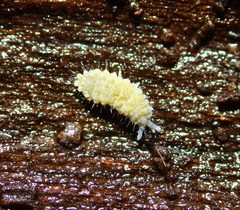
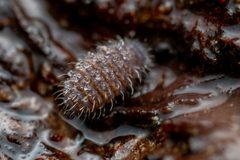
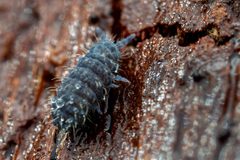
3is a of springtails (Collembola) in the order Poduromorpha, established by Carl Börner in 1901. Members are characterized by their compact, pudgy body form and relatively short legs compared to other families. The family comprises six recognized and approximately 97 , with notable diversity in the Caucasus region and Neotropics. Many exhibit distinctive morphological traits including specialized chaetotaxy (bristle arrangement) and patterns on the and body segments.
Pronunciation
How to pronounce Neanuridae: /niːəˈnjʊrɪdiː/
These audio files are automatically generated. While they are not always 100% accurate, they are a good starting point.
Identification
Distinguished from other Poduromorpha by the combination of compact body form and relatively short legs. -level identification typically requires examination of microscopic characters including: number and arrangement of (bristles) on the (particularly L+So chaetae); fusion patterns of on the first thoracic segment (e.g., Di and De tubercles); shape (ogival vs. non-ogival); claw (dentate vs. smooth); and presence/absence of male organ. Some such as Endonura and Itanura are distinguished primarily by head tubercle arrangements.
Images
Habitat
information at the level is limited. have been documented from high altitude mountains in Southeast Brazil and various parts of the Caucasus region. One species (Vitronura sp.) has been described as arboreal. Specific habitat preferences vary widely among and remain poorly documented for most .
Distribution
Widespread across multiple continents with documented records from: Europe (including Scandinavia: Denmark, Norway, Sweden), Asia (Caucasus region, Thailand, New Caledonia, North Korea, Vietnam, Israel, Iran, Pacific Russia, China), Australia, North America (Vermont, USA), Solomon Islands, Algeria, and Brazil (Neotropics). The Endonura shows particularly broad distribution across Europe, Asia, and Australia. The austral genus Ectonura has been recorded from the Neotropics.
Diet
Feeding habits at the level are poorly documented. Notes on feeding exist for the Neanurinae, but specific dietary information for the family as a whole is not established.
Similar Taxa
- Other Poduromorpha families can be distinguished from such as Hypogastruridae and Onychiuridae by its more compact, pudgy body form and relatively shorter legs. Many Poduromorpha families have more elongated body proportions.
More Details
Systematics
The contains six recognized : Caputanurininae, Frieseinae, Morulininae, Neanurinae, Pseudachorutinae, and Uchidanurinae. The Pseudoxenylla remains of uncertain relationships and is not assigned to any subfamily. The subfamily Neanurinae has been subject to phylogenetic analysis regarding the validity of its current tribal subdivision.
Taxonomic diversity
Approximately 97 are currently recognized in the . Recent taxonomic work has revealed remarkable diversity in certain genera, particularly Endonura in the Caucasus region, with multiple new described based on fine- morphological differences in chaetotaxy and patterns.
Sources and further reading
- BugGuide
- Wikipedia
- GBIF taxonomy match
- iNaturalist taxon
- NCBI Taxonomy
- Catalogue of Life
- Effect of Feed on Life History of Bilobella braunerae (Dhervang 1981)- (Collembola: Neanuridae)
- New genus, new species and new record of Neanurinae (Collembola, Neanuridae) for the Neotropics
- Remarkable diversity of the genus Endonura Cassagnau, 1979 (Collembola: Neanuridae: Neanurinae) in the Caucasus
- A new arboreal species of Vitronura Yosii, 1969 and a new record of Yuukianura Yosii, 1955 (Collembola, Neanuridae) from China, with notes on the feeding behavior of Neanurinae.
- Is the Current Systematic Subdivision of the Subfamily Neanurinae (Collembola, Neanuridae) Still Valid? Testing the Monophyly and Phylogenetic Relationships of Currently Established Tribes of the Neanurinae.