
Anurida granaria
(Nicolet, 1847)
granary short-legged springtail
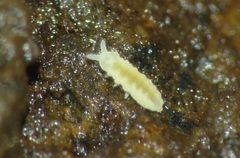
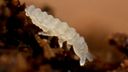
Anurida granaria is a in the Neanuridae, first described by Hercule Nicolet in 1847. It has been observed in a documented mycophagy association with the cup fungus Peziza arvernensis in southern Brazil, where a colony of over 500 individuals used a single fungal apothecium as both food source and living space. The species exhibits complete activities including molting, courtship , and oviposition within fungal structures.

Pronunciation
How to pronounce Anurida granaria: /ænˈjʊrɪdə ɡrəˈnɛəriə/
These audio files are automatically generated. While they are not always 100% accurate, they are a good starting point.
Images
Habitat
Riparian zones with forested areas and litterfall; soil and leaf litter layers. Documented from Vale do Rio Pardo in Vera Cruz, Rio Grande do Sul, southern Brazil, where it occupied the apothecium of Peziza arvernensis as a microhabitat.
Distribution
Documented from southern Brazil (Rio Grande do Sul state); Anurida widely distributed across the American continent. GBIF records indicate additional occurrence in São Miguel, Arctic and Sub-arctic regions, Central Australia, Europe, and Macaronesian islands.
Diet
Mycophagous; uses apothecia of Peziza arvernensis as a nutritional source. In the documented Brazilian study, the apothecium served as the sole food source for colony survival over 5 weeks.
Host Associations
- Peziza arvernensis - mycophagyapothecium used as food source and living space; first reported association for this pair
Life Cycle
Molting observed across 5 weeks with variable frequency (1–5 individuals per week). Oviposition occurred between weeks 3–4. No parental care observed. Complete stages documented within fungal apothecium.
Behavior
Courtship involves circular movements. Uses fungal apothecia as protective structure and living space. Feeding events recorded directly on apothecial tissue.
Ecological Role
Contributes to nutrient cycling and organic matter decomposition in riparian zones. Facilitates fungal spore through mycophagy. Functions as a soil quality bioindicator and forms part of the base of .