
Calosoma
Weber, 1801
Caterpillar-hunter Beetles, Caterpillar Hunters, Caterpillar Searchers
Species Guides
33- Calosoma affine(related beautiful black searcher)
- Calosoma angulatum(angulate caterpillar hunter)
- Calosoma aurocinctum(gold-ringed caterpillar hunter)
- Calosoma calidum(Fiery Hunter)
- Calosoma cancellatum(latticed beautiful black searcher)
- Calosoma discors(different beautiful black searcher)
- Calosoma eremicola(solitary caterpillar hunter)
- Calosoma externum(Narrow Searcher Beetle)
- Calosoma frigidum(Cold-country Caterpillar Hunter)
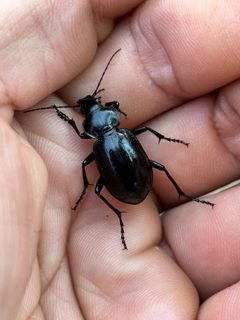
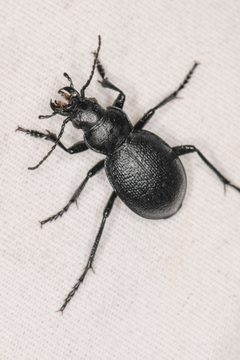
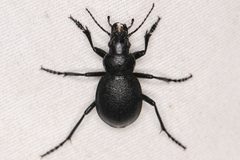
Calosoma is a of large ground beetles in the Carabidae, comprising approximately 120–167 distributed primarily throughout the Northern Hemisphere. Commonly known as caterpillar hunters or searchers, these beetles are characterized by their large size (many species 15–25 mm or more), prominent , and distinctive that is nearly as large as the and much wider than the . Many species are black or dark-colored, though some exhibit bright metallic coloration. The genus includes both fully winged and flightless species, with about half the species having reduced wings associated with of remote such as oceanic islands, highlands, and deserts. Calosoma beetles are notable for their potent chemical defense: glands near the tip of the abdomen produce a foul-smelling spray containing compounds such as methacrylic acid and salicylaldehyde.
Pronunciation
How to pronounce Calosoma: /kæ.loʊˈsoʊ.mə/
These audio files are automatically generated. While they are not always 100% accurate, they are a good starting point.
Identification
Calosoma is recognizable by its disproportionately large, wide that approaches the size of the and substantially exceeds the width. The body is robust and large relative to most ground beetles, with many exceeding 15 mm in length. are prominent, heavily sculptured, and directed forward (exposed, not concealed beneath the ). have segments longer than wide, appearing filamentous rather than bead-like. Coloration ranges from entirely black in some species (e.g., C. sayi, C. semilaeve) to bright metallic green, , or purple in others (e.g., C. scrutator). The may be smooth or have distinct surface sculpturing. Some species show bright metallic coloration on the pronotum or elytra, while others are uniformly dull black.
Images
Habitat
Calosoma occupy diverse terrestrial . Forested areas appear to be primary habitat for many species, with observations from oak forests, bottomland forests, and upland woodlands. Some species are arboreal, ascending trees to hunt caterpillars. Others inhabit open habitats including dry sand deposits along river systems, prairies, and grasslands. Flightless species occur in isolated habitats including highlands, deserts, and oceanic islands. Specific collection records include forested paths at 841 m elevation in British Columbia, gardens and agricultural areas in Egypt, and sand prairie remnants in Missouri.
Distribution
The occurs primarily throughout the Northern Hemisphere with worldwide distribution. Documented records include North America (United States: Missouri, New England, Maryland, Virginia, North Carolina, California, Oklahoma, Texas, Arkansas, Illinois, Tennessee, Florida; Canada: British Columbia, possibly others), Europe (Denmark, Norway, Sweden), and Africa (Egypt: Alexandria, Kafr El-Zayat in the Nile Delta). Some have been intentionally introduced for ; C. sycophanta was established in New England in 1905.
Seasonality
are active during warmer months. Specific observations include late July through August in Missouri, late August in southeastern Missouri, May through September across various North American locations, and June for mating activity in C. wilcoxi. Larvae are ground-dwelling and active during summer months. Some are attracted to ultraviolet light at night.
Diet
Calosoma are predatory, feeding primarily on caterpillars. Documented prey includes fall cankerworms (Alsophila pometaria), spring cankerworms, gypsy moth larvae (Lymantria dispar), eastern tent caterpillars, and spongy moth (formerly gypsy moth) caterpillars. Both and larval stages are predatory. Adults hunt day and night; larvae consume prey on the ground. C. sycophanta has been described as a voracious consumer of caterpillars during both life stages.
Life Cycle
are deposited in soil in early summer and hatch in approximately one week. Larvae are ground-dwelling that live one to two years or longer. The larval stage actively consumes prey including caterpillars that drop from vegetation. live two to three years or possibly longer. Mating occurs in June in at least one (C. wilcoxi). Some species exhibit rapid, continuous running that makes them difficult to approach.
Behavior
are fast-running, active that are difficult to capture due to their speed. Many are primarily ground-dwelling but some are adept climbers, ascending trees to hunt caterpillars in forest . When disturbed, adults release a foul-smelling defensive spray from abdominal glands; this chemical defense contains methacrylic acid and salicylaldehyde and can persist on skin for hours. Some individuals are attracted to ultraviolet light at night. Adults may be observed in large numbers during caterpillar . capability varies: some species are fully winged and capable of flight, others are brachypterous (short-winged), and some are completely flightless due to wing reduction. C. tepidum is but likely flight-unfit due to thoracic muscle reduction.
Ecological Role
Calosoma function as significant of caterpillars and are generally considered beneficial insects in forest and agricultural . Several species have been used or considered for of pest caterpillars, including the introduction of C. sycophanta to New England in 1905 for spongy moth control. Their presence has been associated with declines in cankerworm in natural forest settings. As large, long-lived predators, they may influence of defoliating insects. Some species serve as bioindicators: C. olivieri has been used to monitor heavy metal pollution from industries, accumulating chromium, nickel, and cadmium in tissues with measurable physiological consequences.
Human Relevance
Calosoma are valued as beneficial insects for of caterpillar pests. C. sycophanta was intentionally introduced to New England in 1905 for control of the spongy moth (then called gypsy moth) and established successfully. The black calosoma (C. semilaeve) is especially common in California. These beetles are generally not considered household pests, though they may occasionally enter structures attracted to outdoor lighting. Their chemical defense can be unpleasant if handled. The is of scientific interest for studies of wing evolution, with genomic resources developed for flightless species to understand the genomic basis of wing reduction.
Similar Taxa
- CallisthenesFormerly recognized as a separate , now treated as a subgenus of Calosoma; such as C. calidus (formerly Callisthenes calidus) share the large size, metallic coloration, and caterpillar-hunting of Calosoma sensu stricto. Distinguishing features involve subtle differences in body proportions and structure that require close examination.
- Cicindela (tiger beetles)Both are fast-running, predatory beetles with large and exposed , and molecular data place tiger beetles within the Carabinae alongside Calosoma. Tiger beetles are generally smaller, more slender, with proportionally longer legs adapted for sprinting, and possess distinctive white maculations on the . Calosoma are larger, more robust, with a disproportionately wide , and lack the characteristic tiger body plan.
- Eleodes (darkling beetles)Both groups are dark-colored, ground-dwelling beetles that may be found in similar and share a chemical defense posture. Darkling beetles have bead-like () segments, concealed beneath the , and move slowly; when disturbed, Eleodes characteristically stand on their . Calosoma has filamentous antennae, exposed forward-directed mandibles, runs rapidly, and does not head-stand.
Sources and further reading
- BugGuide
- Wikipedia
- GBIF taxonomy match
- iNaturalist taxon
- NCBI Taxonomy
- Catalogue of Life
- Ground beetles up in the air: Calosoma wilcoxi and Calosoma scrutator — Bug of the Week
- Feasting on the bounty | Beetles In The Bush
- May | 2011 | Beetles In The Bush | Page 2
- Bug Eric: ID Tip: Ground Beetle or Darkling Beetle?
- Best of BitB 2012 | Beetles In The Bush
- November | 2012 | Beetles In The Bush | Page 2
- Calosoma sycophanta : its life history, behavior, and successful colonization in New England /
- Chromosome-Scale Genomes of the Flightless Caterpillar Hunter Beetles Calosoma tepidum and Calosoma wilkesii From British Columbia (Coleoptera: Carabidae)
- Pathophysiology and histological anomalies in testicular tissues of Calosoma olivieri exposed to heavy metals generated by pesticide industries.