
Calosoma wilcoxi
LeConte, 1848
Wilcox's Spring Caterpillar Hunter, Wilcox's caterpillar hunter
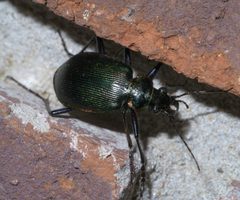
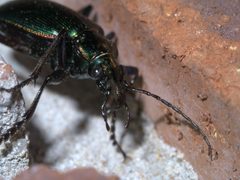
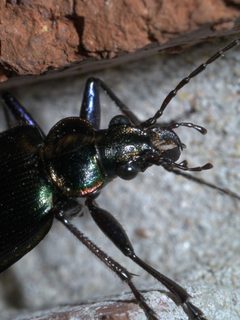
Calosoma wilcoxi is a medium-sized ground beetle in the Calosoma, commonly known as Wilcox's Spring Caterpillar Hunter. It is an arboreal that climbs trees to hunt caterpillars, including fall cankerworms, spring cankerworms, gypsy moth larvae, and eastern tent caterpillars. The is smaller than its Calosoma scrutator (the fiery searcher), typically reaching about one third of that species' size. It has been observed in large numbers during caterpillar in deciduous forests. are active both day and night and possess potent chemical defenses including methacrylic acid and salicylaldehyde.
Pronunciation
How to pronounce Calosoma wilcoxi: /ˌkæ.loʊˈsoʊ.mə ˈwɪl.kɒk.saɪ/
These audio files are automatically generated. While they are not always 100% accurate, they are a good starting point.
Identification
Distinguished from the similar and larger Calosoma scrutator (fiery searcher) by its smaller size (approximately one third the length), less elongated and , and less intense purple coloration on the central area of the pronotum. Temporal occurrence may also differ between the two . Both species exhibit arboreal and chemical defenses, so and behavior alone cannot separate them.
Images
Habitat
Deciduous forests and adjacent gardens, cultivated fields, orchards, and urban trees. Unlike most ground beetles, are frequently found in tree where they hunt caterpillars. Larvae are ground-dwelling. occurs in cavities in the ground.
Distribution
North America: Canada and the United States. Present in eastern and central regions of North America.
Seasonality
are active spring through fall. Mating occurs in June. are deposited in soil in early summer and hatch in approximately one week. Adults overwinter in ground cavities. Most commonly observed during caterpillar in spring and early summer.
Diet
Caterpillars are the primary prey, including fall cankerworms (Alsophila pometaria), spring cankerworms (Paleacrita vernata), gypsy moth larvae (Lymantria dispar), and eastern tent caterpillars (Malacosoma americanum). Also consumes other soft-bodied insects including grasshoppers.
Host Associations
- Quercus spp. - foraging siteoak trees where caterpillar prey are found
- Acer spp. - foraging sitemaple trees where caterpillar prey are found
- Betula spp. - foraging sitebirch trees where caterpillar prey are found
- Alsophila pometaria - preyfall cankerworm
- Paleacrita vernata - preyspring cankerworm
- Lymantria dispar - preygypsy moth
- Malacosoma americanum - preyeastern tent caterpillar
Life Cycle
are deposited in soil in early summer and hatch in approximately one week. Larvae are ground-dwelling that consume caterpillars and other prey. Larval development occurs in soil. live two to three years or possibly longer. Adults overwinter in cavities in the ground.
Behavior
Arboreal foraging is distinctive: climbs trees to hunt caterpillars in , unlike most ground beetles that remain on the ground. are both and . When handled or threatened, releases potent chemical defenses including methacrylic acid and salicylaldehyde that can linger on skin for hours. Fast runners that are difficult to approach for photography. Several literature accounts associate the presence of this with the decline and end of caterpillar in natural forest settings.
Ecological Role
Important agent of caterpillar pests in deciduous forests. by C. wilcoxi has been linked to the termination of cankerworm in natural forest settings. Serves as a natural enemy of several significant forest and agricultural pests including gypsy moth and tent caterpillars.
Human Relevance
Beneficial insect for forest and urban tree health through of caterpillar pests. May occasionally startle humans when encountered in trees. Chemical defenses can cause skin irritation if handled. Vulnerable to degradation from urbanization, which may explain persistent caterpillar in some developed areas where this has been eliminated.
Similar Taxa
- Calosoma scrutatorSimilar appearance, coloration, and arboreal ; distinguished by larger size (25mm+), more elongated and , and more intense purple pronotal coloration
- Calosoma sayiAnother black caterpillar hunter in the same with similar arboreal predatory habits
More Details
Urbanization impact
A meta-analysis of ground beetle responses to urbanization found that large forest-dwelling ground beetles like C. wilcoxi are among the most severely impacted when forests become cities. This may explain why some locations in Maryland, Virginia, and North Carolina experience prolonged cankerworm lasting years or decades—natural by this has been disrupted.
Historical outbreaks
During major caterpillar , such as gypsy moth in Maryland, this has been observed in exceptionally high abundance in forest .
Sources and further reading
- BugGuide
- Wikipedia
- GBIF taxonomy match
- iNaturalist taxon
- NCBI Taxonomy
- Ground beetles up in the air: Calosoma wilcoxi and Calosoma scrutator — Bug of the Week
- Archive — Bug of the Week
- Feasting on the bounty | Beetles In The Bush
- May | 2011 | Beetles In The Bush | Page 2
- Best of BitB 2012 | Beetles In The Bush
- Bug Eric: ID Tip: Ground Beetle or Darkling Beetle?