
Calosoma sycophanta
(Linnaeus, 1758)
forest caterpillar hunter, Agreeable Caterpillar Hunter
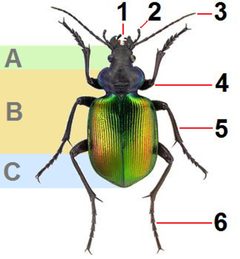
Calosoma sycophanta is a large, metallic ground beetle renowned for its specialized on caterpillars. reach 21–35 mm in length and display striking iridescent green with a bluish scutellum, though coloration shifts with light angle to show blue, bronze, , gold, or black tones. Both adults and larvae are arboreal hunters, ascending trees to prey on caterpillars including Lymantria dispar (gypsy moth), Thaumetopoea processionea (oak processionary), and Thaumetopoea pityocampa. The is and visually orients toward dark objects and tree bases in forests. Native to Europe, it has been introduced to North America for and is now established in the northeastern United States.
Pronunciation
How to pronounce Calosoma sycophanta: /ˌkæ.loʊˈsoʊ.mə ˌsaɪ.kəˈfæntə/
These audio files are automatically generated. While they are not always 100% accurate, they are a good starting point.
Identification
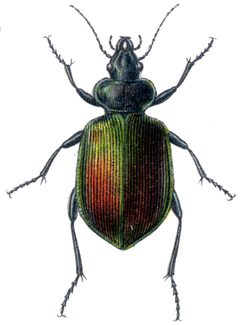
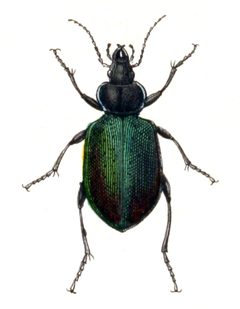
Distinguished from by its large size (21–35 mm), metallic bright green with iridescent color shifts, and bluish metallic scutellum. The is black; pronotum is transverse, posteriorly sharply narrowed, wrinkled and punctured. Elytra are flattened with clearly visible punctures in the . Larger than Calosoma wilcoxi (which is about one-third its size) and differs from Calosoma scrutator in having less elongated and less intense purple coloration on the central pronotum.
Images
Habitat
Forests, particularly oak woodlands; and larvae live in trees. In North America, associated with deciduous forests where gypsy moth and other caterpillar prey occur.
Distribution
Native to Europe, present in most European countries, eastern , Near East, and North Africa. Introduced to North America in 1905–1907 near Boston, Massachusetts; now established from southern Maine through New England, south to Pennsylvania, Delaware, Maryland, and West Virginia. Recently recorded range expansion in Western Siberia, Russia (300 km north, 600 km east). Historically native to Britain but now possibly nationally extinct.
Seasonality
active during caterpillar ; in North America, associated with spring through fall activity depending on prey availability. Mating occurs in June; deposited in soil in early summer and hatch in approximately one week.
Diet
Voracious of caterpillars. Prey includes Lymantria dispar (gypsy moth), Thaumetopoea processionea (oak processionary), Thaumetopoea pityocampa, Euproctis chrysorrhoea (brown-tail moth), and fall cankerworms (Alsophila pometaria). Both larvae and feed on caterpillars; larvae have been observed destroying up to 70% of gypsy moth pupae under burlap bands. Adults show preference for Vairimorpha disparis-infected larvae over uninfected or Nosema lymantriae-infected larvae.
Life Cycle
deposited in soil in early summer, hatching in approximately one week. Larvae are ground-dwelling initially but ascend trees to prey on caterpillars; they also prey on pupae under burlap bands and near ground level. Larval development occurs through multiple instars; presumably in soil. live 2–3 years or longer. Both adults and larvae are arboreal, living in trees rather than on the ground.
Behavior
. visually orient toward dark objects and tree bases, moving faster toward large-diameter dark cylinders than light ones. This orientation positions them to find caterpillar prey in trees or hiding spots. Adults and larvae actively hunt in tree . Adults are fast-moving and difficult to approach; when handled, they discharge defensive chemicals including methacrylic acid and salicylaldehyde. Males tend to aggregate more than females and move about more actively, likely seeking mates; females spend more time hidden in leaf litter or ovipositing in soil. estimated at approximately 6 km/year in North America.
Ecological Role
Important of forest caterpillars, particularly during . Can substantially reduce gypsy moth ; studies suggest a relatively low of can destroy approximately 40% of pupae in a given area. Acts as a for microsporidian (Nosema lymantriae and Vairimorpha disparis), disseminating spores through prey consumption and , thereby influencing pathogen transmission in gypsy moth populations.
Human Relevance
Introduced to North America in 1905–1907 and subsequently released multiple times as a agent against the gypsy moth (Lymantria dispar), an pest of forests. Currently being considered for reintroduction to Britain to control the invasive oak processionary (Thaumetopoea processionea). Used in mass-rearing programs for biocontrol releases. Valued by entomologists and naturalists for its striking appearance and ecological importance.
Similar Taxa
- Calosoma scrutatorSimilar metallic coloration and caterpillar-hunting , but larger (typically 25+ mm), with more elongated and , and more intense purple central pronotum coloration.
- Calosoma wilcoxiSmaller cousin (about one-third the size of C. sycophanta), similar arboreal caterpillar-hunting , but distinguished by smaller size and less vivid coloration.
- Calosoma sayiAll-black coloration without metallic green; similar large size and predatory on caterpillars, but readily distinguished by lack of iridescent green .
Sources and further reading
- BugGuide
- Wikipedia
- GBIF taxonomy match
- iNaturalist taxon
- NCBI Taxonomy
- Ground beetles up in the air: Calosoma wilcoxi and Calosoma scrutator — Bug of the Week
- Feasting on the bounty | Beetles In The Bush
- May | 2011 | Beetles In The Bush | Page 2
- Best of BitB 2012 | Beetles In The Bush
- Bug Eric: ID Tip: Ground Beetle or Darkling Beetle?
- November | 2012 | Beetles In The Bush | Page 2
- Calosoma sycophanta : its life history, behavior, and successful colonization in New England /
- ORIENTATION OFCALOSOMA SYCOPHANTAL. (COLEOPTERA: CARABIDAE) IN FORESTS: INSIGHTS FROM VISUAL RESPONSES TO OBJECTS
- Reintroducing a nationally extinct predator, the forest caterpillar hunter (Calosoma sycophanta), for biocontrol of the invasive oak processionary (Thaumetopoea processionea) in Britain: considerations, benefits and risks
- The Importance of Prey for Fecundity and Behavior in the Gypsy Moth (Lepidoptera: Lymantriidae) Predator Calosoma sycophanta (Coleoptera: Carabidae)
- BEHAVIOR OF THE GYPSY MOTH PREDATOR, CALOSOMA SYCOPHANTA L. (CARABIDAE: COLEOPTERA), AS INFLUENCED BY TIME OF DAY AND REPRODUCTIVE STATUS
- Releases of Calosoma sycophanta (Coleoptera: Carabidae) Near the Edge of Gypsy Moth (Lepidoptera: Lymantriidae) Distribution
- Evaluation of Insect Spatial Distributions by Spectral Analysis, with Particular Reference to the Gypsy Moth (Lepidoptera: Lymantriidae) and Calosoma sycophanta (Coleoptera: Carabidae)
- Changes in Population Size, Dispersal Behavior, and Reproduction of Calosoma sycophanta (Coleoptera: Carabidae), Associated with Changes in Gypsy Moth, Lymantria dispar (Lepidoptera: Lymantriidae), Abundance
- Emigration and spatial dispersion of the gypsy moth predator Calosoma sycophanta
- PREDATION BY CALOSOMA SYCOPHANTA L. (COLEOPTERA: CARABIDAE): EVIDENCE FOR A LARGE IMPACT ON GYPSY MOTH, LYMANTRIA DISPAR L. (LEPIDOPTERA: LYMANTRIIDAE), PUPAE
- New records and range expansion of Calosoma sycophanta (Linnaeus, 1758) (Coleoptera, Carabidae) in Western Siberia, Russia
- Distribution of microsporidial infection in the predator beetle, Calosoma sycophanta(Coleoptera:Carabidae)-rearing laboratories in Turkey
- Current Distribution and Historical Range Expansion of Calosoma sycophanta (L.) (Coleoptera: Carabidae) in North America
- Influence of the forest caterpillar hunter Calosoma sycophanta on the transmission of microsporidia in larvae of the gypsy moth Lymantria dispar