
Alsophila pometaria
(Harris, 1841)
Fall Cankerworm Moth, Fall Cankerworm, Inchworm
Alsophila pometaria, the fall cankerworm, is a native North American geometrid notable for its sexually dimorphic : males are winged and capable of , while females are wingless, flightless, and lack functional mouthparts. The exhibits a distinctive with adult in late autumn and early winter, -laying on tree bark, and larval feeding in spring. Caterpillars are known as "inchworms" or "loopers" due to their characteristic looping locomotion. The species is a defoliator of deciduous hardwood trees and can reach densities, causing significant economic and ecological impact.
Pronunciation
How to pronounce Alsophila pometaria: /ælsəˈfaɪlə poʊmɪˈtɛəriə/
These audio files are automatically generated. While they are not always 100% accurate, they are a good starting point.
Identification
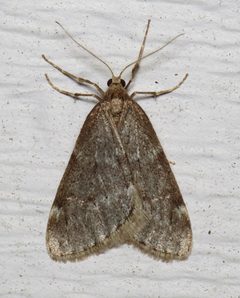
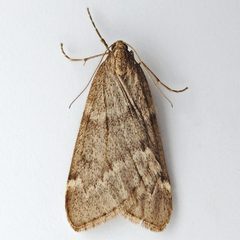
are most readily distinguished from similar cankerworm by seasonal activity: fall cankerworm adults emerge in late autumn through early winter, while spring cankerworm (Paleacrita vernata) adults emerge in late winter through early spring. Males of A. pometaria have distinctly banded forewings with irregular white markings, whereas spring cankerworm males have more uniform gray-brown coloration. Females are reliably identified only by association with males or by geographic and temporal occurrence. Larvae are distinguished from other inchworms by the reduced first pair of on abdominal segment 8 (a trait shared with spring cankerworm), and from Noctuidae larvae by having only three pairs of prolegs rather than four or five. The combination of larval proleg structure and adult season separates this species from all other North American geometrids.
Images
Habitat
Deciduous hardwood forests, urban and suburban landscapes with mature shade trees, parklands, and forest edges. Larval is the of trees during spring feeding period. females require vertical structures (tree trunks, building walls) for climbing to oviposition sites. Soil with suitable texture for pupal cocoon burial is required for successful .
Distribution
Native to North America; occurs from Nova Scotia westward across Canada to Alberta, southward through the United States to Colorado and California. Core range includes the northeastern and north-central United States and adjacent southern Canada. Western are more scattered and associated with suitable tree availability in riparian and montane areas.
Seasonality
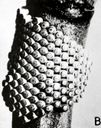
emerge from soil pupal cases beginning in late October through November, with activity continuing into December and January during mild weather. Mating occurs on winter nights when temperatures permit activity. are deposited on tree bark from late autumn through early winter and overwinter in this stage. Larvae hatch in early spring coincident with tree bud break and leaf expansion, typically March through May depending on latitude and elevation. Larval feeding continues for 4–6 weeks. occurs in late spring and early summer, with adults remaining in pupal chambers until autumn .
Diet
Larvae are folivores feeding on young, expanding leaves of multiple deciduous hardwood tree . Documented include: Ulmus (elm), Fraxinus (ash), Acer (maple), Quercus (oak), Carya (hickory), Fagus (beech), and various members of Rosaceae, Juglandaceae (walnut), and Salicaceae (willow). Larvae consume entire leaf blades leaving only midribs and major at high densities. do not feed; females lack functional mouthparts and die shortly after oviposition.
Host Associations
- Ulmus americana - larval food plantAmerican elm, preferred in many areas
- Fraxinus spp. - larval food plantAsh widely utilized
- Acer spp. - larval food plantMaple including sugar maple and red maple
- Quercus spp. - larval food plantOak major in areas
- Carya spp. - larval food plantHickory
- Fagus grandifolia - larval food plantAmerican beech
- Juglans spp. - larval food plantWalnut
- Salix spp. - larval food plantWillow
- Celtis occidentalis - larval food plantHackberry
- Rosaceae - larval food plantVarious members including cherry and apple
Life Cycle
Holometabolous complete with four stages: , larva, pupa, . Eggs are laid in clusters on bark of twigs and branches, in this stage. Larvae hatch in early spring and pass through five or six instars over 4–6 weeks. First instar larvae may disperse via silk ballooning to locate suitable foliage. Final instar larvae descend to ground and burrow into soil to construct silk cocoon around pupa. Pupal stage lasts approximately 6–7 months, with adults developing within but remaining until autumn . Adults emerge from soil, females climb vertical structures and release to attract flying males. After mating, females deposit eggs and die within days. Single per year ().
Behavior
females exhibit positive geotaxis after , climbing upward on tree trunks and other vertical surfaces to reach oviposition sites in the . Females release -specific beginning shortly after sunset on mild winter nights; males exhibit strong positive anemotaxis, flying upwind to locate sources. Larvae display characteristic "looper" locomotion, arching the body into a loop and extending to grasp with legs, then drawing legs forward. When disturbed, larvae drop from foliage on silk threads and hang suspended, a that facilitates and avoidance. Larvae are solitary feeders but can reach high densities during , resulting in collective defoliation of entire canopies. occurs in soil with burrowing behavior by prepupal larvae.
Ecological Role
As a native herbivore, larvae function as primary consumers in deciduous forest , transferring energy from foliage to higher . During , cankerworms significantly alter forest canopy structure and light penetration, with cascading effects on understory vegetation and forest microclimate. Defoliation can reduce tree growth and, when repeated in consecutive years, cause tree mortality particularly in stressed individuals. The serves as important prey for multiple vertebrate and . Larvae are consumed by numerous bird species including warblers, vireos, and woodpeckers. The ground beetle Calosoma frigidum actively preys on larvae. are parasitized by the scelionid Telenomus alsophilae. Larvae are parasitized by the braconid wasp Aleiodes gastritor. These natural enemies contribute to and ecosystem stability.
Human Relevance
Economic pest of shade trees, orchards, and forest resources. cause severe defoliation of urban street trees, park trees, and forest stands, reducing aesthetic value, tree health, and property values. Repeated defoliation can kill trees, particularly those already stressed by drought, compaction, or other factors. Management approaches include: tree banding with sticky barriers to intercept climbing females; applications to foliage for larval control; through conservation of natural enemies; and burlap banding for population monitoring. The has been studied extensively for its unusual reproductive including female flightlessness and parthenogenetic , contributing to understanding of evolution and -plant . Climate change may alter phenological synchrony between hatch and host leaf , potentially affecting .
Similar Taxa
- Paleacrita vernataSpring cankerworm, closely related with nearly identical larval and female flightlessness; distinguished primarily by season (late winter-early spring vs. late autumn-early winter for A. pometaria); male forewings less distinctly patterned.
- Operophtera brumataWinter moth, introduced European with similar including female flightlessness and winter activity; distinguished by geographic range (primarily northeastern North America), male wing pattern, and subtle differences in larval .
- Erannis tiliariaLinden looper, related geometrid with female flightlessness and similar ; distinguished by preference (Tilia, linden), and geographic distribution.
- Lomographa vestaliataWhite slant-line, geometrid with similar larval looping locomotion but both sexes winged and active in summer; larvae feed on multiple but do not overwinter as on bark.
More Details
Sexual Dimorphism and Reproductive Biology
The extreme in A. pometaria represents one of the most striking examples of female flightlessness (aptery) in Lepidoptera. This trait has evolved independently in multiple geometrid lineages. The adaptive significance is hypothesized to involve resource reallocation: energy and nutrients that would otherwise support wing development and musculature in females are instead directed toward production, potentially increasing . Females produce 100+ eggs. Some exhibit parthenogenetic (gynogenesis), with clonal lineages specialized on particular tree showing different egg-hatching times that match host .
Population Dynamics and Outbreak Cycles
Alsophila pometaria is classified as an eruptive herbivore, exhibiting irregular separated by years or decades of low . Outbreaks may involve millions of larvae per hectare, resulting in complete defoliation of tree . Population crashes typically follow due to starvation, , or natural enemy mortality. Climate variability, particularly spring temperature patterns affecting synchrony between hatch and leaf , appears to influence outbreak probability. Urban heat islands may facilitate earlier spring activity and altered in city populations.
Genetic and Clonal Structure
Research has documented extensive clonal diversity in A. pometaria, with multiple lineages coexisting with sexual . Clonal lineages show evidence of -plant specialization, with different exhibiting optimal performance on different tree . This genetic structure may represent an to spatial variation in host across heterogeneous landscapes. The interaction between sexual and asexual in this species has made it an important model for studying the evolutionary maintenance of sex and the ecological consequences of clonal diversity.
Sources and further reading
- BugGuide
- Wikipedia
- GBIF taxonomy match
- iNaturalist taxon
- NCBI Taxonomy
- Catalogue of Life
- Inch by Inch, Fall Cankerworms Will Eat Your Trees
- Bug Eric: New Year’s Insects and Spiders
- Archive — Bug of the Week
- Bug Eric: 2026
- Chilly winter days can’t stop the fall cankerworm, Alsophila pometaria — Bug of the Week
- Wintry appearance of a strange moth: Fall cankerworm, Alsophila pometaria — Bug of the Week
- The Origin and Distribution of Clonal Diversity in Alsophila pometaria (Lepidoptera: Geometridae)
- Genetic Variation and Covariation in Responses to Host Plants by Alsophila pometaria (Lepidoptera: geometridae)
- THE ORIGIN AND DISTRIBUTION OF CLONAL DIVERSITY IN ALSOPHILA POMETARIA (LEPIDOPTERA: GEOMETRIDAE)
- GENETIC VARIATION AND COVARIATION IN RESPONSES TO HOST PLANTS BY ALSOPHILA POMETARIA (LEPIDOPTERA: GEOMETRIDAE)
- The Role of Parthenogenesis and Female Aptery in Microgeographic, Ecological Adaptation in the Fall Cankerworm, Alsophila Pometaria Harris (Lepidoptera: Geometridae)
- Adaptation to Host Plants in the Fall Cankerworm (Alsophila pometaria) and Its Bearing on the Evolution of Host Affiliation in Phytophagous Insects
- The nutritional ecology of larvae of Alsophila pometaria and Anisota senatoria feeding on early‐ and late‐season oak foliage