
Operophtera brumata
(Linnaeus, 1758)
Winter Moth
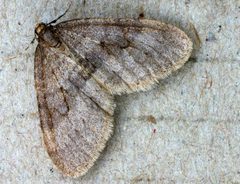
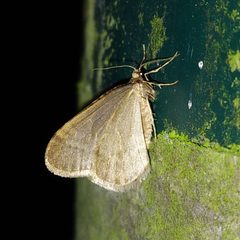
Operophtera brumata, the winter moth, is a geometrid native to Europe and the Near East that has been introduced to North America. It is notable among temperate Lepidoptera for activity during late fall and early winter. Females are flightless, while males are fully winged. The is a significant pest of deciduous trees and an important food source for birds such as Blue Tits, which feed their young almost exclusively on winter moth caterpillars. The USA National Network includes this species in its Pheno Forecast program to aid pest management.
Pronunciation
How to pronounce Operophtera brumata: /ˌɒpəˈrɒftə ˈbruːmətə/
These audio files are automatically generated. While they are not always 100% accurate, they are a good starting point.
Identification
Females are readily distinguished from most other by their flightless, wingless condition; males can be identified by their late fall/early winter period. Distinguished from the native North American Bruce spanworm (Operophtera bruceata) by genetic and morphological characteristics; the two form a hybrid zone where their ranges overlap.
Images
Appearance
males have fully developed wings and fly strongly; females are virtually wingless and cannot fly. Adults are active after the initial frosts of late fall.
Habitat
Deciduous forests, orchards, and areas with trees including fruit trees and shrubs. In North America, found in forested and agricultural areas of the Northeast and Pacific Northwest.
Distribution
Native to Europe and the Near East; introduced to North America. Present in Canada (Nova Scotia, British Columbia), the United States (Northeast, Pacific Northwest including western Oregon), and has been recorded in Japan, North Africa (Algeria, Tunisia), and other regions.
Seasonality
are active in late fall and early winter, typically after the first frosts. This unusual distinguishes it from most temperate Lepidoptera. Caterpillars hatch in spring, coinciding with the breeding season of predatory birds such as Blue Tits.
Host Associations
- Quercus rubra - red oak; significant defoliation recorded in Nova Scotia
- Ulmus americana - white elm
- Malus - apple and related fruit trees
- Cyanistes caeruleus - Blue Tit; feeds young almost exclusively on winter moth caterpillars, with single consuming over 100,000 caterpillars
- Philonthus decorus - predatory rove beetle; preys upon winter moth pupae
Life Cycle
emerge and mate in late fall and early winter after initial frosts. Flightless females climb tree trunks and release to attract flying males. are laid on trees. Caterpillars hatch in spring and feed on host foliage. occurs in soil, where pupae are vulnerable to by ground-dwelling beetles such as Philonthus decorus.
Behavior
Females exhibit a distinctive mate-seeking : they climb tree trunks at night and emit to attract males. This behavior is disrupted by artificial light at night, which can inhibit female movement and reduce male attraction to illuminated trees, thereby impairing .
Ecological Role
As a herbivore, winter moth caterpillars defoliate deciduous trees and can cause significant damage in . As prey, they serve as a critical food resource for insectivorous birds, particularly during spring breeding seasons. The pupal stage is preyed upon by soil-dwelling including rove beetles. by natural enemies influences in parts of its introduced range.
Human Relevance
Significant economic pest of orchards and forests, causing defoliation of fruit trees and shade trees. The USA National Network provides Pheno Forecast maps for this to help forest managers, arborists, and professionals optimize control efforts. Light pollution from artificial lighting has been identified as a threat to the species, with conservation implications for both the and dependent bird .
Similar Taxa
- Operophtera bruceataNative North American (Bruce spanworm) with which O. brumata hybridizes; forms a clinal hybrid zone in the northeastern United States. Distinguished by genetic and subtle morphological differences.
- Alsophila pometariaFall cankerworm; historically confused with winter moth in Nova Scotia, but occur in fall rather than late fall/winter and females are winged.
- Paleacrita vernataSpring cankerworm; occur in spring, not late fall/winter, and have different seasonal .
More Details
Light pollution impacts
Artificial light at night affects winter moth in two ways: illuminated trees may trap females in permanent daylight conditions, disrupting their climbing and increasing risk; and artificial light inhibits male attraction to female , reducing mating success. These effects can cascade to bird dependent on winter moth caterpillars as food.
Hybrid zone dynamics
The hybrid zone between introduced O. brumata and native O. bruceata represents one of the first documented examples of real-time formation and geographic settling of a clinal hybrid zone. The zone's location appears independent of environmental variables such as winter temperature extremes, instead being maintained by , reduced hybrid , and low rates under a tension zone model.
Sources and further reading
- BugGuide
- GBIF taxonomy match
- iNaturalist taxon
- NCBI Taxonomy
- Catalogue of Life
- Dim the Lights for Birds (and Bugs) at Night! - Buglife Blog - Buglife
- National Phenology Network Aids Pest Management With Insect Forecast Maps
- Operophtera brumata . [Distribution map].
- Distribution and Parasitism of Winter Moth, Operophtera brumata (Lepidoptera: Geometridae), in Western Oregon
- Biology of Philonthus decorus (Coleoptera, Staphylinidae) ,in relation to its role as a predator ofwinter m oth pupae [Operophtera brumata (Lepidoptera, Geometridae)]
- Real-time geographic settling of a hybrid zone between the invasive winter moth (Operophtera brumata L.) and the native Bruce spanworm (O. bruceata Hulst)
- The Distribution, Life History, and Economic Importance of the Winter Moth, Operophtera brumata (L.) (Lepidoptera, Geometridae) in Nova Scotia