
Aleiodes
Wesmael, 1838
mummy-wasps, Common Mummy Wasps
Species Guides
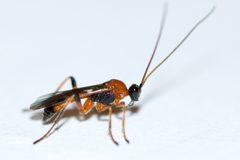
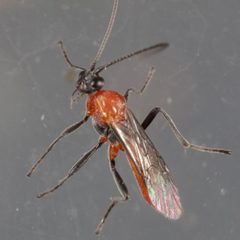
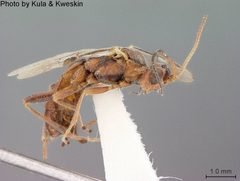
21Aleiodes is a large of in the Braconidae, commonly known as mummy-wasps. The genus was established by Constantin Wesmael in 1838 and contains thousands of described , with exceptional diversity in the Western Hemisphere. Females are solitary koinobiont endoparasitoids that attack caterpillars, laying inside living . The developing wasp larvae consume the host from within, eventually killing it and causing the remains to harden into a distinctive 'mummy' from which the emerges.
Pronunciation
How to pronounce Aleiodes: /ˌæliˈoʊdiːz/
These audio files are automatically generated. While they are not always 100% accurate, they are a good starting point.
Identification
Members of Aleiodes can be distinguished from other braconid by their characteristic mummification of caterpillars—leaving hardened, intact host remains with a small hole. The genus name derives from Greek roots meaning 'not smooth appearance', alluding to sculptured body surfaces. Some groups exhibit distinctive morphological features, such as the Asian spurivena group with a reclivous spur on fore wing 1–1A. Accurate species identification typically requires examination of wing venation, structure, and other fine morphological details, often necessitating taxonomic expertise.
Images
Habitat
Aleiodes occupy diverse terrestrial including pastures, vegetable gardens, orchards, olive groves, and trefoil fields at varying altitudes. Collections have been made using sweep nets and , suggesting activity in vegetation zones where caterpillars are abundant. Specific habitat preferences vary by species.
Distribution
distribution with exceptional in the Western Hemisphere. Documented from North America (including Washington State and Okanogan County), South America (Ecuador, with numerous new described from cloud forests), Europe (including Bozcaada/Tenedos Island, Turkey; Denmark; Norway; Sweden), and Asia (Vietnam, Thailand, Nepal, India, Western Malaysia, South Korea).
Host Associations
- Macrolepidoptera larvae (Noctuoidea) - koinobiont endoparasitoidprimary ; includes spongy
- Macrolepidoptera larvae (Geometroidea) - koinobiont endoparasitoid
- Macrolepidoptera larvae (Arctioidea) - koinobiont endoparasitoidrarely used
- Macrolepidoptera larvae (Sphingoidea) - koinobiont endoparasitoidrarely used
- Macrolepidoptera larvae (Papilionoidea) - koinobiont endoparasitoidrarely used
- Spodoptera species - koinobiont endoparasitoiddocumented for A. ceres
- Tent caterpillars (Malacosoma) - koinobiont endoparasitoidpest frequently targeted
Life Cycle
Solitary koinobiont endoparasitoid . Females deposit directly into living caterpillar . Eggs hatch and larvae feed internally, allowing the host to continue development temporarily. The larva eventually consumes the host entirely, causing the remains to harden into a protective 'mummy'. occurs within the mummy, with the wasp emerging through a small circular hole in the host .
Behavior
Females actively search for and attack caterpillars, using the ovipositor to deposit inside the body. The 's development induces distinctive host in some ; for example, A. shakirae causes infected caterpillars to bend and twist their in a manner reminiscent of belly dancing. are presumably short-lived and focused on and host location.
Ecological Role
Potentially important agents against lepidopteran pest insects. By parasitizing caterpillars of agricultural and forestry pests—including spongy , tent caterpillars, and Spodoptera —Aleiodes species help regulate herbivore naturally. Their koinobiont strategy allows them to exploit that would otherwise continue feeding and causing damage.
Human Relevance
Several Aleiodes have been named after celebrities, drawing public attention to insect and tropical biodiversity. Aleiodes shakirae was featured in the Danish museum exhibition 'From Rock Fossils to Pop Insects' at Naturama Museum in Svendborg. Other eponymous species include A. colberti (Stephen Colbert), A. falloni (Jimmy Fallon), A. stewarti (Jon Stewart), A. elleni (Ellen DeGeneres), A. gaga (Lady Gaga), and A. frosti (Robert Frost). These naming choices have generated media coverage and public engagement with entomological research. The has also been the subject of multiple sequencing projects (A. similis, A. leptofemur, A. testaceus), contributing to understanding of evolution and .
Similar Taxa
- Other Rogadinae generashare characteristics but lack the distinctive mummification and hardened remains typical of Aleiodes
- Other Braconidae generamany are also caterpillar but do not produce the characteristic 'mummy' with hole; require examination of wing venation and body sculpturing for separation
More Details
Etymology
The name derives from Greek: ἀ (a, 'not'), λείος (leios, 'smooth'), and εἵδος (eidos, 'appearance'), referring to the sculptured, non-smooth body surface typical of these .
Taxonomic diversity
Thousands of have been described, with 24 new species discovered from eastern Ecuador cloud forests in a single 2014 study alone. Three new species were described from Washington State in 2021 (A. khalafi, A. okanoganensis, A. quasiburrus), and 10 species were documented from Bozcaada Island, Turkey, representing first records for that fauna.
Research significance
Multiple Aleiodes have had their sequenced (A. similis, A. leptofemur, A. testaceus), contributing to comparative studies of , venom evolution, and manipulation mechanisms.
Sources and further reading
- BugGuide
- Wikipedia
- GBIF taxonomy match
- iNaturalist taxon
- NCBI Taxonomy
- Catalogue of Life
- Primary Type List | Entomology Research Museum
- Denmark Museum Highlights UW Entomologist’s Naming of Shakira Wasp
- Türkiye’nin Bozcaada (Tenedos) Parazitoit Aleiodes Wesmael, 1838 (Hymenoptera: Braconidae: Rogadinae) Türleri Parasitoid species of Aleiodes Wesmael, 1838 (Hymenoptera: Braconidae: Rogadinae) from Bozcaada (Tenedos) Island, Turkey
- Figure 1 from: Quicke D, Butcher B, Smith M (2011) A new derived species group of Aleiodes parasitoid wasps (Hymenoptera, Braconidae, Rogadinae) from Asia with descriptions of three new species. Journal of Hymenoptera Research 23: 35-42. https://doi.org/10.3897/jhr.23.1663
- Aleiodes (Hymenoptera, Braconidae, Rogadinae) diversity in Washington U.S.A. including three new species
- The genome sequence of the Common Mummy Wasp, Aleiodes similis (Curtis, 1834) (Hymenoptera: Braconidae).
- New records of the genus Aleiodes (Hymenoptera, Rogadinae) from South Korea.
- Parasitism by Aleiodes ceres Shimbori, 2023 (Hymenoptera: Braconidae) of three species of Spodoptera Guenée, 1852: effects of preferential instar and host diet.
- The genome sequence of a braconid wasp, Aleiodes testaceus (Telenga, 1941).
- The genome sequence of a braconid wasp, Aleiodes leptofemur van Achterberg & Shaw, 2016.
- Resolution of the Aleiodesseriatus (Herrich-Schäffer, 1838)-aggregate in the western Palaearctic (Hymenoptera, Braconidae, Rogadinae), with description of a new species.