
Rogadinae
Mummy Wasps
Genus Guides
5- Aleiodes(mummy-wasps)
- Polystenidea
- Stiropius
- Triraphis(Needlegrass)
- Yelicones
Rogadinae is a large, of braconid commonly known as "mummy wasps." Members are koinobiont endoparasitoids of lepidopteran larvae, uniquely characterized by causing their caterpillars to mummify—the wasp larva pupates within the desiccated host remains. The subfamily contains six tribes (Aleiodini, Betylobraconini, Clinocentrini, Rogadini, Stiropiini, Yeliconini) and is especially diverse in the Aleiodes. Several are important natural agents of agricultural pest caterpillars.
Pronunciation
How to pronounce Rogadinae: /rɔˈɡa.dɪ.naɪ/
These audio files are automatically generated. While they are not always 100% accurate, they are a good starting point.
Identification
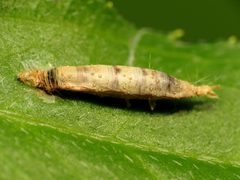
Rogadinae can be distinguished from other braconid by the combination of: cyclostome mouthparts, medial ridge on the , and the unique mummy-making where the caterpillar is reduced to a desiccated husk containing the pupa. The subfamily Aleiodini ( Aleiodes) is distinguished by sculptured, -like metasomal tergite IV. The coxalis -group has vertex and sculptured fourth metasomal . Host mummies are distinctive and can be used to identify species. Separation from Hormiinae and Lysiterminae (now synonymized under Hormiinae based on phylogenomic data) requires molecular or detailed morphological analysis.
Images
Appearance
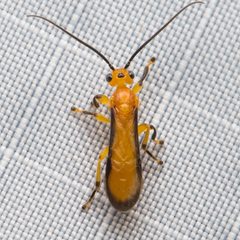
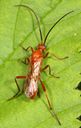
Small , usually under 8 mm in length. Cyclostome mouthpart structure (circular opening). Typically possess a medial ridge on the . Body form varies among ; Aleiodes often have sculptured, -like metasomal tergite IV. Members of the Tetrasphaeropyx lineage are distinguished by sculptured fourth metasomal . Coloration ranges from uniformly dark to patterned with black, white, and orange markings in some tropical species.
Habitat
Diverse terrestrial including forests, grasslands, agricultural areas, and alpine meadows. Collection records span elevations from sea level to over 3,400 meters. are often found in vegetation near caterpillar habitats. Many are as adults. Habitats include: pastures, vegetable gardens, orchards, olive groves, trefoil areas, and native vegetation across temperate and tropical regions.
Distribution
distribution across all major zoogeographical regions: Afrotropical, Australasian, Nearctic, Neotropical, Oceania, Oriental, and Palaearctic. Particularly diverse in the Western Hemisphere. Documented from: North America (USA, Canada, Mexico), Central and South America ( Rica, Brazil, Peru, Chile), Europe (widespread including UK, Scandinavia, Mediterranean, Eastern Europe), Turkey, Iran, South Korea, Thailand, Papua New Guinea, Australia, New Zealand, and Africa.
Seasonality
activity patterns vary by region and . Many species are . In temperate regions, adults emerge in spring and summer; in tropical regions, activity may occur year-round. Specific seasonal data limited for most species.
Host Associations
- Lepidoptera: Noctuidae - primary Major including agricultural pests like Heliothis peltigera
- Lepidoptera: Geometridae - primary Exclusive of Aleiodes (Tetrasphaeropyx) lineage; includes forest and agricultural pests
- Lepidoptera: Arctiidae/Erebidae - Documented for multiple Aleiodes
- Lepidoptera: Lasiocampidae - Tent caterpillars and lappet moths
- Lepidoptera: Notodontidae - Prominent moths
- Lepidoptera: Pyralidae/Crambidae - Snout moths including agricultural pests
- Lepidoptera: Nymphalidae - rare Brush-footed butterflies
- Lepidoptera: Lycaenidae - rare Gossamer-winged butterflies
- Lepidoptera: Papilionoidea - rare Swallowtails and related butterflies
- Lepidoptera: Sphingoidea - rare Hawk moths
- Lepidoptera: Dalceridae - New record for Triraphis ( Rica)
- Lepidoptera: Megalopygidae - New record for Triraphis ( Rica)
- Lepidoptera: Tortricidae - Leafroller moths
- Lepidoptera: Gelechiidae - Twirler moths
- Lepidoptera: Yponomeutidae - Ermine moths
- Lepidoptera: Pterophoridae - Plume moths
- Lepidoptera: Zygaenidae - Burnet and forester moths
- Lepidoptera: Drepanidae - Hook-tip moths
- Lepidoptera: Endromidae - Kentish glory and related
- Lepidoptera: Elachistidae - Grass-miner moths
- Lepidoptera: Lyonetiidae - Leaf-miner moths ( )
- Lepidoptera: Ennominae (Geometridae) - Specific of geometrid moths
Life Cycle
Koinobiont endoparasitoid development: females oviposit into larvae, which continue to feed and grow while the larva develops internally. The host is eventually killed and mummified—reduced to a desiccated husk. The wasp larva then pupates within the mummy, and the emerges by cutting an exit hole. Development is solitary (one wasp per host) in most . The mummified host remains are distinctive and can be used for species identification.
Behavior
Females actively search for caterpillars and use their ovipositor to inject into the host body. Many are as . Host searching includes utilization of chemical cues from host plants and . Some species display specialized behaviors: for example, the mummy-making process is unique among braconids in Rogadinae. Adult may feed on nectar, honeydew, or not feed at all (specific adult diet poorly documented for most species).
Ecological Role
Important natural agents of lepidopteran , including agricultural and forest pest caterpillars. By parasitizing herbivorous larvae, they help regulate plant damage and maintain balance. Some have been introduced internationally for biocontrol purposes (e.g., to USA, Canada, Yugoslavia). The mummification may also influence nutrient cycling in ecosystems through altered decomposition patterns of remains.
Human Relevance
Significant value in biological pest control. Several parasitize economically important pest caterpillars including: Heliothis peltigera (safflower pest), various Noctuidae (cutworms, armyworms), Geometridae (inchworms/loopers), and (). Some species have been introduced to new regions for . The distinctive mummies are used by researchers and practitioners to monitor rates and identify species. Taxonomic research on Rogadinae has generated notable culturally-referenced species names (e.g., Aleiodes shakirae, Troporhogas rogerfedereri, T. rafaelnadali).
Similar Taxa
- HormiinaePreviously considered a separate , but phylogenomic studies show Hormiinae and Lysiterminae are not reciprocally monophyletic with Rogadinae; all three are now united under an expanded Hormiinae concept. Historically distinguished by different associations and habits.
- LysiterminaeAnother now synonymized under Hormiinae based on molecular ; previously distinguished from Rogadinae by morphological and biological characteristics that are now recognized as convergent.
- MicrotypinaeRelated of Braconidae with some morphological similarities; distinguished by different associations (typically of wood-boring beetles rather than Lepidoptera larvae) and lack of mummy-making .
- Other Braconidae subfamilies (e.g., Microgastrinae)Microgastrinae are also koinobiont endoparasitoids of Lepidoptera but lack the distinctive mummy-making of Rogadinae; they typically emerge from living or freshly dead rather than mummified remains.
More Details
Taxonomic composition
Rogadinae contains six tribes: Aleiodini ( Aleiodes with >400 ), Betylobraconini (including Gondwanocentrus from Chile), Clinocentrini, Rogadini (including Rogas), Stiropiini, and Yeliconini (including Yelicones). Recent phylogenomic studies have synonymized Xenolobus and Bequartia within Aleiodes, and Promesocentrus with Pilichremylus.
Molecular systematics
Ultraconserved element (UCE) phylogenomics has provided nearly fully resolved for Rogadinae, confirming monophyly including Betylobraconini. Ancestral preference was likely attacking concealed lepidopteran larvae, with at least two transitions to attacking both concealed and exposed hosts.
Species diversity
Extremely -rich; Aleiodes alone contains hundreds of described species with many more undescribed. The Tetrasphaeropyx lineage within Aleiodes includes 72+ species. The Triraphis is most diverse in the New World. High diversity remains to be discovered, especially in tropical regions.
Collection methods
are collected using , sweep nets, light traps, and yellow pan traps. Rearing from caterpillars is essential for documenting host associations and obtaining biological data. Mummified host remains are valuable for identification.
Sources and further reading
- BugGuide
- Wikipedia
- iNaturalist taxon
- NCBI Taxonomy
- Zookeys | Blog - Part 32
- Uncategorized | Blog - Part 40
- celebrities | Blog
- Pensoft blog - Part 145
- Pensoft blog - Part 129
- wasps | Blog
- Türkiye’nin Bozcaada (Tenedos) Parazitoit Aleiodes Wesmael, 1838 (Hymenoptera: Braconidae: Rogadinae) Türleri Parasitoid species of Aleiodes Wesmael, 1838 (Hymenoptera: Braconidae: Rogadinae) from Bozcaada (Tenedos) Island, Turkey
- Contribution to the Rogadinae (Hymenoptera, Braconidae) fauna of Turkey
- An annotated catalogue of the Iranian Microtypinae and Rogadinae (Hymenoptera: Braconidae)
- The First Host Association for Aleiodes shawi (Hymenoptera: Braconidae: Rogadinae)
- Aleiodes (Hymenoptera, Braconidae, Rogadinae) diversity in Washington U.S.A. including three new species
- Revision of Yelicones (Hymenoptera : Braconidae : Rogadinae) from the Australasian region
- Phylogenomics of the lepidopteran endoparasitoid wasp subfamily Rogadinae (Hymenoptera: Braconidae) and related subfamilies
- A new species of Aleiodes (Hymenoptera, Braconidae, Rogadinae) from Brazil, with biological notes
- A Revision of the Tetrasphaeropyx Ashmead Lineage of the Genus Aleiodes Wesmael (Hymenoptera: Braconidae: Rogadinae)
- New data on braconid wasps (Hymenoptera: Braconidae: Cheloninae, Opiinae, Rogadinae) of South-Eastern Iran
- A new larval parasitoid of Heliothis peltigera (Denis & Schiffermüller) (Lepidoptera: Noctuidae), Aleiodes (Chelonorhogas) miniatus (Herrich-Schäffer) (Hymenoptera: Braconidae: Rogadinae) Heliothis peltigera (Denis & Schiffermüller) (Lepidoptera: Noctuidae)’nın yeni bir larva parazitoiti; Aleiodes (Chelonorhogas) miniatus (Herrich-Schäffer) (Hymenoptera: Braconidae: Rogadinae)
- Description of a new Betylobraconini-like parasitoid wasp genus and species (Hymenoptera: Braconidae: Rogadinae) from Chile
- Thirteen new Costa Rican species belonging to the genus Triraphis Ruthe (Braconidae: Rogadinae) with their host records
- Revision of Nearctic Aleiodes Wesmael (Part 8): the coxalis (Spinola) Species-Group (Hymenoptera: Braconidae, Rogadinae)
- Two new Eastern North American species of the Aleiodes coxalis (Spinola) species-group (Hymenoptera: Braconidae, Rogadinae) reared from Geometridae
- New records of the genus Aleiodes (Hymenoptera, Rogadinae) from South Korea.
- Resolution of the Aleiodesseriatus (Herrich-Schäffer, 1838)-aggregate in the western Palaearctic (Hymenoptera, Braconidae, Rogadinae), with description of a new species.
- Revision of Troporhogas Cameron (Hymenoptera, Braconidae, Rogadinae) with six new species from India and Thailand.