
Calosoma sayi
Dejean, 1826
Black Caterpillar Hunter, Say's Caterpillar Hunter
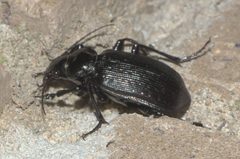
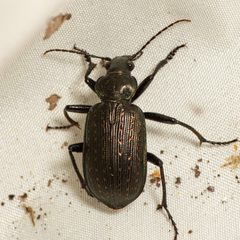
Calosoma sayi is a large ground beetle in the Carabinae, commonly known as the Black Caterpillar Hunter or Say's Caterpillar Hunter. It is one of the largest carabid beetles in North America, measuring 25–28 mm in length. Unlike many , it lacks metallic coloration, instead appearing uniformly lustrous black. Both and larvae are active that specialize in hunting caterpillars and other soft-bodied insect larvae.
Pronunciation
How to pronounce Calosoma sayi: //kæloʊˈsoʊ.mə ˈseɪ.aɪ//
These audio files are automatically generated. While they are not always 100% accurate, they are a good starting point.
Identification
Distinguished from other Calosoma by its uniformly black, non-metallic coloration (most show metallic green, blue, or purple). The ruby-red elytral pits are notably smaller than those of related species such as C. scrutator. Large size (25–28 mm) and prominent sculptured are additional identifying features. May be confused with other large black carabids, but the combination of size, elytral pitting, and mandibular structure is distinctive.
Images
Habitat
Found in open, disturbed including fields, grasslands, and forest edges. have been observed in urban settings, including under street lamps at night. Both larvae and adults occur in ground-level habitats, with adults also foraging in vegetation.
Distribution
Widespread throughout the United States. Records from Mexico, Cuba, and Hispaniola. Absent from the Pacific Northwest and most of New England based on available observation data.
Seasonality
active from late spring through fall, with peak activity in summer months. Observed in late August in Missouri. foraging activity common.
Diet
Both larvae and are predatory, feeding primarily on soft-bodied insect larvae and pupae. Documented prey includes caterpillars (Lepidoptera larvae), (Scarabaeidae larvae), and fly larvae (Diptera).
Life Cycle
Complete with , larva, pupa, and stages. Eggs deposited in soil. Larvae are ground-dwelling . Larval development and details not well documented. Adults may live two or more years.
Behavior
Fast, active runner using long legs to cover large areas while foraging. Primarily , hiding under stones, leaves, or wood during daylight hours. frequently attracted to lights at night. Both larvae and adults are voracious that actively search for prey rather than ambushing.
Ecological Role
Important agent of caterpillars and other herbivorous insect larvae. Contributes to regulation of of agricultural and forest pests, including fall armyworm and other lepidopteran larvae. Serves as prey for larger vertebrate .
Human Relevance
Beneficial insect for agriculture and horticulture due to on pest caterpillars. Occasionally encountered in urban and suburban environments. No known negative impacts. Subject of ecological research using clay model techniques to study predation pressure in turfgrass systems.
Similar Taxa
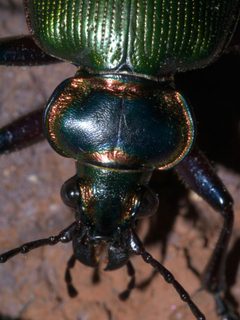
- Calosoma scrutator (Fiery Searcher)Larger (up to 35 mm), with brilliant metallic green, blue, or purple coloration and larger elytral pits. More strictly arboreal, frequently climbing trees to hunt caterpillars.
- Calosoma wilcoxiSmaller (about one-third the size of C. scrutator), with metallic coloration. More strongly associated with forest and cankerworm .
- Other large black CarabidaeLack the characteristic sculptured and ruby-red elytral pitting of Calosoma sayi; most are smaller or have different body proportions.
More Details
Etymology
epithet 'sayi' honors Thomas Say, early American entomologist.
Research applications
Used as a model in clay model studies of in turfgrass , where it leaves distinctive paired mandibular marks on decoy caterpillars.
Phylogenetic relationships
Calosoma is closely related to tiger beetles (Cicindelinae), with molecular data suggesting tiger beetles are nested within Carabinae.
Sources and further reading
- BugGuide
- Wikipedia
- GBIF taxonomy match
- iNaturalist taxon
- NCBI Taxonomy
- Fulgoridae | Beetles In The Bush
- Clues in the Clay: Decoy Insect Larvae Reveal Predator Presence in Turfgrass
- November | 2012 | Beetles In The Bush | Page 2
- conservation | Beetles In The Bush
- Chloropidae | Beetles In The Bush
- Ground beetles up in the air: Calosoma wilcoxi and Calosoma scrutator — Bug of the Week