
Calosoma affine
Chaudoir, 1843
related beautiful black searcher
Calosoma affine is a of ground beetle in the Carabinae, described by Maximilien Chaudoir in 1843. It is one of the so-called "caterpillar hunters," large predatory beetles known for ascending trees to feed on caterpillars. The species occurs in Mexico and the southern United States, where are active both day and night and exhibit gregarious .
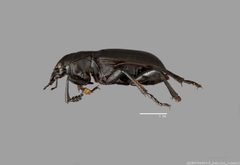
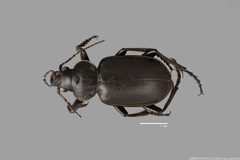
Pronunciation
How to pronounce Calosoma affine: /ˈkal.oˌso.ma aˈfi.ne/
These audio files are automatically generated. While they are not always 100% accurate, they are a good starting point.
Images
Habitat
Inhabits pastures, cultivated fields, and sand dunes. Based on related in the Calosoma, likely associated with open or semi-open where caterpillars are abundant.
Distribution
Mexico and the southern United States.
Diet
Preys on lepidopterous caterpillars.
Behavior
are and and gregarious. Like other Calosoma , has been observed ascending vegetation to hunt caterpillars.
Ecological Role
of caterpillars, potentially providing of lepidopteran in agricultural and natural settings.
Human Relevance
May contribute to natural pest control in pastures and cultivated fields. No known negative impacts to humans.
Similar Taxa
- Calosoma sayiBoth are black, non-metallic Calosoma in the same geographic region, but C. sayi is generally larger with more pronounced mandibular sculpturing.
- Calosoma scrutatorSimilar arboreal caterpillar-hunting , but C. scrutator exhibits distinctive green and purple metallic coloration rather than black coloration.
- Calosoma wilcoxiSimilar size and black coloration, but C. wilcoxi is smaller (about one-third the size of C. scrutator) and may show subtle differences in structure.
More Details
Taxonomic note
Calosoma affine belongs to the nominate Carabinae, a group that includes some of the largest ground beetles. This subfamily is closely related to tiger beetles (Cicindelinae), with molecular data suggesting tiger beetles are nested within Carabinae.
Etymology
The specific epithet "affine" is Latin for "related" or "bordering," likely referring to its close relationship to other in the .
Sources and further reading
- BugGuide
- Wikipedia
- GBIF taxonomy match
- iNaturalist taxon
- November | 2012 | Beetles In The Bush | Page 2
- conservation | Beetles In The Bush
- Ground beetles up in the air: Calosoma wilcoxi and Calosoma scrutator — Bug of the Week
- Feasting on the bounty | Beetles In The Bush
- May | 2011 | Beetles In The Bush | Page 2
- Best of BitB 2012 | Beetles In The Bush